


How do I write a short cover letter?
A short cover letter follows the same core structure as a full one, just stripped to its most effective elements.
Include a greeting, one or two focused paragraphs that connect your value to the role, and a brief call to action.
Aim for 150 to 250 words.
Every sentence should earn its place, so writing one well comes down to discipline.
The goal is not to write less but to say more with fewer words, so here is how to do it in four steps.
Step 1: Open with a direct connection
Name the role and, in one sentence, state the single strongest reason you are a fit.
If someone referred you, this is where you mention them.
Avoid opening with "I am writing to apply for" as it adds words without adding anything useful, and a recruiter reading their twentieth letter of the morning will notice the difference.
- Example: "My colleague Dana Reed suggested I reach out, I have spent five years managing customer service teams in fast-growth retail and I believe I can bring that experience directly to your Head of CX role."
Step 2: Make your case in one focused paragraph
Choose one or two achievements or skills that directly match what the employer needs, and lead with the most relevant one.
A specific metric or outcome will always carry more weight than a general claim about your abilities.
Your resume covers the full picture; this paragraph gives the reviewer a clear reason to read it.
- Example: "In my current role at Harwick Retail, I reduced average customer resolution time from 11 minutes to 6 by restructuring our triage process, which lifted satisfaction scores by 22% over six months."
Step 3: Show you understand the company
One sentence referencing something specific about the team, the product, or the direction of the business is enough to signal genuine interest.
Generic enthusiasm, "I have always admired your company", does not land the same way as a reference to something real.
This is the part of a short cover letter that most people skip, which is exactly why including it tends to stand out.
- Example: "I have followed your expansion into same-day fulfilment closely and I am particularly interested in the operational challenges that come with scaling a service model at that speed."
Step 4: Close with a clear call to action
Express your interest in an interview, thank the reader for their time, and sign off.
Keep the closing of your cover letter confident and direct rather than tentative.
"I would welcome the opportunity to discuss this further" is more effective than "I hope to hear from you if you feel I may be suitable."
- Example: "I would welcome the chance to discuss how my background fits what you are building. Thank you for your time and I hope to hear from you soon."
Pros and cons of a short cover letter
Before committing to the format, it is worth understanding where it works in your favor and where it does not.
| Pros | Cons |
|---|---|
| Easier for a busy recruiter to read in full | Less room to include keywords for ATS screening |
| Forces you to focus on your strongest point | Can feel thin if not written with care |
| Suits email and direct message applications naturally | May not meet expectations in formal or traditional industries |
| Signals confidence and strong communication skills | Not appropriate when a full page is explicitly requested |
| Takes less time to tailor for each application | Leaves less space to explain career gaps or changes |
What is a short cover letter?
A short cover letter is a brief version of a traditional cover letter, typically between 150 and 250 words, or roughly half a page.
It covers the same essential ground, who you are, why you are a good fit, and what you want next, without extended context or storytelling.
It usually contains three elements: a direct opening, one paragraph of evidence, and a brief closing that requests an interview.
The format suits digital delivery particularly well, since a short cover letter sent as the body of an email is far more likely to be read in full than a long attachment.
If you are weighing up whether a cover letter is necessary for your situation at all, do I still need a cover letter addresses that question directly.

Is a short cover letter ok?
Yes, and in many situations it is the better choice.
Recruiters often spend less than a minute on each application, and a letter that makes its case in 200 words will hold attention more reliably than one that takes three times as long to reach the point.
The anxiety around short cover letters is understandable, it can feel as though writing less signals less effort, but a focused letter shows that you have identified what matters and chosen to lead with that.
The one situation where a short cover letter works against you is when applying through ATS software or when the job description explicitly requests a full page, in both cases length is an asset, not a drawback.
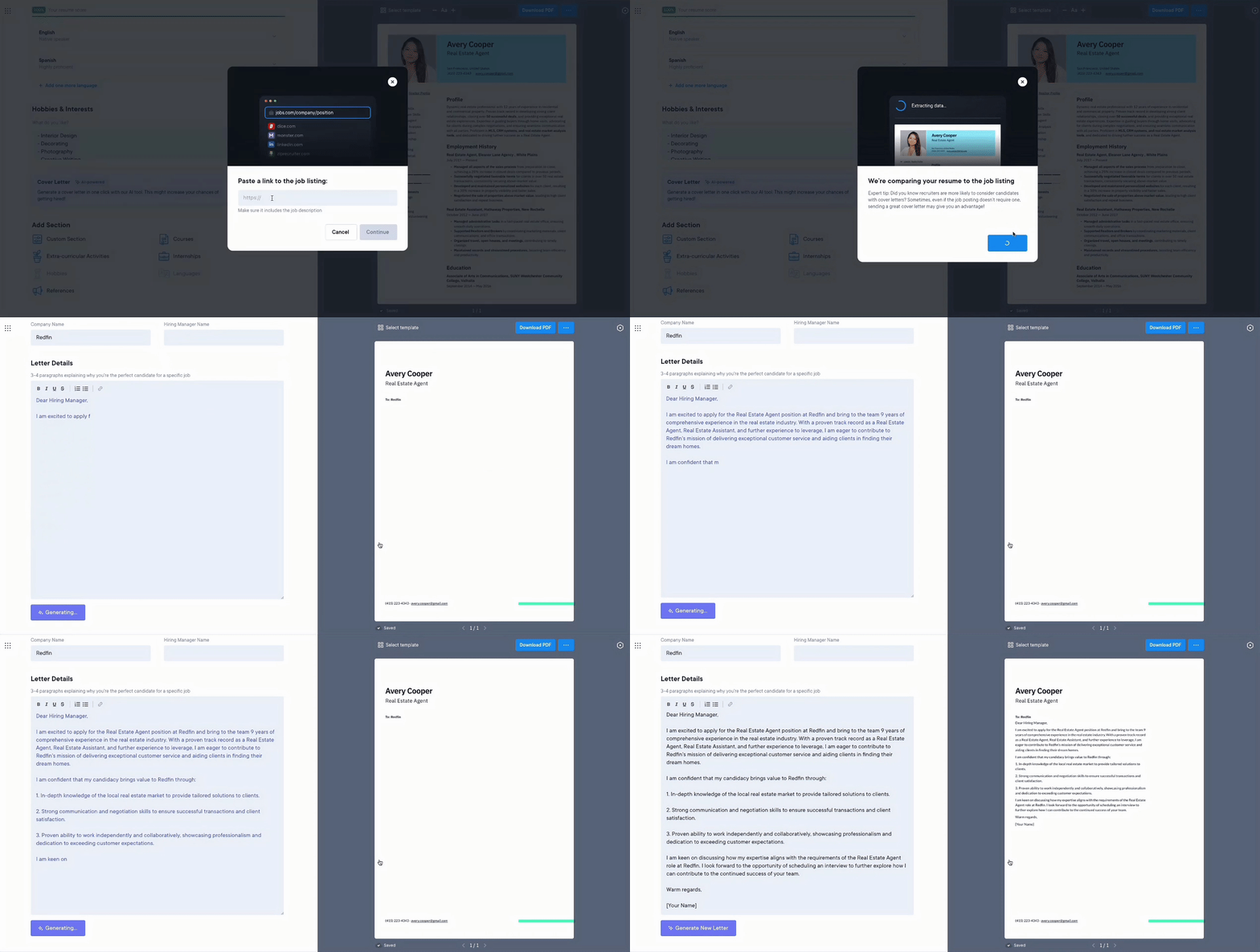
What does a good short cover letter look like?
A good short cover letter is specific, human, and direct.
It does not try to cover everything; it picks the single strongest angle and develops it well.
The best ones feel like they were written for this role, at this company, by someone who has done their research.
You can see a wide range of approaches across our cover letter examples if you want to compare styles before writing your own.
Here is a general-purpose sample that demonstrates the approach across most situations:
Dear [Hiring Manager Name],
I am writing to express my interest in the [Job Title] position at [Company Name], which I found on [platform]. With [number] years of experience in [relevant field], I have developed strong skills in [skill 1] and [skill 2].
In my most recent role at [Previous Company], I [specific achievement with a metric, e.g., reduced customer response times by 30% through a new triage process]. I am confident that the same approach would translate well to your team.
I admire [Company Name]'s work on [specific project, product, or value], and I would welcome the opportunity to contribute. I am available for an interview at your convenience and have attached my resume for your review.
Sincerely, [Your Name]
What makes this work is not the template itself but what goes into it.
The achievement in the second paragraph is specific, not vague.
The company reference in the third paragraph is real, not generic.
And the whole letter stays under 150 words without feeling thin, because every sentence is doing a job.
If you find that personalizing a template like this feels difficult, our templates include editable formats for a range of roles and experience levels.
Short cover letter samples for different situations
The right tone and focus shifts depending on why you are writing.
Below are 11 samples covering the most common scenarios.
Each one leaves out the header for clarity, but every real letter should include your contact details, the date, and a professional sign-off.
One note before you use these: a short cover letter works because it feels personal.
Copying without tailoring will undermine the very thing that makes this format effective.
1. Basic short cover letter
Dear Mr. Gantley,
I am writing to see whether you need a talented mathematician on your marketing team. My former colleague Hannah Wilson mentioned that you may be hiring soon.
I have used my data science degree to outstanding effect in my marketing career thus far, diving deep into customer behaviors and seeing profit uplifts of 125% on certain projects.
I know that I will add value as you seek to increase your 12% market share. My expertise in lead targeting and customer segmentation will help you to plot the right path. I would love the opportunity of an interview to discuss my bespoke marketing analytics platform.
Sincerely, Lois Hankett

2. Speculative application
Dear Ms. Richards,
Having just moved to Seattle, I am looking to continue my five-year career in customer service. I was in the top 5% of call handlers in terms of call volume and customer satisfaction at my previous employer and I thrive on resolving customer complaints.
My hospitality degree adds to my understanding of the industry and gives me a sound appreciation of the nuances in any situation. I moved into a team leader role towards the end of my last position, and this is a career path I would hope to continue with my next employer.
I know that you are not advertising for roles currently, but I feel I would be a strong member of the team should you wish to explore the possibility at any point.
Sincerely, Martha Yates
3. When you know the hiring manager
Dear Marissa,
It was a pleasure to catch up at the conference the other day. I was fascinated to hear about the role and feel that it would be a good fit for what I am looking for. I know that my market research skills will prove beneficial.
I would welcome the opportunity to send over my resume to the hiring manager and would love to hear more information when it is available. I understand that you will be running a full recruitment process and do not expect any special treatment. From what you told me about the company culture, I think I would enjoy working there.
Sincerely, Kathleen Carlsby
4. Short story format
Dear Mr. Green,
Having cycled across the United States on your bike for charity in 2015 without a single serious mechanical issue, it has been a long-held ambition to work within your procurement department. Only the best parts go into making a RollEasy bike, and my ten years of automotive and cycling sourcing experience will help me make my difference.
I helped a stationary bike manufacturer save 19% and consolidate from 24 suppliers to 18 within a two-year period. I know that cost savings are on your agenda and understand how to achieve them without compromising on quality. I would love to explain how during a potential interview.
Sincerely, Simon Geedeth
5. No experience short cover letter
Dear Ms. Hinch,
Having graduated from college and spent a year in a call center, I am now ready to take on a customer-facing role in retail. I am accustomed to dealing with customers, resolving complaints, and ensuring satisfaction, skills that would enable success at Parath.
I worked in hospitality during my studies and am used to operating in a fast-paced environment with a wide team depending on each other. I would welcome the opportunity of an interview to explore any openings.
Sincerely, Lara Baker

6. Internship cover letter
Dear Mr. Bennett,
I am applying for the summer intern role with your PR firm because I want to translate the promotional skills I have developed building my social media following (64k across three channels) into a broader creative direction.
Much of my writing and content editing experience should prove directly useful. I have enclosed a selection of my most popular posts alongside some of your recent campaigns, and I believe the styles share common ground. I would be fascinated to understand the data behind your creative decisions.
I am driven by results and want to begin a creative career with measurement at its core. The chance to talk further would mean a great deal.
Sincerely, Tamsin Poulsen

7. New graduate
Dear Dr. Bradley,
As a recent biotech graduate, I am looking for my first role as a laboratory assistant. I saw that your new lab was hiring at all levels and wanted to find out whether you were welcoming applications from recent graduates.
I have spent over nine months in laboratory settings across my studies and am proficient in all relevant technology. My safety record is impeccable and I thrive in controlled, high-pressure environments.
Sincerely, Mika Ivanovic

8. Portfolio-led
Dear Ms. Kramer,
I saw your message on LinkedIn that you are about to begin searching for a new publishing assistant, and I wanted to share details of my social media work to illustrate my knowledge base and industry network. I understand that building connections within publishing is central to the role.
I hope the links below give you a sense of my potential. I would be delighted to send over my resume if you like what you see.
Sincerely, Barnaby Farrow
9. Bullet point accomplishments
Dear Mrs. Wilson,
I felt it may be useful to share a brief summary of my achievements before sending over my full resume for the project manager role.
- Managed project teams of 5 to 45 across consumer industries
- Delivered work across logistics, merchandising, marketing, and buying
- Achieved average sales uplifts of between 8 and 25% across 30+ product areas
- Trained internal teams on current project management techniques
I am available for an interview at short notice and have strong references ready to share at the appropriate stage.
Sincerely, Damian Harris
10. Start-up application
Dear Bill,
As a long-term follower of Hussle, I have been watching your next move with genuine interest. Having served as financial director for two established FinTech startups, I am drawn to the energy of joining a small founding team from the beginning.
A mutual contact mentioned you are looking for someone with deep finance experience to join your first team, and I would be honored to be considered. I will be at the conference next week and wondered whether you would be open to a coffee. My LinkedIn profile includes detail on my track record if that is helpful in the meantime.
Sincerely, Randall Haysmith
11. Internal promotion
Dear Ms. Simons,
As a member of the Sales and Marketing department for the past three years, I am writing to express my interest in the newly created Sales Manager position. With a 73% conversion rate on cold calls, I am consistently among the team's strongest performers, and I am ready to take that experience into a leadership role.
I have stepped into a supervisory position on several occasions when needed. During the Mitchell Smith campaign, I led the sales team's approach and helped us exceed our targets. I am confident I can bring that same focus to the department on a permanent basis.
I hope you will consider my application and look forward to the opportunity to discuss it at a formal interview.
Kind regards, Taylor Banks
When should I use a short cover letter?
A short cover letter works best when the context calls for brevity over depth.
Knowing when to reach for this format is one of the more useful practical judgments in a job search, and it tends to come down to how and where you are making contact.
These are the situations where a short cover letter is most likely to serve you well:
- Speculative or cold applications: When you are reaching out to a company that has not posted a role, you are asking for attention rather than responding to a request. A short letter that is easy to read and easy to act on will outperform a longer one that requires effort to get through.
- Email applications: When your cover letter is the body of an email cover letter rather than a formal attachment, conciseness is expected. Long emails rarely get read in full. A short, clear message that earns a reply is the goal.
- When you know the recruiter or hiring manager: A long formal letter to someone you have met or connected with on LinkedIn can feel out of place. A brief, warm message that references your conversation and confirms your interest is more natural and often more effective.
- Internship and entry-level applications: Early-career applicants do not need to fill space they do not yet have. A focused letter that leads with motivation and one concrete example is more compelling than a padded longer one.
- When your resume is doing the heavy lifting: Experienced candidates with strong, detailed resumes can use the letter to add something personal that the document cannot convey, rather than repeating what is already there.

When should I avoid a short cover letter?
A short cover letter is not always the right choice, and submitting one in the wrong context can work against you.
These are the situations where a fuller letter is the better approach:
- ATS applications: When applying through an online portal that stores your letter in an applicant tracking system, word count matters. ATS platforms assess cover letters in part on keyword presence, and 150 words does not give you enough room to reflect the language of the job description. Treat length as an asset in this context.
- When the job description specifies a format: If an employer asks for a one-page cover letter, follow the instruction. Deviating from it sends the wrong signal before your application has been read.
- Senior roles and leadership positions: At a more senior level, a short letter can read as under-prepared. Hiring decisions at this level often involve more stakeholders, and a fuller letter gives you more room to make a considered case.
- Roles where writing is central to the job: If the position involves communication, content, or editorial work, the cover letter is itself a writing sample. A very short letter in that context may feel like an incomplete demonstration of what you can do.
- Highly formal or traditional industries: Law, finance, and certain academic contexts carry a stronger expectation of detailed, formal applications. A short cover letter in these settings may not meet the unspoken standard.
- When you have something important to explain: Career changes, employment gaps, or relocations often benefit from a direct, honest explanation. It does not give you the space to address these clearly, and leaving them unexplained can raise questions a fuller letter would have answered.
A reliable approach when you are uncertain: write a focused cover letter at full length first, then edit it down to what genuinely earns its place.
That process tends to produce something better than aiming for short from the outset.
How do I make my cover letter shorter?
The most effective way to shorten a cover letter is to interrogate each sentence individually.
If a sentence restates something your resume already shows clearly, remove it.
If it is providing context before the actual point, cut it and start with the point itself.
A few targeted techniques help:
- Swap phrases for single words: "Due to the fact that" becomes "because." "In the process of" becomes "during." "A number of" becomes "several." These substitutions reduce length without losing meaning.
- Cut the standard opener: Sentences beginning "I am writing to apply for..." add words but contribute nothing distinctive. Open instead with the most specific or interesting thing you have to say.
- Replace self-assessment with evidence: Phrases like "I am a highly motivated and results-driven professional" tell the reader nothing concrete. A single specific achievement says the same thing far more effectively.
- Combine related points: If two observations are closely connected, see whether they can become one sharper sentence rather than two separate ones.
- Read it aloud: Sentences that are hard to say quickly are often sentences that can be tightened. Anything that leaves you short of breath is probably too long.
It is worth being honest about what this process actually requires.
Editing a cover letter down to something that reads naturally and confidently usually takes more drafts than writing a longer one, not fewer.
A short cover letter that flows easily is one of the more convincing signals you can send about how you communicate.
Key takeaways
- A short cover letter is typically 150 to 250 words: a greeting, one or two focused paragraphs, and a call to action. That is enough space to make a compelling case when every sentence is earning its place.
- The format suits speculative applications, email submissions, internship applications, and situations where you already have a connection with the person you are writing to.
- Avoid a short cover letter when applying through ATS software, when the job description specifies a full-page letter, or when you need space to explain a career change or employment gap.
- A short cover letter does not need to mention your previous job titles. Your resume covers employment history. Use the letter to add something your resume cannot show: motivation, personality, or a specific connection to the role.
- Editing down to something short and convincing takes real revision. That discipline is also what tends to make the final letter stand out.
Frequently asked questions
The questions below address the most common points of uncertainty when deciding whether a short cover letter is right for your application.
Is a short cover letter unprofessional?
No. Professionalism comes from clarity, accuracy, and appropriate tone, not length.
A well-written 200-word letter that is specific, relevant, and respectfully worded is more professional than a longer letter filled with padding.
The format is widely accepted and, in many contexts, actively preferred by recruiters.
How long should a short cover letter be?
A short cover letter should be between 150 and 250 words, or roughly half a page.
That is sufficient for a greeting, two short paragraphs, and a closing call to action.
Going below 150 words risks feeling incomplete; going above 300 begins to lose the core advantage of keeping it focused.
Do I need to mention my previous jobs in a short cover letter?
No. Your resume covers your employment history in full, so there is no obligation to repeat it in the cover letter.
In a short format, the space is often better used to focus on your motivation for this specific role, a personal connection to the company, or one concrete example that your resume does not already explain.
Leaving out the job titles is a legitimate choice, not an oversight.


