


What should a cover letter header include?
A cover letter header should include your full name, phone number, email address, and location at minimum, followed by the date and the hiring manager's contact details.
These elements give the reader everything they need to identify you and follow up.
Some fields are required; others are optional depending on your role and industry.
Every cover letter header needs these elements:
- Full name
- Phone number
- Professional email address (for example, firstname.lastname@gmail.com)
- City and state (a full street address is no longer expected or necessary)
- The date, written out in full (for example, May 21, 2026)
- Hiring manager's name and title, if known
- Company name
- Company address
The following are worth adding when they strengthen your application:
- LinkedIn profile URL, if your profile is complete and current
- Portfolio or personal website, particularly useful for creative, tech, or writing roles
- Current job title, placed directly beneath your name in a smaller font
Do not include optional fields if they are out of date or incomplete.
For email cover letters, the date and employer block move to a different position, see the email section below for how that works.
What does a cover letter header look like?
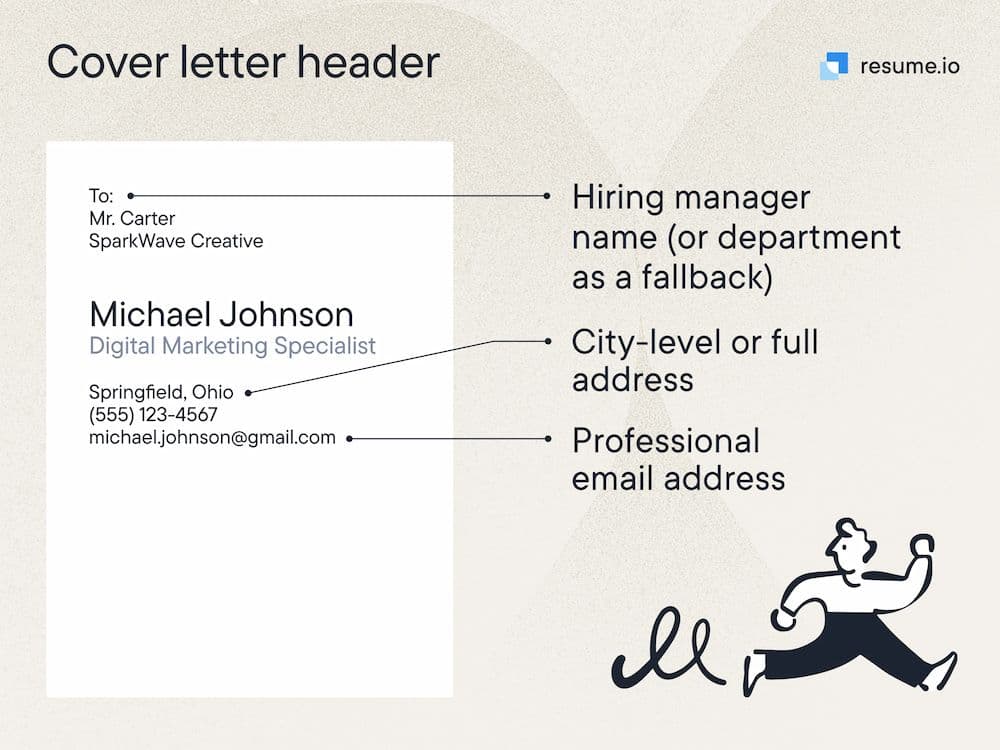
A complete cover letter header follows the standard business letter format: your contact details at the top, the date on its own line, then the employer's information below.
Here is an example of a correctly formatted header:
Jordan Ellis Marketing Coordinator (312) 555-0174 | jordan.ellis@gmail.com | Chicago, IL | linkedin.com/in/jordanellis
May 21, 2026
Sarah Chen Head of Marketing Brightfield Agency 400 N Michigan Avenue, Chicago, IL 60611
Dear Ms. Chen,
Your name carries the most visual weight at the top.
The date sits between your details and the employer block, with a line break on either side.
The employer's information is written out line by line where known.
If you cannot find the hiring manager's name, use their title (for example, "Head of Marketing"), or open with "Dear Hiring Manager."
When addressing a cover letter is unclear because the recipient is unknown, their job title is usually the most professional fallback.
How do you format a cover letter header?
Formatting your cover letter header correctly takes five steps.
The goal is a clean, professional block that matches the rest of your letter and sits consistently alongside your resume.
- Step 1: Start with your name in a larger font. Use 14-18pt for your name and 10-12pt for everything else. Bold your name so it reads as the headline of the document.
- Step 2: List your contact details on one line or stacked. Separate inline items with a pipe symbol (|) or use line breaks. Choose whichever matches your resume layout.
- Step 3: Place the date on its own line. Skip a line after your contact details, write the full date, then skip another line before the employer block. Always write dates with the month in full rather than a numeric format.
- Step 4: Write the employer's information in full. Include the hiring manager's name, their title, the company name, and the company address if you have it. Each item sits on its own line.
- Step 5: Match your resume exactly. Use the same font, font size, and margins as your resume. If your resume uses a colored header bar or a specific alignment, mirror it in your cover letter to create a unified application package.
Left-align everything unless your resume uses a centered layout, in which case center your personal details to match.
Save your cover letter as a PDF before submitting so the formatting stays intact on any device.
The font you choose here should match the body of your letter throughout.

Should a cover letter have a header?
Yes. Every cover letter submitted as a document or PDF should have a header.
It ensures the hiring manager can identify who you are and how to contact you, even if your cover letter is reviewed separately from your resume.
It also signals professionalism and attention to detail before the reader reaches your opening paragraph.
A header is one part of a well-structured document.
The full cover letter format follows a clear order once the header is in place, moving from your opening paragraph through to your closing and sign-off.
The only time you skip the traditional header block is when your cover letter is written directly into the body of an email.

What should a cover letter header look like for an email application?
When your cover letter is the body of an email rather than an attached document, the traditional header block does not belong at the top.
Place a clear subject line in the email instead, which includes the job title and your name, for example: "Application: Marketing Coordinator - Jordan Ellis."
Move your contact details to below your sign-off at the end of the email.
This keeps the opening of your message clean and ensures the hiring manager reads your qualifications before a block of contact information.
For a cover letter sent as a PDF attachment alongside a brief email, use the full header format described above.
The email cover letter itself should be short: introduce yourself, name the role, and direct the reader to the attached documents.
Cover letter header examples for different situations
Most cover letter headers follow the same core structure, but the details change depending on what information you have available.
These examples cover the three situations you are most likely to encounter.
1. Standard header when the hiring manager's name is known
This is the most complete version of a header.
Use it whenever you can find the hiring manager's name and the company address.
Marcus Webb (646) 555-0231 | marcus.webb@gmail.com | New York, NY | linkedin.com/in/marcuswebb
May 21, 2026
Diana Flores Senior Recruiter Calloway Partners 1120 Avenue of the Americas, New York, NY 10036
Dear Ms. Flores,
2. Header when the hiring manager's name is unknown
If you cannot find the hiring manager's name after checking the job posting, the company website, and LinkedIn, use their title or department instead.
Do not leave the recipient block blank.
Priya Nair (415) 555-0187 | priya.nair@gmail.com | San Francisco, CA
May 21, 2026
Hiring Manager Product Team Ironside Technology 535 Mission Street, San Francisco, CA 94105
Dear Hiring Manager,
3. Header for a creative or portfolio-based role
For roles in design, writing, development, or any field where your work speaks for itself, add your portfolio URL alongside your other contact details.
Keep everything else consistent with the standard format.
Leo Hartmann Senior UX Designer (312) 555-0149 | leo.hartmann@gmail.com | Chicago, IL | leodesigns.com
May 21, 2026
Rachel Kim Head of Design Novaform Studio 222 W Merchandise Mart Plaza, Chicago, IL 60654
Dear Ms. Kim,
Each of these examples follows the same underlying structure.
The differences are in what information is available and what is relevant to the role, not in the format itself.
Key takeaways
- A cover letter header must include your name, phone number, email address, location, the date, and the employer's details.
- Your name should be the most prominent element, formatted at a larger size or in bold so it reads as the headline of the document.
- The header must match your resume in font, size, and layout to create a consistent, professional application package.
- A full street address is no longer required; city and state is sufficient.
- For email cover letters, move your contact details below your sign-off rather than placing them at the top.
Frequently asked questions
Here are direct answers to the questions job seekers ask most often about cover letter headers.
Do cover letters require a header?
Yes, a cover letter requires a header when submitted as a document or PDF.
The header identifies you and provides your contact information, which is essential if your cover letter is reviewed separately from your resume.
Skip the traditional header block only when your cover letter is written directly into the body of an email.
What if I do not know the hiring manager's name?
If you do not know the hiring manager's name, include their title if you can find it, for example "Head of Marketing" or "Hiring Manager."
If you cannot find either, write "Hiring Manager" in the recipient block and open with "Dear Hiring Manager."
Avoid "To Whom It May Concern", it reads as generic and is considered outdated by most hiring managers.
Should my cover letter header match my resume?
Yes. Your cover letter header should use the same font, font size, and layout as your resume header.
Matching both documents creates a cohesive application that signals care and consistency.
If your resume uses a design element such as a color block or a specific alignment, carry that through to your cover letter.


