245-110515-02 OSU-22-30 VIRUS-LIKE PARTICLES DISPLAYING NEISSERIA GONORRHOEAE ANTIGENS AND USE THEREOF FOR IMMUNIZATION AGAINST GONORRHEA CROSS REFERENCE TO RELATED APPLICATIONS This application claims the benefit of U.S. Provisional Application No.63/595,427, filed November 2, 2023, which is herein incorporated by reference in its entirety. FIELD This disclosure concerns immunogenic compositions that include Neisseria gonorrhoeae antigens displayed on virus-like particles, and use of the immunogenic compositions for protection against gonorrhea. ACKNOWLEDGMENT OF GOVERNMENT SUPPORT This invention was made with government support under AI117235 awarded by the National Institutes of Health. The government has certain rights in the invention. INCORPORATION OF ELECTRONIC SEQUENCE LISTING The electronic sequence listing, submitted herewith as an XML file named 245-110515-02.xml (91,368 bytes), created on October 28, 2024, is herein incorporated by reference in its entirety. BACKGROUND The World Health Organization Global Health Sector Strategy on sexually transmitted infections (STI) notes vaccines as key innovations needed for sustainable STI control (WHO, Global health sector strategy on sexually transmitted infections, 2016–2021). Among STI, gonorrhea is the second most reported notifiable disease in the United States after chlamydia and the number of cases has risen steadily since the historic low in 2009, increasing by 92% (a total of 616,392 reported cases) in 2019 (CDC, 2018 Sexually Transmitted Diseases Surveillance, 2019). Globally, approximately 87 million gonorrhea infections occurred in 2016 but these statistics are underestimated due to frequent asymptomatic infections (Rowley et al., Bull World Health Organ 97(8):548-562P, 2019; Rice et al., Ann Rev Microbiol 71:665-686, 2017). Neisseria gonorrhoeae (Ng), the gram-negative bacterium and etiological agent of gonorrhea, is categorized as a high-priority pathogen for research and development efforts (World Health Organization, Global priority list of antibiotic-resistant bacteria to guide research, discovery, and development of new antibiotics, 2017; Gottlieb et al., Vaccine 38(28):4362-73, 2020; CDC, Antibiotic resistance threats in the United States, 2019). The U.S. Centers for Disease Control and Prevention recommends ceftriaxone for treatment of uncomplicated gonorrhea, but failures with this therapy have occurred and multidrug-resistant Ng strains are rising globally (WHO, Global action plan to control the spread and impact of antimicrobial resistance in Neisseria gonorrhoeae, May 4, 2012; WHO, Surveillance of antibiotic resistance in Neisseria gonorrhoeae in the Western Pacific and South East Asian Regions, Communicable diseases intelligence
245-110515-02 OSU-22-30 quarterly report 35(1):2-7, 2011; WHO, Antimicrobial resistance draft global action plan on antimicrobial resistance, 2015; CDC, Gonorrhea Treatment Guidelines, 2013; CDC, Sexually Transmitted Disease Surveillance 2014, 2015; Alirol et al., PLoS Med 14(7):e1002366, 2017; Newman et al., PloS One 10(12):e0143304, 2015; Fifer et al., N Engl J Med 374(25):2504-2506, 2016; CDC, MMWR Morb Mortal Wkly Rep 69:1911–1916, 2020). In addition to high prevalence and antibiotic resistance, the need for developing an effective gonorrhea vaccine is exacerbated by the brunt of gonorrhea, including infertility and its ability to augment transmission and acquisition of HIV (Fleming and Wasserheit, Sex Transm Infect 75(1):3-17, 1999). In women, gonorrhea may lead to pelvic inflammatory disease, miscarriage, preterm birth, and ectopic pregnancies. In males, this STI presents as uncomplicated urethritis but can ascend to the epididymis or testes (Trojian et al., Am Fam Physician 79(7):583-587, 2009). Gonorrhea primarily affects the genitourinary tract, but other mucosal surfaces can be involved and disseminated disease may also occur (Rice, Infect Dis Clin North Am 19(4):853-861, 2005; Barr and Danielsson, Br Med J 1(5747):482-485, 1971; Knapp and Holmes, J Infect Dis 132(2):204-208, 1975; Lochner and Maraqa, Pediatr Drugs 20(6):501-509, 2018; Humbert and Christodoulides, Pathogens 9(1):10, 2019). Neonatal conjunctivitis can be acquired from the infected birth canal, which if left untreated, can result in corneal scarring and blindness (Humbert and Christodoulides, Pathogens 9(1):10, 2019; Mallika et al., Malays Fam Physician 3(2):77-81, 2008; Yeu and Hauswirth, Clin Ophthalmol 14:805-813, 2020). Thus, a need exists for an effective vaccine for the prevention of gonorrhea. SUMMARY Described herein are immunogenic compositions that display conserved N. gonorrhoeae antigens on the surface of virus-like particles (VLPs), such as VLPs formed by the capsid protein of an RNA bacteriophage. Also described is use of the immunogenic compositions for protection against gonorrhea. Provided herein are immunogenic compositions that include a capsid protein of an RNA bacteriophage fused to a first peptide tag, and a N. gonorrhoeae antigen fused to a second peptide tag. The first peptide tag and the second peptide tag are joined by an isopeptide bond, and the capsid protein and antigen form a virus-like particle (VLP) displaying the antigen. In some aspects, the antigen is selected from the group consisting of surface-exposed lysozyme inhibitor of c-type lysozyme (SliC), methionine binding protein (MetQ), Neisserial adhesin complex protein (ACP), β-barrel assembly machinery protein E (BamE), β-barrel assembly machinery protein G (BamG) and anaerobically induced outer membrane protein A (AniA). In some aspects, the RNA bacteriophage is AP205. In some aspects, the first peptide tag is a SpyTag peptide and the second peptide tag is a SpyCatcher peptide; or the first peptide tag is a SpyCatcher peptide and the second peptide tag is a SpyTag peptide. In some examples, the immunogenic composition further includes a pharmaceutically acceptable carrier and/or an adjuvant (such as CpG oligodeoxynucleotides and/or a squalene-based oil-in-water emulsion). Also provided herein are nucleic acid molecules that encode the immunogenic compositions disclosed herein. In some aspects, the nucleic acid molecule encodes the first peptide tag fused to the capsid
245-110515-02 OSU-22-30 protein of the RNA bacteriophage, the second peptide tag fused to the antigen, or both. Further provided are vectors that include the disclosed nucleic acid molecules and isolated host cells that contain the nucleic acid molecules and vectors. Methods of eliciting an immune response against N. gonorrhoeae in a subject, and methods of immunizing a subject against N. gonorrhoeae, by administering to the subject an effective amount of an immunogenic composition disclosed herein are also provided. In some aspects, the immunogenic composition is administered subcutaneously, intramuscularly, intranasally, or any combination thereof. The foregoing and other features of this disclosure will become more apparent from the following detailed description of several aspects which proceeds with reference to the accompanying figures. BRIEF DESCRIPTION OF THE DRAWINGS FIGS 1A-1C: Design of the SpyTag plasmid system for the Tag/Catcher-AP205 capsid virus-like particle (cVLP) platform for gonorrhea vaccine development. (FIG.1A) An outline of in silico designed genetic engineering process to develop the SpyTag plasmid system using pET-22b(+), sliC from Ng FA1090, gene blocks carrying SpyTag on the N- or C-terminus (STN and STC, respectively), a linker, a multicloning site, a tobacco etch virus (TEV) protease cleavage site and a 10×His Tag. (FIG.1B) Gibson assembly was used to clone STN and STC gene blocks to pET-22b(+) yielding pET22-STN and pET22-STC that enable fusion of antigens with the SpyTag on either the N- or C-terminus, respectively. E. coli PelB signal sequence is also added to promote proper antigen folding in a heterologous host. The sliC gene was cloned into pET22-STN and pET22-STC to create pET22-N-SliC and pET22-C-SliC. (FIG.1C) The core AP205 cVLP displaying a complementary Catcher (SpyCatcher VLP) is expressed in E. coli and purified. The AP205 cVLP Catcher is mixed in solution with purified N-SliC or C-SliC. The Tag and Catcher rapidly react to form a spontaneous isopeptide bond leading to formation of N-SliC-VLP and C-SliC-VLP complexes. FIGS.2A-2D: Assembly and quality assessment of the Tag/Catcher SliC-VLP vaccine. (FIG.2A) E. coli BL21(DE3) carrying pET22-N-SliC and pET22-C-SliC (N and C, respectively) were cultured without (-) and with (+) IPTG. The whole cell extracts were normalized by OD
600, separated by SDS-PAGE and stained with Colloidal Coomassie. Both SliC fusion proteins (N-SliC and C-SliC) were overproduced (arrow) and migrated on the SDS-PAGE according to the predicted molecular weight of ~15 kDa. (FIG.2B) Purified AP205 cVLP alone (cVLP), C-SliC, N-SliC, and reaction mixtures after incubation of the cVLP and either variant of SliC (C-SliC-VLP and N-SliC-VLP) were separated by SDS-PAGE and stained with Coomassie. The covalently coupled C-SliC-VLP and N-SliC-VLP were observed together with an excess of uncoupled cVLP and SliC. Comparison of the intensity of the conjugated SliC-VLP bands before (-) and after (+) centrifugation was used to assess the aggregation state/stability of the vaccine formulation. (FIG. 2C) Dynamic light-scattering of the uncoupled cVLP, the C-SliC-VLP, and the N-SliC-VLP. (FIG.2D) N-
245-110515-02 OSU-22-30 SliC-VLPs were adsorbed to 200-mesh carbon-coated grids, stained with 2% uranyl acetate (pH 7.0), and analyzed with an accelerating voltage of 80 kV, using a CM 100 BioTWIN electron microscope. FIGS.3A-3D: The N-SliC-VLP vaccine adjuvanted with ADDAVAX markedly induced antibody titers compared to the corresponding vaccine containing monomeric N-SliC. (FIG.3A) Systemic total IgG titers were examined in pre-immune (P) and ten days after first (1), second (2) and third (3) subcutaneous administration of cVLP, N-SliC, or N-SliC-VLP. All treatments were adjuvanted with ADDAVAX. (FIG. 3B) Total IgG, IgG1, IgG2a, IgG3 and IgA antibody titers in final sera from mice immunized with cVLP, N- SliC, or N-SliC-VLP. (FIG.3C) Vaginal total IgG titers were examined in pre-immune (P) and ten days after first (1), second (2) and third (3) subcutaneous administration of cVLP, N-SliC, or N-SliC-VLP. (FIG. 3D) Total IgG, IgG1, IgG2a, and IgA titers in final vaginal lavages obtained from mice immunized with cVLP, N-SliC, or N-SliC-VLP. Bar graphs represent geometric mean ELISA titers with error bars showing 95% confidence limits. Statistical significance was determined using Kruskal-Wallis with Dunn’s multiple comparison test. For the comparison of two groups, the non-parametric Mann-Whitney U test was carried out. For all analyses, *p<0.05. FIGS.4A-4C: SliC-specific systemic IgG and IgA and vaginal IgG were elicited by subcutaneous immunization with N-SliC-VLP vaccine adjuvanted with ADDAVAX. Female mice were subcutaneously immunized with cVLP, N-SliC, or N-SliC-VLP adjuvanted with ADDAVAX. Purified N-SliC (FIGS.4A and 4B) and whole cell extracts obtained from the isogenic Ng strain FA1090, the ∆sliC knockout, the complemented ∆sliC/P::sliC, and a panel of geographically, genetically, and temporally diverse Ng isolates were fractionated by SDS-PAGE. Immunoblotting was performed with pooled serum (FIGS.4A and 4C) and vaginal washes (FIG.4B) collected after the third immunization, followed by secondary antibodies against mouse IgG (FIGS.4A and 4C) or IgA (FIGS.4A and 4B). FIGS.5A-5F: Anti-SliC antibody titers elicited by N-SliC and N-SliC-VLP subcutaneous and intranasal immunization. Post-immunization (d31 and d52) total IgG (FIG.5A), IgG1 (FIG.5B), IgG2a (FIG.5C), IgG3 (FIG.5D) and IgA (FIG.5E) antibody titers in sera from mice immunized with N-SliC- VLP-ADDAVAX (2.5 and 5 µg/dose), N-SliC-VLP-CpG (2.5, 5, and 10 µg/dose), N-SliC, VLP- ADDAVAX, cVLP-CpG, or unimmunized (PBS). (FIG.5F) Post-immunization (d32) vaginal IgG and IgA titers were assessed in female mice administered with N-SliC-VLP-ADDAVAX (2.5 and 5 µg/dose), N- SliC-VLP-CpG (2.5, 5, and 10 µg/dose), N-SliC, cVLP-ADDAVAX, cVLP-CpG, or PBS. Bar graphs represent geometric mean ELISA titers with error bars showing 95% confidence limits. Statistical significance between data in groups was determined using Kruskal-Wallis with Dunn’s multiple comparison test. For the comparison of two groups, the non-parametric Mann-Whitney U test was carried out. *p<0.05. FIGS.6A-6C: N-SliC-VLP-ADDAVAX/CpG vaccines elicited SliC-specific systemic and vaginal IgG and IgA after subcutaneous immunization and intranasal boost. Female mice were administered N-SliC- VLP-ADDAVAX (Add; 2.5 and 5 µg/dose), N-SliC-VLP-CpG (2.5, 5, and 10 µg/dose), N-SliC, cVLP- ADDAVAX (cVLP-Add), cVLP-CpG, or PBS, as indicated. Purified N-SliC (FIGS.6A and 6B) and whole cell extracts obtained from the isogenic Ng strain FA1090, the ∆sliC knockout, the complemented
245-110515-02 OSU-22-30 ∆sliC/P::sliC, the 2016 WHO Ng panel and FA6146 were separated by SDS-PAGE. Immunoblotting was performed with murine pooled serum (FIGS.6A and 6C) and vaginal washes (FIG.6B) collected after the second immunization, followed by secondary antibodies against mouse IgG (FIGS.6A and 6C) or IgA (FIGS.6A and 6B). FIGS.7A-7D: Assessment of SliC and adhesin complex protein (ACP) activity against human lysozyme. (FIG.7A) To determine if addition of SpyTag affects the SliC-mediated inhibition of c-type human lysozyme, samples containing 2.5 µM human lysozyme (HL) were incubated with increasing concentrations of N-SliC (0-5 µM) for 30 minutes at 37°C. The controls contained HL alone. After incubation, the reaction was initiated by addition of DQ lysozyme substrate. The reaction was monitored for 20 minutes at excitation and emission wavelengths of 485 nm and 530 nm, respectively. (FIGS.7B-7D) To examine if immunization with SliC/ACP elicits antigen function blocking antibodies, SliC/ACP were incubated with pooled sera from immunized rabbits (FIGS.7B and 7C), immunized mice (FIGS.7B and 7D), or control groups (1:10 v/v) for 30 minutes and the lysozyme assays were carried out as described above. FIGS.8A-8E: Serum antibody titers elicited by intramuscular (IM) immunization with SliC-VLP or SliC-VLP+CpG vaccines. Serum IgG, IgG1, IgG2a, IgG3 and IgA were assessed on Days 31 and 52 following immunization. Each dot represents antibody titer in an individual mouse. FIGS.9A-9B: Vaginal IgG and IgA antibody titers elicited by IM immunizations with SliC-VLP or SliC-VLP+CpG vaccines. Each dot represents antibody titer in an individual mouse. FIGS.10A-10E: Serum antibody responses elicited by SliC-VLP and SliC-VLP+CpG vaccines. Mice received one subcutaneous (SC) dose and two intranasal (IN) doses of vaccine. Serum IgG, IgG1, IgG2a, IgG3 and IgA were assessed on Days 31 and 52 after immunization. Each dot represents antibody titer in an individual mouse. FIGS.11A-11B: Vaginal SliC-specific IgG and IgA elicited by one SC and two IN immunizations with SliC-VLP or SliC-VLP+CpG vaccines. Each dot represents antibody titer in individual mouse. FIGS.12A-12D: Serum and vaginal IgG and IgA elicited by three IM immunizations with ACP alone or ACP-VLP. Antibody titers were determined on Days 31, 52 and 75 following immunization. Each dot represents antibody titer in an individual mouse. FIGS.13A-13B: Serum and vaginal antibody responses elicited in mice immunized with ACP+CpG or ACP-SliC+CpG vaccines administered IN, or with ACP-VLP or ACP-VLP+SliC-VLP vaccines administered IM. Antibody titers were determined on Days 31, 52 and 75 following immunization. Each dot represents antibody titer in an individual mouse. FIGS.14A-14E: Serum antibody responses elicited by immunization with MetQ-CpG or MetQ- VLP vaccines. Mice received one dose of vaccine administered SC and three doses of vaccine administered IN. Antibody titers were determined on Days 31, 52 and 79 following immunization. Each dot represents antibody titers measured in an individual experimental mouse.
245-110515-02 OSU-22-30 FIGS.15A-15B: Vaginal MetQ-specific IgG and IgA induced by immunization with MetQ-CpG or MetQ-VLP vaccines. Mice received one dose of vaccine administered SC and three doses of vaccine administered IN. Antibody titers were determined on Days 31, 52 and 79 following immunization. Each dot represents antibody titers measured in an individual experimental mouse SEQUENCE LISTING The nucleic acid and amino acid sequences listed in the accompanying sequence listing are shown using standard letter abbreviations for nucleotide bases, and single letter code for amino acids, as defined in 37 C.F.R.1.822. Only one strand of each nucleic acid sequence is shown, but the complementary strand is understood as included by any reference to the displayed strand. SEQ ID NO: 1 is an exemplary amino acid sequence of the AP205 capsid protein (GENBANK Accession No. NP_085472.1). MANKPMQPITSTANKIVWSDPTRLSTTFSASLLRQRVKVGIAELNNVSGQYVSVYKRPAPKPEGCA DACVIMPNENQSIRTVISGSAENLATLKAEWETHKRNVDTLFASGNAGLGFLDPTAAIVSSDTTA SEQ ID NO: 2 is an exemplary amino acid sequence of a SpyTag peptide. AHIVMVDAYKPTK SEQ ID NO: 3 is an exemplary amino acid sequence of a SpyCatcher peptide. MVDTLSGLSSEQGQSGDMTIEEDSATHIKFSKRDEDGKELAGATMELRDSSGKTISTWISDGQVKD FYLYPGKYTFVETAAPDGYEVATAITFTVNEQGQVTVNGKATKGDAHI SEQ ID NO: 4 is an exemplary amino acid sequence of the N. gonorrhoeae antigen SliC. PEAYDGGGRGYMPPVQNQAGPDDFRAFSCENGLSVRVRNLDGGKIALRLDGRRAVLSSDVAASGE RYTAEHGLFGNGTEWHQKGGEAFFGFTDAYGNSVETSCRAR SEQ ID NO: 5 is an exemplary amino acid sequence of the N. gonorrhoeae antigen MetQ. QKDSAPAASAAAPSADNGAAKKEIVFGTTVGDFGDMVKEQIQAELEKKGYTVKLVEFTDYVRPNL ALAEGELDINVFQHKPYLDDFKKEHNLDITEAFQVPTAPLGLYPGKLKSLEEVKDGSTVSAPNDPSN FARALVMLNELGWIKLKDGINPLTASKADIAENLKNIKIVELEAAQLPRSRADVDFAVVNGNYAISS GMKLTEALFQEPSFAYVNWSAVKTADKDSQWLKDVTEAYNSDAFKAYAHKRFEGYKYPAAWNE GAAK SEQ ID NO: 6 is an exemplary amino acid sequence of the N. gonorrhoeae antigen ACP. AGTNNPTVAKKTVSYVCQQGKKVKVTYGFNKQGLTTYASAVINGKRVQMPINLDKSDNMDTFYG KEGGYVLSTGAMDSKSYRKQPIMITAPDNQIVFKDCSPR SEQ ID NO: 7 is an exemplary amino acid sequence of the N. gonorrhoeae antigen BamE. NKTLILALSALFSLTACSVERVSLFPSYKLKIIQGNELEPRAVAALRPGMTKDQVLLLLGSPILRDAF HTDRWDYTFNTSRNGIIKERSNLTVYFENGVLVRTEGDALQNAAEALRAKQNADKQ SEQ ID NO: 8 is an exemplary amino acid sequence of the N. gonorrhoeae antigen BamG. CFSAVVGGAAVGAKSVIDRRTTGAQTDDNVMALRIETTARSYLRQNNQTKGYTPQISVVGYNRHL LLLGQVATEGEKQFVGQIARSEQAAEGVYNYITVASLPRTAGDIAGDTWNTSKVRATLLGISPATQ ARVKIITYGNVTYVMGILTPEEQAQITQKVSTTVGVQKVITLYQNYVQR
245-110515-02 OSU-22-30 SEQ ID NO: 9 is an exemplary amino acid sequence of the N. gonorrhoeae antigen AniA. PAAQAPAETPAASAEAASSAAQATAETPAGELPVIDAVTTHAPEVPPAIDRDYPAKVRVKMETVEK TMKMDDGVEYRYWTFDGDVPGRMIRVREGDTVEVEFSNNPSSTVPHNVDFHAATGQGGGAAATF TAPGRTSTFSFKALQPGLYIYHCAVAPVGMHIANGMYGLILVEPKEGLPKVDKEFYIVQGDFYTKG KKGAQGLQPFDMDKAVAEQPEYVVFNGHVGAIAGDNALKAKAGETVRMYVGNGGPNLVSSFHVI GEIFDKVYVEGGKLINENVQSTIVPAGGSAIVEFKVDIPGNYTLVDHSIFRAFNKGALGQLKVEGAE NPEIMTQKLSDTAYAGSGAASAPAASAPAASAPAASAS SEQ ID NO: 10 is a nucleic acid sequence of the SpyTag gene block with linker. GCCCATATCGTAATGGTCGATGCCTATAAGCCAACAAAAGGTTCAGGTGAGTCCGGG Nucleotides 1-39 SpyTag sequence Nucleotides 40-57 Linker sequence

nce for the SpyCatcher gene block with linker. ATGGTTGATACCTTATCAGGTTTATCAAGTGAGCAAGGTCAGTCCGGTGATATGACAATTGAAGAAGATAGT GCTACCCATATTAAATTCTCAAAACGTGATGAGGACGGCAAAGAGTTAGCTGGTGCAACTATGGAGTTGCGT GATTCATCTGGTAAAACTATTAGTACATGGATTTCAGATGGACAAGTGAAAGATTTCTACCTGTATCCAGGA AAATATACATTTGTCGAAACCGCAGCACCAGACGGTTATGAGGTAGCAACTGCTATTACCTTTACAGTTAAT GAGCAAGGTCAGGTTACTGTAAATGGCAAAGCAACTAAAGGTGACGCTCATATTGGTTCAGGTGAGTCCGGG Nucleotides 1-342 SpyCatcher sequence N l tid 343360 Li k
s e a o ac seque ce of SliC-SpyTagN. MKYLLPTAAAGLLLLAAQPAMAAHIVMVDAYKPTKGSGESGPEAYDGGGRGYMPPVQNQAGPD DFRAFSCENGLSVRVRNLDGGKIALRLDGRRAVLSSDVAASGERYTAEHGLFGNGTEWHQKGGEA FFGFTDAYGNSVETSCRARLEENLYFQGHHHHHHHHHH Residues 1-22 pelB leader sequence
SEQ ID NO: 13 is an exemplary nucleic acid sequence encoding SliC-SpyTagN. GCCGGAAGCGTATGATGGCGGCGGACGCGGGTATATGCCGCCTGTTCAAAACCAAGCCGGCCCGGACGATTT TCGAGCGTTTTCATGCGAGAACGGTTTGTCTGTGCGCGTCCGCAATTTGGACGGCGGCAAAATCGCGTTGCG GCTGGACGGCAGGCGTGCCGTCCTCTCTTCCGACGTTGCCGCATCCGGCGAACGCTATACCGCCGAACACGG TTTGTTCGGAAACGGAACCGAGTGGCACCAGAAAGGCGGCGAAGCCTTTTTCGGCTTTACCGATGCCTACGG CAATTCGGTCGAAACTTCCTGCCGCGCCCGTCTCGAGGAAAATTTATATTTTCAAGGTCACCACCATCATCA TCACCACCACCACCAT SEQ ID NO: 14 is the amino acid sequence of SliC-SpyTagC.
245-110515-02 OSU-22-30 MKYLLPTAAAGLLLLAAQPAMAHHHHHHHHHHENLYFQGPWPEAYDGGGRGYMPPVQNQAGP DDFRAFSCENGLSVRVRNLDGGKIALRLDGRRAVLSSDVAASGERYTAEHGLFGNGTEWHQKGGE AFFGFTDAYGNSVETSCRARLEGSGESGAHIVMVDAYKPTK Residues 1-22 pelB leader sequence Residues 23-32 His tag

ence encoding SliC-SpyTagC. ATGAAATACCTGCTGCCGACCGCTGCTGCTGGTCTGCTGCTCCTCGCTGCCCAGCCGGCGATGGCCCACCAC CATCATCATCACCACCACCACCATGAAAATTTATATTTTCAAGGTCCATGGCCGGAAGCGTATGATGGCGGC GGACGCGGGTATATGCCGCCTGTTCAAAACCAAGCCGGCCCGGACGATTTTCGAGCGTTTTCATGCGAGAAC GGTTTGTCTGTGCGCGTCCGCAATTTGGACGGCGGCAAAATCGCGTTGCGGCTGGACGGCAGGCGTGCCGTC CTCTCTTCCGACGTTGCCGCATCCGGCGAACGCTATACCGCCGAACACGGTTTGTTCGGAAACGGAACCGAG TGGCACCAGAAAGGCGGCGAAGCCTTTTTCGGCTTTACCGATGCCTACGGCAATTCGGTCGAAACTTCCTGC CGCGCCCGTCTCGAGGGTTCAGGTGAGTCCGGGGCCCATATCGTAATGGTCGATGCCTATAAGCCAACAAAA SEQ ID NO: 16 is the amino acid sequence of SliC-SpyCatcherN. MKYLLPTAAAGLLLLAAQPAMAMVDTLSGLSSEQGQSGDMTIEEDSATHIKFSKRDEDGKELAGA TMELRDSSGKTISTWISDGQVKDFYLYPGKYTFVETAAPDGYEVATAITFTVNEQGQVTVNGKATK GDAHIGSGESGPWVPEAYDGGGRGYMPPVQNQAGPDDFRAFSCENGLSVRVRNLDGGKIALRLDG RRAVLSSDVAASGERYTAEHGLFGNGTEWHQKGGEAFFGFTDAYGNSVETSCRARLEENLYFQGH HHHHHHHHH Residues 1-22 pelB leader sequence

SEQ ID NO: 17 is an exemplary nucleic acid sequence encoding SliC-SpyCatcherN. ATGAAATACCTGCTGCCGACCGCTGCTGCTGGTCTGCTGCTCCTCGCTGCCCAGCCGGCGATGGCCATGGTT GATACCTTATCAGGTTTATCAAGTGAGCAAGGTCAGTCCGGTGATATGACAATTGAAGAAGATAGTGCTACC CATATTAAATTCTCAAAACGTGATGAGGACGGCAAAGAGTTAGCTGGTGCAACTATGGAGTTGCGTGATTCA TCTGGTAAAACTATTAGTACATGGATTTCAGATGGACAAGTGAAAGATTTCTACCTGTATCCAGGAAAATAT ACATTTGTCGAAACCGCAGCACCAGACGGTTATGAGGTAGCAACTGCTATTACCTTTACAGTTAATGAGCAA GGTCAGGTTACTGTAAATGGCAAAGCAACTAAAGGTGACGCTCATATTGGTTCAGGTGAGTCCGGGCCATGG GTGCCGGAAGCGTATGATGGCGGCGGACGCGGGTATATGCCGCCTGTTCAAAACCAAGCCGGCCCGGACGAT TTTCGAGCGTTTTCATGCGAGAACGGTTTGTCTGTGCGCGTCCGCAATTTGGACGGCGGCAAAATCGCGTTG CGGCTGGACGGCAGGCGTGCCGTCCTCTCTTCCGACGTTGCCGCATCCGGCGAACGCTATACCGCCGAACAC GGTTTGTTCGGAAACGGAACCGAGTGGCACCAGAAAGGCGGCGAAGCCTTTTTCGGCTTTACCGATGCCTAC
245-110515-02 OSU-22-30 GGCAATTCGGTCGAAACTTCCTGCCGCGCCCGTCTCGAGGAAAATTTATATTTTCAAGGTCACCACCATCAT CATCACCACCACCACCAT SEQ ID NO: 18 is the amino acid sequence of SliC-SpyCatcherC. MKYLLPTAAAGLLLLAAQPAMAHHHHHHHHHHENLYFQGPWVPEAYDGGGRGYMPPVQNQAG PDDFRAFSCENGLSVRVRNLDGGKIALRLDGRRAVLSSDVAASGERYTAEHGLFGNGTEWHQKGG EAFFGFTDAYGNSVETSCRARLEGSGESGMVDTLSGLSSEQGQSGDMTIEEDSATHIKFSKRDEDGK ELAGATMELRDSSGKTISTWISDGQVKDFYLYPGKYTFVETAAPDGYEVATAITFTVNEQGQVTVN GKATKGDAHI Residues 1-22 pelB leader sequence Residues 23-32 His tag

ence encoding SliC-SpyCatcherC. ATGAAATACCTGCTGCCGACCGCTGCTGCTGGTCTGCTGCTCCTCGCTGCCCAGCCGGCGATGGCCCACCAC CATCATCATCACCACCACCACCATGAAAATTTATATTTTCAAGGTCCATGGGTGCCGGAAGCGTATGATGGC GGCGGACGCGGGTATATGCCGCCTGTTCAAAACCAAGCCGGCCCGGACGATTTTCGAGCGTTTTCATGCGAG AACGGTTTGTCTGTGCGCGTCCGCAATTTGGACGGCGGCAAAATCGCGTTGCGGCTGGACGGCAGGCGTGCC GTCCTCTCTTCCGACGTTGCCGCATCCGGCGAACGCTATACCGCCGAACACGGTTTGTTCGGAAACGGAACC GAGTGGCACCAGAAAGGCGGCGAAGCCTTTTTCGGCTTTACCGATGCCTACGGCAATTCGGTCGAAACTTCC TGCCGCGCCCGTCTCGAGGGTTCAGGTGAGTCCGGGATGGTTGATACCTTATCAGGTTTATCAAGTGAGCAA GGTCAGTCCGGTGATATGACAATTGAAGAAGATAGTGCTACCCATATTAAATTCTCAAAACGTGATGAGGAC GGCAAAGAGTTAGCTGGTGCAACTATGGAGTTGCGTGATTCATCTGGTAAAACTATTAGTACATGGATTTCA GATGGACAAGTGAAAGATTTCTACCTGTATCCAGGAAAATATACATTTGTCGAAACCGCAGCACCAGACGGT TATGAGGTAGCAACTGCTATTACCTTTACAGTTAATGAGCAAGGTCAGGTTACTGTAAATGGCAAAGCAACT AAAGGTGACGCTCATATT SEQ ID NO: 20 is the amino acid sequence of ACP-SpyTagN. MKYLLPTAAAGLLLLAAQPAMAAHIVMVDAYKPTKGSGESGPWAGTNNPTVAKKTVSYVCQQG KKVKVTYGFNKQGLTTYASAVINGKRVQMPINLDKSDNMDTFYGKEGGYVLSTGAMDSKSYRKQ PIMITAPDNQIVFKDCSPRLEENLYFQGHHHHHHHHHH Residues 1-22 pelB leader sequence

SEQ ID NO: 21 is an exemplary nucleic acid sequence encoding ACP-SpyTagN.
245-110515-02 OSU-22-30 ATGAAATACCTGCTGCCGACCGCTGCTGCTGGTCTGCTGCTCCTCGCTGCCCAGCCGGCGATGGCCGCCCAT ATCGTAATGGTCGATGCCTATAAGCCAACAAAAGGTTCAGGTGAGTCCGGGCCATGGGCCGGCACGAACAAC CCCACCGTTGCCAAAAAAACCGTCAGCTACGTCTGCCAGCAAGGTAAAAAAGTCAAAGTAACCTACGGCTTT AACAAACAGGGCCTGACCACATACGCCTCCGCCGTCATCAACGGCAAACGTGTGCAAATGCCCATCAATTTG GATAAATCCGACAATATGGACACGTTCTACGGCAAAGAAGGCGGTTATGTGCTGAGCACCGGCGCAATGGAC AGCAAATCCTACCGCAAACAGCCTATTATGATTACCGCACCTGACAACCAAATCGTCTTCAAAGACTGTTCC CCACGTCTCGAGGAAAATTTATATTTTCAAGGTCACCACCATCATCATCACCACCACCACCAT SEQ ID NO: 22 is the amino acid sequence of ACP-SpyTagC. MKYLLPTAAAGLLLLAAQPAMAHHHHHHHHHHENLYFQGPWAGTNNPTVAKKTVSYVCQQGK KVKVTYGFNKQGLTTYASAVINGKRVQMPINLDKSDNMDTFYGKEGGYVLSTGAMDSKSYRKQP IMITAPDNQIVFKDCSPRLEGSGESGAHIVMVDAYKPTK Residues 1-22 pelB leader sequence Residues 23-32 His tag

ence encoding ACP-SpyTagC. ATGAAATACCTGCTGCCGACCGCTGCTGCTGGTCTGCTGCTCCTCGCTGCCCAGCCGGCGATGGCCCACCAC CATCATCATCACCACCACCACCATGAAAATTTATATTTTCAAGGTCCATGGGCCGGCACGAACAACCCCACC GTTGCCAAAAAAACCGTCAGCTACGTCTGCCAGCAAGGTAAAAAAGTCAAAGTAACCTACGGCTTTAACAAA CAGGGCCTGACCACATACGCCTCCGCCGTCATCAACGGCAAACGTGTGCAAATGCCCATCAATTTGGATAAA TCCGACAATATGGACACGTTCTACGGCAAAGAAGGCGGTTATGTGCTGAGCACCGGCGCAATGGACAGCAAA TCCTACCGCAAACAGCCTATTATGATTACCGCACCTGACAACCAAATCGTCTTCAAAGACTGTTCCCCACGT CTCGAGGGTTCAGGTGAGTCCGGGGCCCATATCGTAATGGTCGATGCCTATAAGCCAACAAAA SEQ ID NO: 24 is the amino acid sequence of ACP-SpyCatcherN. MKYLLPTAAAGLLLLAAQPAMAMVDTLSGLSSEQGQSGDMTIEEDSATHIKFSKRDEDGKELAGA TMELRDSSGKTISTWISDGQVKDFYLYPGKYTFVETAAPDGYEVATAITFTVNEQGQVTVNGKATK GDAHIGSGESGPWAGTNNPTVAKKTVSYVCQQGKKVKVTYGFNKQGLTTYASAVINGKRVQMPI NLDKSDNMDTFYGKEGGYVLSTGAMDSKSYRKQPIMITAPDNQIVFKDCSPRLEENLYFQGHHHH HHHHHH Residues 1-22 pelB leader sequence
SEQ ID NO: 25 is an exemplary nucleic acid sequence encoding ACP-SpyCatcherN.
245-110515-02 OSU-22-30 ATGAAATACCTGCTGCCGACCGCTGCTGCTGGTCTGCTGCTCCTCGCTGCCCAGCCGGCGATGGCCATGGTT GATACCTTATCAGGTTTATCAAGTGAGCAAGGTCAGTCCGGTGATATGACAATTGAAGAAGATAGTGCTACC CATATTAAATTCTCAAAACGTGATGAGGACGGCAAAGAGTTAGCTGGTGCAACTATGGAGTTGCGTGATTCA TCTGGTAAAACTATTAGTACATGGATTTCAGATGGACAAGTGAAAGATTTCTACCTGTATCCAGGAAAATAT ACATTTGTCGAAACCGCAGCACCAGACGGTTATGAGGTAGCAACTGCTATTACCTTTACAGTTAATGAGCAA GGTCAGGTTACTGTAAATGGCAAAGCAACTAAAGGTGACGCTCATATTGGTTCAGGTGAGTCCGGGCCATGG GCCGGCACGAACAACCCCACCGTTGCCAAAAAAACCGTCAGCTACGTCTGCCAGCAAGGTAAAAAAGTCAAA GTAACCTACGGCTTTAACAAACAGGGCCTGACCACATACGCCTCCGCCGTCATCAACGGCAAACGTGTGCAA ATGCCCATCAATTTGGATAAATCCGACAATATGGACACGTTCTACGGCAAAGAAGGCGGTTATGTGCTGAGC ACCGGCGCAATGGACAGCAAATCCTACCGCAAACAGCCTATTATGATTACCGCACCTGACAACCAAATCGTC TTCAAAGACTGTTCCCCACGTCTCGAGGAAAATTTATATTTTCAAGGTCACCACCATCATCATCACCACCAC CACCATT SEQ ID NO: 26 is the amino acid sequence of ACP-SpyCatcherC. MKYLLPTAAAGLLLLAAQPAMAHHHHHHHHHHENLYFQGPWAGTNNPTVAKKTVSYVCQQGK KVKVTYGFNKQGLTTYASAVINGKRVQMPINLDKSDNMDTFYGKEGGYVLSTGAMDSKSYRKQP IMITAPDNQIVFKDCSPRLEGSGESGMVDTLSGLSSEQGQSGDMTIEEDSATHIKFSKRDEDGKELA GATMELRDSSGKTISTWISDGQVKDFYLYPGKYTFVETAAPDGYEVATAITFTVNEQGQVTVNGK ATKGDAHI Residues 1-22 pelB leader sequence Residues 23-32 His ta

Q : s an exempary nuc e c ac sequence encoding ACP-SpyCatcherC. ATGAAATACCTGCTGCCGACCGCTGCTGCTGGTCTGCTGCTCCTCGCTGCCCAGCCGGCGATGGCCCACCAC CATCATCATCACCACCACCACCATGAAAATTTATATTTTCAAGGTCCATGGGCCGGCACGAACAACCCCACC GTTGCCAAAAAAACCGTCAGCTACGTCTGCCAGCAAGGTAAAAAAGTCAAAGTAACCTACGGCTTTAACAAA CAGGGCCTGACCACATACGCCTCCGCCGTCATCAACGGCAAACGTGTGCAAATGCCCATCAATTTGGATAAA TCCGACAATATGGACACGTTCTACGGCAAAGAAGGCGGTTATGTGCTGAGCACCGGCGCAATGGACAGCAAA TCCTACCGCAAACAGCCTATTATGATTACCGCACCTGACAACCAAATCGTCTTCAAAGACTGTTCCCCACGT CTCGAGGGTTCAGGTGAGTCCGGGATGGTTGATACCTTATCAGGTTTATCAAGTGAGCAAGGTCAGTCCGGT GATATGACAATTGAAGAAGATAGTGCTACCCATATTAAATTCTCAAAACGTGATGAGGACGGCAAAGAGTTA GCTGGTGCAACTATGGAGTTGCGTGATTCATCTGGTAAAACTATTAGTACATGGATTTCAGATGGACAAGTG AAAGATTTCTACCTGTATCCAGGAAAATATACATTTGTCGAAACCGCAGCACCAGACGGTTATGAGGTAGCA ACTGCTATTACCTTTACAGTTAATGAGCAAGGTCAGGTTACTGTAAATGGCAAAGCAACTAAAGGTGACGCT CATATT SEQ ID NO: 28 is the amino acid sequence of BamE-SpyTagN. MKYLLPTAAAGLLLLAAQPAMAAHIVMVDAYKPTKGSGESGPWNKTLILALSALFSLTACSVERV SLFPSYKLKIIQGNELEPRAVAALRPGMTKDQVLLLLGSPILRDAFHTDRWDYTFNTSRNGIIKERSN LTVYFENGVLVRTEGDALQNAAEALRAKQNADKQLEENLYFQGHHHHHHHHHH Residues 1-22 pelB leader sequence

Residues 36-41 Linker sequence Residues 44-167 BamE sequence
ence encoding BamE-SpyTagN. ATGAAATACCTGCTGCCGACCGCTGCTGCTGGTCTGCTGCTCCTCGCTGCCCAGCCGGCGATGGCCGCCCAT ATCGTAATGGTCGATGCCTATAAGCCAACAAAAGGTTCAGGTGAGTCCGGGCCATGGAACAAAACCCTCATC CTCGCCCTTTCCGCCCTGTTCAGCCTGACCGCGTGCAGCGTCGAACGCGTCTCGCTGTTTCCCTCCTACAAA CTCAAAATCATCCAAGGCAACGAACTCGAACCGCGCGCCGTTGCCGCCCTGCGCCCCGGCATGACCAAAGAC CAAGTCCTGCTCCTGCTCGGCAGCCCCATACTGCGCGACGCTTTCCATACCGACCGCTGGGACTATACCTTC AACACCTCCCGCAACGGCATCATCAAAGAACGCAGCAACCTGACCGTCTATTTTGAAAACGGCGTACTCGTC CGCACCGAAGGCGACGCCCTCCAAAATGCCGCCGAAGCCCTCCGCGCGAAACAAAACGCAGACAAACAACTC GAGGAAAATTTATATTTTCAAGGTCACCACCATCATCATCACCACCACCACCAT SEQ ID NO: 30 is the amino acid sequence of BamE-SpyTagC. MKYLLPTAAAGLLLLAAQPAMAHHHHHHHHHHENLYFQGPWNKTLILALSALFSLTACSVERVSL FPSYKLKIIQGNELEPRAVAALRPGMTKDQVLLLLGSPILRDAFHTDRWDYTFNTSRNGIIKERSNLT VYFENGVLVRTEGDALQNAAEALRAKQNADKQLEGSGESGAHIVMVDAYKPTK Residues 1-22 pelB leader sequence R id 2332 Hi t

SEQ ID NO: 31 s an exempary nuc e c ac d sequence encoding BamE-SpyTagC. ATGAAATACCTGCTGCCGACCGCTGCTGCTGGTCTGCTGCTCCTCGCTGCCCAGCCGGCGATGGCCCACCAC CATCATCATCACCACCACCACCATGAAAATTTATATTTTCAAGGTCCATGGAACAAAACCCTCATCCTCGCC CTTTCCGCCCTGTTCAGCCTGACCGCGTGCAGCGTCGAACGCGTCTCGCTGTTTCCCTCCTACAAACTCAAA ATCATCCAAGGCAACGAACTCGAACCGCGCGCCGTTGCCGCCCTGCGCCCCGGCATGACCAAAGACCAAGTC CTGCTCCTGCTCGGCAGCCCCATACTGCGCGACGCTTTCCATACCGACCGCTGGGACTATACCTTCAACACC TCCCGCAACGGCATCATCAAAGAACGCAGCAACCTGACCGTCTATTTTGAAAACGGCGTACTCGTCCGCACC GAAGGCGACGCCCTCCAAAATGCCGCCGAAGCCCTCCGCGCGAAACAAAACGCAGACAAACAACTCGAGGGT TCAGGTGAGTCCGGGGCCCATATCGTAATGGTCGATGCCTATAAGCCAACAAAA SEQ ID NO: 32 is the amino acid sequence of BamE-SpyCatcherN. MKYLLPTAAAGLLLLAAQPAMAMVDTLSGLSSEQGQSGDMTIEEDSATHIKFSKRDEDGKELAGA TMELRDSSGKTISTWISDGQVKDFYLYPGKYTFVETAAPDGYEVATAITFTVNEQGQVTVNGKATK GDAHIGSGESGPWNKTLILALSALFSLTACSVERVSLFPSYKLKIIQGNELEPRAVAALRPGMTKDQ VLLLLGSPILRDAFHTDRWDYTFNTSRNGIIKERSNLTVYFENGVLVRTEGDALQNAAEALRAKQN ADKQLEENLYFQGHHHHHHHHHH Residues 1-22 pelB leader sequence

Residues 23-136 SpyCatcher sequence Residues 137-142 Linker sequence

ence encoding BamE-SpyCatcherN. ATGAAATACCTGCTGCCGACCGCTGCTGCTGGTCTGCTGCTCCTCGCTGCCCAGCCGGCGATGGCCATGGTT GATACCTTATCAGGTTTATCAAGTGAGCAAGGTCAGTCCGGTGATATGACAATTGAAGAAGATAGTGCTACC CATATTAAATTCTCAAAACGTGATGAGGACGGCAAAGAGTTAGCTGGTGCAACTATGGAGTTGCGTGATTCA TCTGGTAAAACTATTAGTACATGGATTTCAGATGGACAAGTGAAAGATTTCTACCTGTATCCAGGAAAATAT ACATTTGTCGAAACCGCAGCACCAGACGGTTATGAGGTAGCAACTGCTATTACCTTTACAGTTAATGAGCAA GGTCAGGTTACTGTAAATGGCAAAGCAACTAAAGGTGACGCTCATATTGGTTCAGGTGAGTCCGGGCCATGG AACAAAACCCTCATCCTCGCCCTTTCCGCCCTGTTCAGCCTGACCGCGTGCAGCGTCGAACGCGTCTCGCTG TTTCCCTCCTACAAACTCAAAATCATCCAAGGCAACGAACTCGAACCGCGCGCCGTTGCCGCCCTGCGCCCC GGCATGACCAAAGACCAAGTCCTGCTCCTGCTCGGCAGCCCCATACTGCGCGACGCTTTCCATACCGACCGC TGGGACTATACCTTCAACACCTCCCGCAACGGCATCATCAAAGAACGCAGCAACCTGACCGTCTATTTTGAA AACGGCGTACTCGTCCGCACCGAAGGCGACGCCCTCCAAAATGCCGCCGAAGCCCTCCGCGCGAAACAAAAC GCAGACAAACAACTCGAGGAAAATTTATATTTTCAAGGTCACCACCATCATCATCACCACCACCACCAT SEQ ID NO: 34 is the amino acid sequence of BamE-SpyCatcherC. MKYLLPTAAAGLLLLAAQPAMAHHHHHHHHHHENLYFQGPWNKTLILALSALFSLTACSVERVSL FPSYKLKIIQGNELEPRAVAALRPGMTKDQVLLLLGSPILRDAFHTDRWDYTFNTSRNGIIKERSNLT VYFENGVLVRTEGDALQNAAEALRAKQNADKQLEGSGESGMVDTLSGLSSEQGQSGDMTIEEDSA THIKFSKRDEDGKELAGATMELRDSSGKTISTWISDGQVKDFYLYPGKYTFVETAAPDGYEVATAI TFTVNEQGQVTVNGKATKGDAHI Residues 1-22 pelB leader sequence

SEQ ID NO: 35 is an exemplary nucleic acid sequence encoding BamE-SpyCatcherC. ATGAAATACCTGCTGCCGACCGCTGCTGCTGGTCTGCTGCTCCTCGCTGCCCAGCCGGCGATGGCCCACCAC CATCATCATCACCACCACCACCATGAAAATTTATATTTTCAAGGTCCATGGAACAAAACCCTCATCCTCGCC CTTTCCGCCCTGTTCAGCCTGACCGCGTGCAGCGTCGAACGCGTCTCGCTGTTTCCCTCCTACAAACTCAAA ATCATCCAAGGCAACGAACTCGAACCGCGCGCCGTTGCCGCCCTGCGCCCCGGCATGACCAAAGACCAAGTC CTGCTCCTGCTCGGCAGCCCCATACTGCGCGACGCTTTCCATACCGACCGCTGGGACTATACCTTCAACACC TCCCGCAACGGCATCATCAAAGAACGCAGCAACCTGACCGTCTATTTTGAAAACGGCGTACTCGTCCGCACC GAAGGCGACGCCCTCCAAAATGCCGCCGAAGCCCTCCGCGCGAAACAAAACGCAGACAAACAACTCGAGGGT TCAGGTGAGTCCGGGATGGTTGATACCTTATCAGGTTTATCAAGTGAGCAAGGTCAGTCCGGTGATATGACA ATTGAAGAAGATAGTGCTACCCATATTAAATTCTCAAAACGTGATGAGGACGGCAAAGAGTTAGCTGGTGCA ACTATGGAGTTGCGTGATTCATCTGGTAAAACTATTAGTACATGGATTTCAGATGGACAAGTGAAAGATTTC
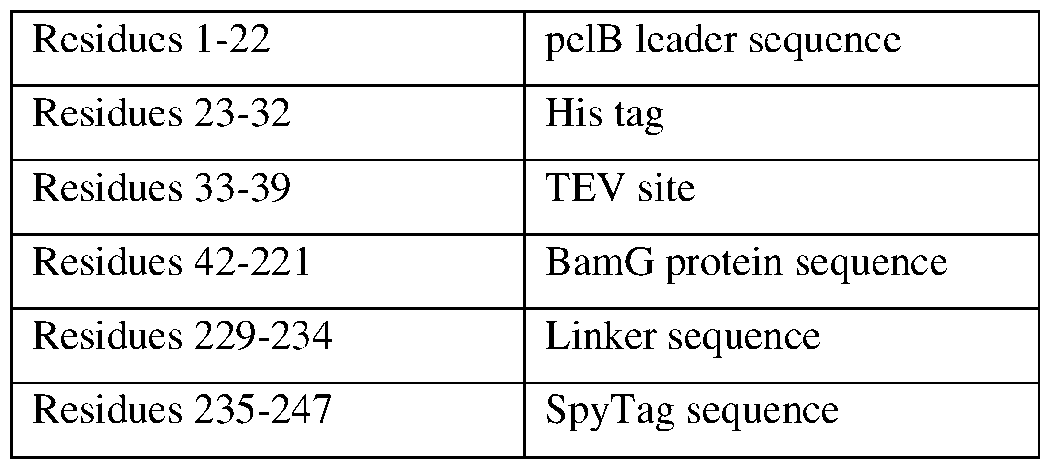
245-110515-02 OSU-22-30 TACCTGTATCCAGGAAAATATACATTTGTCGAAACCGCAGCACCAGACGGTTATGAGGTAGCAACTGCTATT ACCTTTACAGTTAATGAGCAAGGTCAGGTTACTGTAAATGGCAAAGCAACTAAAGGTGACGCTCATATT SEQ ID NO: 36 is the amino acid sequence of BamG-SpyTagN. MKYLLPTAAAGLLLLAAQPAMAAHIVMVDAYKPTKGSGESGPWCFSAVVGGAAVGAKSVIDRRT TGAQTDDNVMALRIETTARSYLRQNNQTKGYTPQISVVGYNRHLLLLGQVATEGEKQFVGQIARS EQAAEGVYNYITVASLPRTAGDIAGDTWNTSKVRATLLGISPATQARVKIITYGNVTYVMGILTPEE QAQITQKVSTTVGVQKVITLYQNYVQRKLAAALEENLYFQGHHHHHHHHHH Residues 1-22 pelB leader sequence Residues 23-35 SpyTag sequence

ence encoding BamG-SpyTagN. ATGAAATACCTGCTGCCGACCGCTGCTGCTGGTCTGCTGCTCCTCGCTGCCCAGCCGGCGATGGCCGCCCAT ATCGTAATGGTCGATGCCTATAAGCCAACAAAAGGTTCAGGTGAGTCCGGGCCATGGTGCTTCAGCGCAGTC GTCGGCGGGGCCGCCGTCGGCGCAAAATCCGTCATCGACCGCCGAACCACCGGCGCGCAAACCGATGACAAC GTTATGGCGTTGCGTATCGAAACCACCGCCCGTTCCTACCTGCGCCAAAACAACCAAACCAAAGGCTACACG CCCCAAATCTCCGTCGTCGGCTACAACCGCCACCTGCTGCTGCTCGGACAAGTCGCCACCGAAGGCGAAAAA CAGTTCGTCGGTCAGATTGCACGTTCCGAACAGGCCGCCGAAGGCGTATACAACTACATTACCGTCGCCTCC CTGCCGCGCACTGCGGGCGACATCGCCGGCGACACTTGGAACACGTCCAAAGTCCGCGCCACGCTGCTGGGC ATCAGCCCCGCTACACAGGCGCGCGTCAAAATCATTACCTACGGCAATGTAACCTACGTTATGGGCATCCTC ACCCCCGAAGAACAGGCGCAGATTACCCAAAAAGTCAGCACCACCGTCGGCGTACAAAAAGTCATTACCCTC TACCAAAACTACGTCCAACGCAAGCTTGCGGCCGCACTCGAGGAAAATTTATATTTTCAAGGTCACCACCAT CATCATCACCACCACCACCAT SEQ ID NO: 38 is the amino acid sequence of BamG-SpyTagC. MKYLLPTAAAGLLLLAAQPAMAHHHHHHHHHHENLYFQGPWCFSAVVGGAAVGAKSVIDRRTT GAQTDDNVMALRIETTARSYLRQNNQTKGYTPQISVVGYNRHLLLLGQVATEGEKQFVGQIARSE QAAEGVYNYITVASLPRTAGDIAGDTWNTSKVRATLLGISPATQARVKIITYGNVTYVMGILTPEEQ AQITQKVSTTVGVQKVITLYQNYVQRKLAAALEGSGESGAHIVMVDAYKPTK Residues 1-22 pelB leader sequence
SEQ ID NO: 39 is an exemplary nucleic acid sequence encoding BamG-SpyTagC. ATGAAATACCTGCTGCCGACCGCTGCTGCTGGTCTGCTGCTCCTCGCTGCCCAGCCGGCGATGGCCCACCAC CATCATCATCACCACCACCACCATGAAAATTTATATTTTCAAGGTCCATGGTGCTTCAGCGCAGTCGTCGGC
245-110515-02 OSU-22-30 GGGGCCGCCGTCGGCGCAAAATCCGTCATCGACCGCCGAACCACCGGCGCGCAAACCGATGACAACGTTATG GCGTTGCGTATCGAAACCACCGCCCGTTCCTACCTGCGCCAAAACAACCAAACCAAAGGCTACACGCCCCAA ATCTCCGTCGTCGGCTACAACCGCCACCTGCTGCTGCTCGGACAAGTCGCCACCGAAGGCGAAAAACAGTTC GTCGGTCAGATTGCACGTTCCGAACAGGCCGCCGAAGGCGTATACAACTACATTACCGTCGCCTCCCTGCCG CGCACTGCGGGCGACATCGCCGGCGACACTTGGAACACGTCCAAAGTCCGCGCCACGCTGCTGGGCATCAGC CCCGCTACACAGGCGCGCGTCAAAATCATTACCTACGGCAATGTAACCTACGTTATGGGCATCCTCACCCCC GAAGAACAGGCGCAGATTACCCAAAAAGTCAGCACCACCGTCGGCGTACAAAAAGTCATTACCCTCTACCAA AACTACGTCCAACGCAAGCTTGCGGCCGCACTCGAGGGTTCAGGTGAGTCCGGGGCCCATATCGTAATGGTC GATGCCTATAAGCCAACAAAA SEQ ID NO: 40 is the amino acid sequence of BamG-SpyCatcherN. MKYLLPTAAAGLLLLAAQPAMAMVDTLSGLSSEQGQSGDMTIEEDSATHIKFSKRDEDGKELAGA TMELRDSSGKTISTWISDGQVKDFYLYPGKYTFVETAAPDGYEVATAITFTVNEQGQVTVNGKATK GDAHIGSGESGPWCFSAVVGGAAVGAKSVIDRRTTGAQTDDNVMALRIETTARSYLRQNNQTKGY TPQISVVGYNRHLLLLGQVATEGEKQFVGQIARSEQAAEGVYNYITVASLPRTAGDIAGDTWNTSK VRATLLGISPATQARVKIITYGNVTYVMGILTPEEQAQITQKVSTTVGVQKVITLYQNYVQRKLAAA LEENLYFQGHHHHHHHHHH Residues 1-22 pelB leader sequence Residues 23-136 SpyCatcher sequence

s a e e pa y uc e c ac sequence encoding BamG-SpyCatcherN. ATGAAATACCTGCTGCCGACCGCTGCTGCTGGTCTGCTGCTCCTCGCTGCCCAGCCGGCGATGGCCATGGTT GATACCTTATCAGGTTTATCAAGTGAGCAAGGTCAGTCCGGTGATATGACAATTGAAGAAGATAGTGCTACC CATATTAAATTCTCAAAACGTGATGAGGACGGCAAAGAGTTAGCTGGTGCAACTATGGAGTTGCGTGATTCA TCTGGTAAAACTATTAGTACATGGATTTCAGATGGACAAGTGAAAGATTTCTACCTGTATCCAGGAAAATAT ACATTTGTCGAAACCGCAGCACCAGACGGTTATGAGGTAGCAACTGCTATTACCTTTACAGTTAATGAGCAA GGTCAGGTTACTGTAAATGGCAAAGCAACTAAAGGTGACGCTCATATTGGTTCAGGTGAGTCCGGGCCATGG TGCTTCAGCGCAGTCGTCGGCGGGGCCGCCGTCGGCGCAAAATCCGTCATCGACCGCCGAACCACCGGCGCG CAAACCGATGACAACGTTATGGCGTTGCGTATCGAAACCACCGCCCGTTCCTACCTGCGCCAAAACAACCAA ACCAAAGGCTACACGCCCCAAATCTCCGTCGTCGGCTACAACCGCCACCTGCTGCTGCTCGGACAAGTCGCC ACCGAAGGCGAAAAACAGTTCGTCGGTCAGATTGCACGTTCCGAACAGGCCGCCGAAGGCGTATACAACTAC ATTACCGTCGCCTCCCTGCCGCGCACTGCGGGCGACATCGCCGGCGACACTTGGAACACGTCCAAAGTCCGC GCCACGCTGCTGGGCATCAGCCCCGCTACACAGGCGCGCGTCAAAATCATTACCTACGGCAATGTAACCTAC GTTATGGGCATCCTCACCCCCGAAGAACAGGCGCAGATTACCCAAAAAGTCAGCACCACCGTCGGCGTACAA AAAGTCATTACCCTCTACCAAAACTACGTCCAACGCAAGCTTGCGGCCGCACTCGAGGAAAATTTATATTTT CAAGGTCACCACCATCATCATCACCACCACCACCAT SEQ ID NO: 42 is the amino acid sequence of BamG-SpyCatcherC. MKYLLPTAAAGLLLLAAQPAMAHHHHHHHHHHENLYFQGPWCFSAVVGGAAVGAKSVIDRRTT GAQTDDNVMALRIETTARSYLRQNNQTKGYTPQISVVGYNRHLLLLGQVATEGEKQFVGQIARSE QAAEGVYNYITVASLPRTAGDIAGDTWNTSKVRATLLGISPATQARVKIITYGNVTYVMGILTPEEQ AQITQKVSTTVGVQKVITLYQNYVQRKLAAALEGSGESGMVDTLSGLSSEQGQSGDMTIEEDSATH IKFSKRDEDGKELAGATMELRDSSGKTISTWISDGQVKDFYLYPGKYTFVETAAPDGYEVATAITFT VNEQGQVTVNGKATKGDAHI
245-110515-02 OSU-22-30 Residues 1-22 pelB leader sequence Residues 23-32 His tag

ence encoding BamG-SpyCatcherC. ATGAAATACCTGCTGCCGACCGCTGCTGCTGGTCTGCTGCTCCTCGCTGCCCAGCCGGCGATGGCCCACCAC CATCATCATCACCACCACCACCATGAAAATTTATATTTTCAAGGTCCATGGTGCTTCAGCGCAGTCGTCGGC GGGGCCGCCGTCGGCGCAAAATCCGTCATCGACCGCCGAACCACCGGCGCGCAAACCGATGACAACGTTATG GCGTTGCGTATCGAAACCACCGCCCGTTCCTACCTGCGCCAAAACAACCAAACCAAAGGCTACACGCCCCAA ATCTCCGTCGTCGGCTACAACCGCCACCTGCTGCTGCTCGGACAAGTCGCCACCGAAGGCGAAAAACAGTTC GTCGGTCAGATTGCACGTTCCGAACAGGCCGCCGAAGGCGTATACAACTACATTACCGTCGCCTCCCTGCCG CGCACTGCGGGCGACATCGCCGGCGACACTTGGAACACGTCCAAAGTCCGCGCCACGCTGCTGGGCATCAGC CCCGCTACACAGGCGCGCGTCAAAATCATTACCTACGGCAATGTAACCTACGTTATGGGCATCCTCACCCCC GAAGAACAGGCGCAGATTACCCAAAAAGTCAGCACCACCGTCGGCGTACAAAAAGTCATTACCCTCTACCAA AACTACGTCCAACGCAAGCTTGCGGCCGCACTCGAGGGTTCAGGTGAGTCCGGGATGGTTGATACCTTATCA GGTTTATCAAGTGAGCAAGGTCAGTCCGGTGATATGACAATTGAAGAAGATAGTGCTACCCATATTAAATTC TCAAAACGTGATGAGGACGGCAAAGAGTTAGCTGGTGCAACTATGGAGTTGCGTGATTCATCTGGTAAAACT ATTAGTACATGGATTTCAGATGGACAAGTGAAAGATTTCTACCTGTATCCAGGAAAATATACATTTGTCGAA ACCGCAGCACCAGACGGTTATGAGGTAGCAACTGCTATTACCTTTACAGTTAATGAGCAAGGTCAGGTTACT GTAAATGGCAAAGCAACTAAAGGTGACGCTCATATT SEQ ID NO: 44 is the amino acid sequence of MetQ-SpyTagN. MKYLLPTAAAGLLLLAAQPAMAAHIVMVDAYKPTKGSGESGPWQKDSAPAASAAAPSADNGAA KKEIVFGTTVGDFGDMVKEQIQAELEKKGYTVKLVEFTDYVRPNLALAEGELDINVFQHKPYLDDF KKEHNLDITEAFQVPTAPLGLYPGKLKSLEEVKDGSTVSAPNDPSNFARALVMLNELGWIKLKDGI NPLTASKADIAENLKNIKIVELEAAQLPRSRADVDFAVVNGNYAISSGMKLTEALFQEPSFAYVNW SAVKTADKDSQWLKDVTEAYNSDAFKAYAHKRFEGYKYPAAWNEGAAKLEENLYFQGHHHHHH HHHH Residues 1-22 pelB leader sequence

SEQ ID NO: 45 is an exemplary nucleic acid sequence encoding MetQ-SpyTagN. ATGAAATACCTGCTGCCGACCGCTGCTGCTGGTCTGCTGCTCCTCGCTGCCCAGCCGGCGATGGCCGCCCAT ATCGTAATGGTCGATGCCTATAAGCCAACAAAAGGTTCAGGTGAGTCCGGGCCATGGCAAAAAGACAGCGCG CCCGCAGCCTCTGCCGCCGCCCCTTCTGCCGATAACGGCGCGGCGAAAAAAGAAATCGTCTTCGGCACGACC GTCGGCGACTTCGGCGATATGGTCAAAGAACAAATCCAAGCCGAGCTGGAGAAAAAAGGCTACACCGTCAAA TTGGTCGAATTTACCGACTATGTGCGCCCGAATCTGGCATTGGCGGAGGGCGAGTTGGACATCAACGTCTTC
245-110515-02 OSU-22-30 CAACACAAACCCTATCTTGACGATTTCAAAAAAGAACACAACCTGGACATCACCGAAGCCTTCCAAGTGCCG ACCGCGCCTTTGGGACTGTATCCGGGCAAACTGAAATCGCTGGAAGAAGTCAAAGACGGCAGCACCGTATCC GCGCCCAACGACCCGTCCAACTTCGCACGCGCCTTGGTGATGCTGAACGAACTGGGTTGGATCAAACTCAAA GACGGCATCAATCCGCTGACCGCATCCAAAGCCGACATCGCGGAAAACCTGAAAAACATCAAAATCGTCGAG CTTGAAGCCGCACAACTGCCGCGCAGCCGCGCCGACGTGGATTTTGCCGTCGTCAACGGCAACTACGCCATA AGCAGCGGCATGAAGCTGACCGAAGCCCTGTTCCAAGAGCCGAGCTTTGCCTATGTCAACTGGTCTGCCGTC AAAACCGCCGACAAAGACAGCCAATGGCTTAAAGACGTAACCGAGGCCTATAACTCCGACGCGTTCAAAGCC TACGCGCACAAACGCTTCGAGGGCTACAAATACCCTGCCGCATGGAATGAAGGCGCAGCCAAACTCGAGGAA AATTTATATTTTCAAGGTCACCACCATCATCATCACCACCACCACCAT SEQ ID NO: 46 is the amino acid sequence of MetQ-SpyTagC. MKYLLPTAAAGLLLLAAQPAMAHHHHHHHHHHENLYFQGPWQKDSAPAASAAAPSADNGAAKK EIVFGTTVGDFGDMVKEQIQAELEKKGYTVKLVEFTDYVRPNLALAEGELDINVFQHKPYLDDFKK EHNLDITEAFQVPTAPLGLYPGKLKSLEEVKDGSTVSAPNDPSNFARALVMLNELGWIKLKDGINPL TASKADIAENLKNIKIVELEAAQLPRSRADVDFAVVNGNYAISSGMKLTEALFQEPSFAYVNWSAV KTADKDSQWLKDVTEAYNSDAFKAYAHKRFEGYKYPAAWNEGAAKLEGSGESGAHIVMVDAYK PTK Residues 1-22 pelB leader sequence Residues 23-32 His tag

s a e e pa y uc e c ac sequence encoding MetQ-SpyTagC. ATGAAATACCTGCTGCCGACCGCTGCTGCTGGTCTGCTGCTCCTCGCTGCCCAGCCGGCGATGGCCCACCAC CATCATCATCACCACCACCACCATGAAAATTTATATTTTCAAGGTCCATGGCAAAAAGACAGCGCGCCCGCA GCCTCTGCCGCCGCCCCTTCTGCCGATAACGGCGCGGCGAAAAAAGAAATCGTCTTCGGCACGACCGTCGGC GACTTCGGCGATATGGTCAAAGAACAAATCCAAGCCGAGCTGGAGAAAAAAGGCTACACCGTCAAATTGGTC GAATTTACCGACTATGTGCGCCCGAATCTGGCATTGGCGGAGGGCGAGTTGGACATCAACGTCTTCCAACAC AAACCCTATCTTGACGATTTCAAAAAAGAACACAACCTGGACATCACCGAAGCCTTCCAAGTGCCGACCGCG CCTTTGGGACTGTATCCGGGCAAACTGAAATCGCTGGAAGAAGTCAAAGACGGCAGCACCGTATCCGCGCCC AACGACCCGTCCAACTTCGCACGCGCCTTGGTGATGCTGAACGAACTGGGTTGGATCAAACTCAAAGACGGC ATCAATCCGCTGACCGCATCCAAAGCCGACATCGCGGAAAACCTGAAAAACATCAAAATCGTCGAGCTTGAA GCCGCACAACTGCCGCGCAGCCGCGCCGACGTGGATTTTGCCGTCGTCAACGGCAACTACGCCATAAGCAGC GGCATGAAGCTGACCGAAGCCCTGTTCCAAGAGCCGAGCTTTGCCTATGTCAACTGGTCTGCCGTCAAAACC GCCGACAAAGACAGCCAATGGCTTAAAGACGTAACCGAGGCCTATAACTCCGACGCGTTCAAAGCCTACGCG CACAAACGCTTCGAGGGCTACAAATACCCTGCCGCATGGAATGAAGGCGCAGCCAAACTCGAGGGTTCAGGT GAGTCCGGGGCCCATATCGTAATGGTCGATGCCTATAAGCCAACAAAA SEQ ID NO: 48 is the amino acid sequence of MetQ-SpyCatcherN. MKYLLPTAAAGLLLLAAQPAMAMVDTLSGLSSEQGQSGDMTIEEDSATHIKFSKRDEDGKELAGA TMELRDSSGKTISTWISDGQVKDFYLYPGKYTFVETAAPDGYEVATAITFTVNEQGQVTVNGKATK GDAHIGSGESGPWQKDSAPAASAAAPSADNGAAKKEIVFGTTVGDFGDMVKEQIQAELEKKGYTV KLVEFTDYVRPNLALAEGELDINVFQHKPYLDDFKKEHNLDITEAFQVPTAPLGLYPGKLKSLEEV KDGSTVSAPNDPSNFARALVMLNELGWIKLKDGINPLTASKADIAENLKNIKIVELEAAQLPRSRAD VDFAVVNGNYAISSGMKLTEALFQEPSFAYVNWSAVKTADKDSQWLKDVTEAYNSDAFKAYAHK RFEGYKYPAAWNEGAAKLEENLYFQGHHHHHHHHHH
245-110515-02 OSU-22-30 Residues 1-22 pelB leader sequence Residues 23-136 SpyCatcher sequence

ence encoding MetQ-SpyCatcherN. ATGAAATACCTGCTGCCGACCGCTGCTGCTGGTCTGCTGCTCCTCGCTGCCCAGCCGGCGATGGCCATGGTT GATACCTTATCAGGTTTATCAAGTGAGCAAGGTCAGTCCGGTGATATGACAATTGAAGAAGATAGTGCTACC CATATTAAATTCTCAAAACGTGATGAGGACGGCAAAGAGTTAGCTGGTGCAACTATGGAGTTGCGTGATTCA TCTGGTAAAACTATTAGTACATGGATTTCAGATGGACAAGTGAAAGATTTCTACCTGTATCCAGGAAAATAT ACATTTGTCGAAACCGCAGCACCAGACGGTTATGAGGTAGCAACTGCTATTACCTTTACAGTTAATGAGCAA GGTCAGGTTACTGTAAATGGCAAAGCAACTAAAGGTGACGCTCATATTGGTTCAGGTGAGTCCGGGCCATGG CAAAAAGACAGCGCGCCCGCAGCCTCTGCCGCCGCCCCTTCTGCCGATAACGGCGCGGCGAAAAAAGAAATC GTCTTCGGCACGACCGTCGGCGACTTCGGCGATATGGTCAAAGAACAAATCCAAGCCGAGCTGGAGAAAAAA GGCTACACCGTCAAATTGGTCGAATTTACCGACTATGTGCGCCCGAATCTGGCATTGGCGGAGGGCGAGTTG GACATCAACGTCTTCCAACACAAACCCTATCTTGACGATTTCAAAAAAGAACACAACCTGGACATCACCGAA GCCTTCCAAGTGCCGACCGCGCCTTTGGGACTGTATCCGGGCAAACTGAAATCGCTGGAAGAAGTCAAAGAC GGCAGCACCGTATCCGCGCCCAACGACCCGTCCAACTTCGCACGCGCCTTGGTGATGCTGAACGAACTGGGT TGGATCAAACTCAAAGACGGCATCAATCCGCTGACCGCATCCAAAGCCGACATCGCGGAAAACCTGAAAAAC ATCAAAATCGTCGAGCTTGAAGCCGCACAACTGCCGCGCAGCCGCGCCGACGTGGATTTTGCCGTCGTCAAC GGCAACTACGCCATAAGCAGCGGCATGAAGCTGACCGAAGCCCTGTTCCAAGAGCCGAGCTTTGCCTATGTC AACTGGTCTGCCGTCAAAACCGCCGACAAAGACAGCCAATGGCTTAAAGACGTAACCGAGGCCTATAACTCC GACGCGTTCAAAGCCTACGCGCACAAACGCTTCGAGGGCTACAAATACCCTGCCGCATGGAATGAAGGCGCA GCCAAACTCGAGGAAAATTTATATTTTCAAGGTCACCACCATCATCATCACCACCACCACCAT SEQ ID NO: 50 is the amino acid sequence of MetQ-SpyCatcherC. MKYLLPTAAAGLLLLAAQPAMAHHHHHHHHHHENLYFQGPWQKDSAPAASAAAPSADNGAAKK EIVFGTTVGDFGDMVKEQIQAELEKKGYTVKLVEFTDYVRPNLALAEGELDINVFQHKPYLDDFKK EHNLDITEAFQVPTAPLGLYPGKLKSLEEVKDGSTVSAPNDPSNFARALVMLNELGWIKLKDGINPL TASKADIAENLKNIKIVELEAAQLPRSRADVDFAVVNGNYAISSGMKLTEALFQEPSFAYVNWSAV KTADKDSQWLKDVTEAYNSDAFKAYAHKRFEGYKYPAAWNEGAAKLEGSGESGMVDTLSGLSS EQGQSGDMTIEEDSATHIKFSKRDEDGKELAGATMELRDSSGKTISTWISDGQVKDFYLYPGKYTF VETAAPDGYEVATAITFTVNEQGQVTVNGKATKGDAHI Residues 1-22 pelB leader sequence

SEQ ID NO: 51 is an exemplary nucleic acid sequence encoding MetQ-SpyCatcherC.
245-110515-02 OSU-22-30 ATGAAATACCTGCTGCCGACCGCTGCTGCTGGTCTGCTGCTCCTCGCTGCCCAGCCGGCGATGGCCCACCAC CATCATCATCACCACCACCACCATGAAAATTTATATTTTCAAGGTCCATGGCAAAAAGACAGCGCGCCCGCA GCCTCTGCCGCCGCCCCTTCTGCCGATAACGGCGCGGCGAAAAAAGAAATCGTCTTCGGCACGACCGTCGGC GACTTCGGCGATATGGTCAAAGAACAAATCCAAGCCGAGCTGGAGAAAAAAGGCTACACCGTCAAATTGGTC GAATTTACCGACTATGTGCGCCCGAATCTGGCATTGGCGGAGGGCGAGTTGGACATCAACGTCTTCCAACAC AAACCCTATCTTGACGATTTCAAAAAAGAACACAACCTGGACATCACCGAAGCCTTCCAAGTGCCGACCGCG CCTTTGGGACTGTATCCGGGCAAACTGAAATCGCTGGAAGAAGTCAAAGACGGCAGCACCGTATCCGCGCCC AACGACCCGTCCAACTTCGCACGCGCCTTGGTGATGCTGAACGAACTGGGTTGGATCAAACTCAAAGACGGC ATCAATCCGCTGACCGCATCCAAAGCCGACATCGCGGAAAACCTGAAAAACATCAAAATCGTCGAGCTTGAA GCCGCACAACTGCCGCGCAGCCGCGCCGACGTGGATTTTGCCGTCGTCAACGGCAACTACGCCATAAGCAGC GGCATGAAGCTGACCGAAGCCCTGTTCCAAGAGCCGAGCTTTGCCTATGTCAACTGGTCTGCCGTCAAAACC GCCGACAAAGACAGCCAATGGCTTAAAGACGTAACCGAGGCCTATAACTCCGACGCGTTCAAAGCCTACGCG CACAAACGCTTCGAGGGCTACAAATACCCTGCCGCATGGAATGAAGGCGCAGCCAAACTCGAGGGTTCAGGT GAGTCCGGGATGGTTGATACCTTATCAGGTTTATCAAGTGAGCAAGGTCAGTCCGGTGATATGACAATTGAA GAAGATAGTGCTACCCATATTAAATTCTCAAAACGTGATGAGGACGGCAAAGAGTTAGCTGGTGCAACTATG GAGTTGCGTGATTCATCTGGTAAAACTATTAGTACATGGATTTCAGATGGACAAGTGAAAGATTTCTACCTG TATCCAGGAAAATATACATTTGTCGAAACCGCAGCACCAGACGGTTATGAGGTAGCAACTGCTATTACCTTT ACAGTTAATGAGCAAGGTCAGGTTACTGTAAATGGCAAAGCAACTAAAGGTGACGCTCATATT SEQ ID NO: 52 is the amino acid sequence of AniA-SpyTagN. MKYLLPTAAAGLLLLAAQPAMAAHIVMVDAYKPTKGSGESGPWPAAQAPAETPAASAEAASSAA QATAETPAGELPVIDAVTTHAPEVPPAIDRDYPAKVRVKMETVEKTMKMDDGVEYRYWTFDGDV PGRMIRVREGDTVEVEFSNNPSSTVPHNVDFHAATGQGGGAAATFTAPGRTSTFSFKALQPGLYIY HCAVAPVGMHIANGMYGLILVEPKEGLPKVDKEFYIVQGDFYTKGKKGAQGLQPFDMDKAVAEQ PEYVVFNGHVGAIAGDNALKAKAGETVRMYVGNGGPNLVSSFHVIGEIFDKVYVEGGKLINENVQ STIVPAGGSAIVEFKVDIPGNYTLVDHSIFRAFNKGALGQLKVEGAENPEIMTQKLSDTAYAGSGAA SAPAASAPAASAPAASASAAALEENLYFQGHHHHHHHHHH Residues 1-22 pelB leader sequence

SEQ ID NO: 53 is an exemplary nucleic acid sequence encoding AniA-SpyTagN. ATGAAATACCTGCTGCCGACCGCTGCTGCTGGTCTGCTGCTCCTCGCTGCCCAGCCGGCGATGGCCGCCCAT ATCGTAATGGTCGATGCCTATAAGCCAACAAAAGGTTCAGGTGAGTCCGGGCCATGGCCTGCCGCGCAAGCC CCTGCCGAAACCCCTGCCGCTTCCGCAGAAGCCGCAAGTTCCGCCGCACAAGCTACCGCCGAAACGCCTGCA GGCGAACTGCCCGTCATCGATGCGGTGACCACCCACGCTCCCGAAGTACCTCCCGCAATCGACCGCGACTAT CCTGCCAAAGTACGCGTAAAAATGGAAACCGTCGAAAAAACCATGAAAATGGACGACGGGGTGGAATACCGC TACTGGACATTTGACGGCGACGTTCCGGGCCGTATGATCCGCGTACGCGAAGGCGATACGGTTGAAGTCGAA TTCTCCAACAATCCTTCTTCTACCGTTCCGCACAACGTCGACTTCCACGCCGCAACCGGTCAGGGCGGCGGT GCAGCCGCGACCTTTACCGCCCCGGGCCGCACTTCCACATTCAGCTTCAAAGCCCTGCAACCGGGCCTGTAC ATCTACCACTGCGCCGTCGCGCCGGTCGGTATGCACATCGCCAACGGTATGTACGGTCTGATTTTGGTCGAG CCTAAAGAAGGCCTGCCGAAAGTGGATAAAGAGTTCTACATCGTCCAAGGCGACTTCTACACCAAAGGCAAA AAAGGCGCGCAAGGCCTGCAACCGTTCGATATGGACAAAGCCGTTGCCGAACAGCCTGAATACGTCGTATTC AACGGCCACGTAGGCGCTATCGCCGGCGATAACGCCCTGAAAGCCAAAGCAGGCGAAACCGTGCGTATGTAC GTCGGTAACGGCGGCCCGAACTTGGTGTCTTCCTTCCACGTCATCGGCGAAATCTTCGACAAAGTTTATGTT GAAGGCGGCAAACTGATTAACGAAAACGTACAAAGCACCATCGTGCCTGCCGGCGGTTCTGCCATCGTCGAA
245-110515-02 OSU-22-30 TTCAAAGTCGACATCCCGGGCAACTACACTTTGGTCGACCACTCCATCTTCCGCGCATTCAACAAAGGCGCG TTGGGGCAATTGAAAGTAGAGGGTGCGGAAAACCCTGAAATCATGACTCAAAAATTGAGTGATACCGCTTAC GCCGGCAGCGGCGCGGCTTCTGCCCCTGCTGCTTCCGCACCGGCTGCTTCTGCCCCGGCAGCCTCTGCATCC GCGGCCGCACTCGAGGAAAATTTATATTTTCAAGGTCACCACCATCATCATCACCACCACCACCAT SEQ ID NO: 54 is the amino acid sequence of AniA-SpyTagC. MKYLLPTAAAGLLLLAAQPAMAHHHHHHHHHHENLYFQGPWPAAQAPAETPAASAEAASSAAQ ATAETPAGELPVIDAVTTHAPEVPPAIDRDYPAKVRVKMETVEKTMKMDDGVEYRYWTFDGDVP GRMIRVREGDTVEVEFSNNPSSTVPHNVDFHAATGQGGGAAATFTAPGRTSTFSFKALQPGLYIYH CAVAPVGMHIANGMYGLILVEPKEGLPKVDKEFYIVQGDFYTKGKKGAQGLQPFDMDKAVAEQP EYVVFNGHVGAIAGDNALKAKAGETVRMYVGNGGPNLVSSFHVIGEIFDKVYVEGGKLINENVQS TIVPAGGSAIVEFKVDIPGNYTLVDHSIFRAFNKGALGQLKVEGAENPEIMTQKLSDTAYAGSGAAS APAASAPAASAPAASASAAALEGSGESGAHIVMVDAYKPTK Residues 1-22 pelB leader sequence Residues 23-32 His tag

p y q ence encoding AniA-SpyTagC. ATGAAATACCTGCTGCCGACCGCTGCTGCTGGTCTGCTGCTCCTCGCTGCCCAGCCGGCGATGGCCCACCAC CATCATCATCACCACCACCACCATGAAAATTTATATTTTCAAGGTCCATGGCCTGCCGCGCAAGCCCCTGCC GAAACCCCTGCCGCTTCCGCAGAAGCCGCAAGTTCCGCCGCACAAGCTACCGCCGAAACGCCTGCAGGCGAA CTGCCCGTCATCGATGCGGTGACCACCCACGCTCCCGAAGTACCTCCCGCAATCGACCGCGACTATCCTGCC AAAGTACGCGTAAAAATGGAAACCGTCGAAAAAACCATGAAAATGGACGACGGGGTGGAATACCGCTACTGG ACATTTGACGGCGACGTTCCGGGCCGTATGATCCGCGTACGCGAAGGCGATACGGTTGAAGTCGAATTCTCC AACAATCCTTCTTCTACCGTTCCGCACAACGTCGACTTCCACGCCGCAACCGGTCAGGGCGGCGGTGCAGCC GCGACCTTTACCGCCCCGGGCCGCACTTCCACATTCAGCTTCAAAGCCCTGCAACCGGGCCTGTACATCTAC CACTGCGCCGTCGCGCCGGTCGGTATGCACATCGCCAACGGTATGTACGGTCTGATTTTGGTCGAGCCTAAA GAAGGCCTGCCGAAAGTGGATAAAGAGTTCTACATCGTCCAAGGCGACTTCTACACCAAAGGCAAAAAAGGC GCGCAAGGCCTGCAACCGTTCGATATGGACAAAGCCGTTGCCGAACAGCCTGAATACGTCGTATTCAACGGC CACGTAGGCGCTATCGCCGGCGATAACGCCCTGAAAGCCAAAGCAGGCGAAACCGTGCGTATGTACGTCGGT AACGGCGGCCCGAACTTGGTGTCTTCCTTCCACGTCATCGGCGAAATCTTCGACAAAGTTTATGTTGAAGGC GGCAAACTGATTAACGAAAACGTACAAAGCACCATCGTGCCTGCCGGCGGTTCTGCCATCGTCGAATTCAAA GTCGACATCCCGGGCAACTACACTTTGGTCGACCACTCCATCTTCCGCGCATTCAACAAAGGCGCGTTGGGG CAATTGAAAGTAGAGGGTGCGGAAAACCCTGAAATCATGACTCAAAAATTGAGTGATACCGCTTACGCCGGC AGCGGCGCGGCTTCTGCCCCTGCTGCTTCCGCACCGGCTGCTTCTGCCCCGGCAGCCTCTGCATCCGCGGCC GCACTCGAGGGTTCAGGTGAGTCCGGGGCCCATATCGTAATGGTCGATGCCTATAAGCCAACAAAA SEQ ID NO: 56 is the amino acid sequence of AniA-SpyCatcherN. MKYLLPTAAAGLLLLAAQPAMAMVDTLSGLSSEQGQSGDMTIEEDSATHIKFSKRDEDGKELAGA TMELRDSSGKTISTWISDGQVKDFYLYPGKYTFVETAAPDGYEVATAITFTVNEQGQVTVNGKATK GDAHIGSGESGPWPAAQAPAETPAASAEAASSAAQATAETPAGELPVIDAVTTHAPEVPPAIDRDYP AKVRVKMETVEKTMKMDDGVEYRYWTFDGDVPGRMIRVREGDTVEVEFSNNPSSTVPHNVDFH AATGQGGGAAATFTAPGRTSTFSFKALQPGLYIYHCAVAPVGMHIANGMYGLILVEPKEGLPKVD KEFYIVQGDFYTKGKKGAQGLQPFDMDKAVAEQPEYVVFNGHVGAIAGDNALKAKAGETVRMY VGNGGPNLVSSFHVIGEIFDKVYVEGGKLINENVQSTIVPAGGSAIVEFKVDIPGNYTLVDHSIFRAF
245-110515-02 OSU-22-30 NKGALGQLKVEGAENPEIMTQKLSDTAYAGSGAASAPAASAPAASAPAASASAAALEENLYFQGH HHHHHHHHH Residues 1-22 pelB leader sequence Residues 23-136 SpyCatcher sequence

ence encoding AniA-SpyCatcherN. ATGAAATACCTGCTGCCGACCGCTGCTGCTGGTCTGCTGCTCCTCGCTGCCCAGCCGGCGATGGCCATGGTT GATACCTTATCAGGTTTATCAAGTGAGCAAGGTCAGTCCGGTGATATGACAATTGAAGAAGATAGTGCTACC CATATTAAATTCTCAAAACGTGATGAGGACGGCAAAGAGTTAGCTGGTGCAACTATGGAGTTGCGTGATTCA TCTGGTAAAACTATTAGTACATGGATTTCAGATGGACAAGTGAAAGATTTCTACCTGTATCCAGGAAAATAT ACATTTGTCGAAACCGCAGCACCAGACGGTTATGAGGTAGCAACTGCTATTACCTTTACAGTTAATGAGCAA GGTCAGGTTACTGTAAATGGCAAAGCAACTAAAGGTGACGCTCATATTGGTTCAGGTGAGTCCGGGCCATGG CCTGCCGCGCAAGCCCCTGCCGAAACCCCTGCCGCTTCCGCAGAAGCCGCAAGTTCCGCCGCACAAGCTACC GCCGAAACGCCTGCAGGCGAACTGCCCGTCATCGATGCGGTGACCACCCACGCTCCCGAAGTACCTCCCGCA ATCGACCGCGACTATCCTGCCAAAGTACGCGTAAAAATGGAAACCGTCGAAAAAACCATGAAAATGGACGAC GGGGTGGAATACCGCTACTGGACATTTGACGGCGACGTTCCGGGCCGTATGATCCGCGTACGCGAAGGCGAT ACGGTTGAAGTCGAATTCTCCAACAATCCTTCTTCTACCGTTCCGCACAACGTCGACTTCCACGCCGCAACC GGTCAGGGCGGCGGTGCAGCCGCGACCTTTACCGCCCCGGGCCGCACTTCCACATTCAGCTTCAAAGCCCTG CAACCGGGCCTGTACATCTACCACTGCGCCGTCGCGCCGGTCGGTATGCACATCGCCAACGGTATGTACGGT CTGATTTTGGTCGAGCCTAAAGAAGGCCTGCCGAAAGTGGATAAAGAGTTCTACATCGTCCAAGGCGACTTC TACACCAAAGGCAAAAAAGGCGCGCAAGGCCTGCAACCGTTCGATATGGACAAAGCCGTTGCCGAACAGCCT GAATACGTCGTATTCAACGGCCACGTAGGCGCTATCGCCGGCGATAACGCCCTGAAAGCCAAAGCAGGCGAA ACCGTGCGTATGTACGTCGGTAACGGCGGCCCGAACTTGGTGTCTTCCTTCCACGTCATCGGCGAAATCTTC GACAAAGTTTATGTTGAAGGCGGCAAACTGATTAACGAAAACGTACAAAGCACCATCGTGCCTGCCGGCGGT TCTGCCATCGTCGAATTCAAAGTCGACATCCCGGGCAACTACACTTTGGTCGACCACTCCATCTTCCGCGCA TTCAACAAAGGCGCGTTGGGGCAATTGAAAGTAGAGGGTGCGGAAAACCCTGAAATCATGACTCAAAAATTG AGTGATACCGCTTACGCCGGCAGCGGCGCGGCTTCTGCCCCTGCTGCTTCCGCACCGGCTGCTTCTGCCCCG GCAGCCTCTGCATCCGCGGCCGCACTCGAGGAAAATTTATATTTTCAAGGTCACCACCATCATCATCACCAC CACCACCAT SEQ ID NO: 58 is the amino acid sequence of AniA-SpyCatcherC. MKYLLPTAAAGLLLLAAQPAMAHHHHHHHHHHENLYFQGPWPAAQAPAETPAASAEAASSAAQ ATAETPAGELPVIDAVTTHAPEVPPAIDRDYPAKVRVKMETVEKTMKMDDGVEYRYWTFDGDVP GRMIRVREGDTVEVEFSNNPSSTVPHNVDFHAATGQGGGAAATFTAPGRTSTFSFKALQPGLYIYH CAVAPVGMHIANGMYGLILVEPKEGLPKVDKEFYIVQGDFYTKGKKGAQGLQPFDMDKAVAEQP EYVVFNGHVGAIAGDNALKAKAGETVRMYVGNGGPNLVSSFHVIGEIFDKVYVEGGKLINENVQS TIVPAGGSAIVEFKVDIPGNYTLVDHSIFRAFNKGALGQLKVEGAENPEIMTQKLSDTAYAGSGAAS APAASAPAASAPAASASAAALEGSGESGMVDTLSGLSSEQGQSGDMTIEEDSATHIKFSKRDEDGK ELAGATMELRDSSGKTISTWISDGQVKDFYLYPGKYTFVETAAPDGYEVATAITFTVNEQGQVTVN GKATKGDAHI Residues 1-22 pelB leader sequence

Residues 33-39 TEV site Residues 42-406 AniA protein sequence

ence encoding AniA-SpyCatcherC. ATGAAATACCTGCTGCCGACCGCTGCTGCTGGTCTGCTGCTCCTCGCTGCCCAGCCGGCGATGGCCCACCAC CATCATCATCACCACCACCACCATGAAAATTTATATTTTCAAGGTCCATGGCCTGCCGCGCAAGCCCCTGCC GAAACCCCTGCCGCTTCCGCAGAAGCCGCAAGTTCCGCCGCACAAGCTACCGCCGAAACGCCTGCAGGCGAA CTGCCCGTCATCGATGCGGTGACCACCCACGCTCCCGAAGTACCTCCCGCAATCGACCGCGACTATCCTGCC AAAGTACGCGTAAAAATGGAAACCGTCGAAAAAACCATGAAAATGGACGACGGGGTGGAATACCGCTACTGG ACATTTGACGGCGACGTTCCGGGCCGTATGATCCGCGTACGCGAAGGCGATACGGTTGAAGTCGAATTCTCC AACAATCCTTCTTCTACCGTTCCGCACAACGTCGACTTCCACGCCGCAACCGGTCAGGGCGGCGGTGCAGCC GCGACCTTTACCGCCCCGGGCCGCACTTCCACATTCAGCTTCAAAGCCCTGCAACCGGGCCTGTACATCTAC CACTGCGCCGTCGCGCCGGTCGGTATGCACATCGCCAACGGTATGTACGGTCTGATTTTGGTCGAGCCTAAA GAAGGCCTGCCGAAAGTGGATAAAGAGTTCTACATCGTCCAAGGCGACTTCTACACCAAAGGCAAAAAAGGC GCGCAAGGCCTGCAACCGTTCGATATGGACAAAGCCGTTGCCGAACAGCCTGAATACGTCGTATTCAACGGC CACGTAGGCGCTATCGCCGGCGATAACGCCCTGAAAGCCAAAGCAGGCGAAACCGTGCGTATGTACGTCGGT AACGGCGGCCCGAACTTGGTGTCTTCCTTCCACGTCATCGGCGAAATCTTCGACAAAGTTTATGTTGAAGGC GGCAAACTGATTAACGAAAACGTACAAAGCACCATCGTGCCTGCCGGCGGTTCTGCCATCGTCGAATTCAAA GTCGACATCCCGGGCAACTACACTTTGGTCGACCACTCCATCTTCCGCGCATTCAACAAAGGCGCGTTGGGG CAATTGAAAGTAGAGGGTGCGGAAAACCCTGAAATCATGACTCAAAAATTGAGTGATACCGCTTACGCCGGC AGCGGCGCGGCTTCTGCCCCTGCTGCTTCCGCACCGGCTGCTTCTGCCCCGGCAGCCTCTGCATCCGCGGCC GCACTCGAGGGTTCAGGTGAGTCCGGGATGGTTGATACCTTATCAGGTTTATCAAGTGAGCAAGGTCAGTCC GGTGATATGACAATTGAAGAAGATAGTGCTACCCATATTAAATTCTCAAAACGTGATGAGGACGGCAAAGAG TTAGCTGGTGCAACTATGGAGTTGCGTGATTCATCTGGTAAAACTATTAGTACATGGATTTCAGATGGACAA GTGAAAGATTTCTACCTGTATCCAGGAAAATATACATTTGTCGAAACCGCAGCACCAGACGGTTATGAGGTA GCAACTGCTATTACCTTTACAGTTAATGAGCAAGGTCAGGTTACTGTAAATGGCAAAGCAACTAAAGGTGAC GCTCATATT SEQ ID NO: 60 is the amino acid sequence of SpytagN_BamE_TEV site_10x His. AHIVMVDAYKPTKGSGESGPWNKTLILALSALFSLTACSVERVSLFPSYKLKIIQGNELEPRAVAALR PGMTKDQVLLLLGSPILRDAFHTDRWDYTFNTSRNGIIKERSNLTVYFENGVLVRTEGDALQNAAE ALRAKQNADKQLEENLYFQGHHHHHHHHHH Residues 1-13 SpyTag sequence

SEQ ID NO: 61 is the amino acid sequence of SpytagN_BamG_TEV site_10x His. AHIVMVDAYKPTKGSGESGPWCFSAVVGGAAVGAKSVIDRRTTGAQTDDNVMALRIETTARSYLR QNNQTKGYTPQISVVGYNRHLLLLGQVATEGEKQFVGQIARSEQAAEGVYNYITVASLPRTAGDIAG DTWNTSKVRATLLGISPATQARVKIITYGNVTYVMGILTPEEQAQITQKVSTTVGVQKVITLYQNYV QRKLAAALEENLYFQGHHHHHHHHHH
245-110515-02 OSU-22-30 Residues 1-13 SpyTag sequence Residues 14-19 Linker sequence
tagN_AniA_TEV site_10x His. AHIVMVDAYKPTKGSGESGPWPAAQAPAETPAASAEAASSAAQATAETPAGELPVIDAVTTHAPEVP PAIDRDYPAKVRVKMETVEKTMKMDDGVEYRYWTFDGDVPGRMIRVREGDTVEVEFSNNPSSTVP HNVDFHAATGQGGGAAATFTAPGRTSTFSFKALQPGLYIYHCAVAPVGMHIANGMYGLILVEPKEGL PKVDKEFYIVQGDFYTKGKKGAQGLQPFDMDKAVAEQPEYVVFNGHVGAIAGDNALKAKAGETV RMYVGNGGPNLVSSFHVIGEIFDKVYVEGGKLINENVQSTIVPAGGSAIVEFKVDIPGNYTLVDHSIF RAFNKGALGQLKVEGAENPEIMTQKLSDTAYAGSGAASAPAASAPAASAPAASASAAALEENLYFQ GHHHHHHHHHH Residues 1-13 SpyTag sequence Residues 14-19 Linker sequence

p q . DETAILED DESCRIPTION I. Introduction Two gonorrhea vaccines, composed of killed Ng and purified pilin, failed in clinical trials decades ago (Greenberg et al., Can J Public Health 65(1):29-33, 1974; Greenberg, J Reprod Med 14(1):34-36, 1975; Boslego et al., Vaccine 9(3):154-162, 1991), illustrating the difficulty Ng poses to traditional vaccine design. The longstanding barriers to developing an effective Ng vaccine include remarkable antigenic variability, highly sophisticated strategies for modulating and evading host innate and adaptive immune responses, and the lack of established correlates of protection (Kraus et al., J Clin Invest 55(6):1349-1356, 1975; Plummer et al., J Clin Invest 83(5):1472-1476, 1989; Fox et al., Am J Epidemiol 149(4):353-358, 1999; Schmidt et al., Sex Transm Dis 28(10):555-564, 2001; Russell et al., Front Immunol 10:2417, 2019; Vincent and Jerse, Vaccine 37(50):7419-7426, 2019). As described herein, to address the first challenge, proteomics and bioinformatics were used to identify conserved vaccine antigens (Zielke et al., Mol Cell Proteomics 15(7):2338-2355, 2016; Zielke et al., Mol Cell Proteomics 13(5):1299-1317, 2014; El-Rami et al., Mol Cell Proteomics 18(1):127-50, 2019; Baarda et al., mSphere 6(1):e00977-20, 2021). Thirty-four gonorrhea protein antigens were discovered through proteome-based reverse vaccinology studies and traditional approaches. Comprehensive analyses were performed on their sequence variation among over five thousand
245-110515-02 OSU-22-30 clinical Ng isolates deposited in the Neisseria PubMLST database (Rice et al., Ann Rev Microbiol 71:665- 686, 2017; Zielke et al., Mol Cell Proteomics 15(7):2338-2355, 2016; Zielke et al., Mol Cell Proteomics 13(5):1299-1317, 2014; El-Rami et al., Mol Cell Proteomics 18(1):127-50, 2019; Baarda et al., mSphere 6(1):e00977-20, 2021). Among the most conserved antigens identified was a surface-exposed lysozyme inhibitor of c-type lysozyme, lipoprotein SliC (Zielke et al., PLoS Pathog 14(7):e1007081, 2018). Other highly conserved antigens identified include methionine binding protein (MetQ), Neisserial adhesin complex protein (ACP), β-barrel assembly machinery protein E (BamE), β-barrel assembly machinery protein G (BamG) and anaerobically induced outer membrane protein A (AniA). The studies described herein show that SliC is exceptionally well conserved and over 96% of isolates have an identical SliC allele. The gene sliC (locus NEIP0196) has a total of 12 alleles and 22 single nucleotide polymorphisms (SNPs). There are only eight different amino acid sequences with 11 single amino acid polymorphisms distributed in less than 4% of Ng isolates globally (Baarda et al., mSphere 6(1):e00977-20, 2021). In addition, utilizing ∆sliC, ∆sliC/p::sliC* (S83A/K103A; a SliC unable to bind lysozyme) and lysozyme KO (LysMcre) mice, it was shown experimentally that SliC provides a significant survival advantage for Ng during mucosal infection that is dependent on its function as a lysozyme inhibitor (Zielke et al., PLoS Pathog 14(7):e1007081, 2018). Together these data provide a premise for incorporating SliC and other highly conserved Ng antigens in gonorrhea vaccines. Subunit protein vaccines can fail due to low immunogenicity caused by small antigen size, instability, or improper presentation to the immune system (Thrane et al., J Nanobiotechnology 14:30, 2016; Amanna et al., N Engl J Med 357(19):1903-1915, 2007). Moreover, considering the mechanisms Ng uses to evade the human immune system, an effective vaccine may need to induce a stronger/different type of immune response compared to that elicited during infection (Gottlieb et al., Vaccine 38(28):4362-73, 2020; Russell et al., Front Immunol 10:2417, 2019; Vincent and Jerse, Vaccine 37(50):7419-7426, 2019). Subunit vaccines based on virus-like particles (VLP) can induce potent B cell responses in humans (Schiller and Lowy, Vaccine 36(32 Pt A):4768-73, 2018; Aves et al., Viruses 12(2):185, 2020), which has led to the licensure of several vaccines, including hepatitis B, human papillomavirus (HPV), malaria, and hepatitis E vaccines. A single dose of the HPV vaccine elicited highly durable (potentially lifelong) antibody responses in humans (Mohsen and Bachmann, Cell Mol Immunol 19(9):993-1011, 2022). This ability is unprecedented by any other subunit vaccine and is believed to rely on the structural characteristics of the L1 antigen, which self-assembles into a semi-crystalline capsid VLP (cVLP). Their antigenic similarity to virions makes them highly immunostimulatory (Bachmann and Jennings, Nat Rev Immunol 10(11):787-796, 2010). Their size (20-200 nm) and particular nature allow for passive drainage into lymph nodes, uptake by professional antigen-presenting cells, including B cells, and innate immune system activation (Manolova et al., Eur J Immunol 38(5):1404-1413, 2008). Further, their repetitive surface structure enables effective B cell receptor crosslinking and B cell activation (Aves et al., Viruses 12(2):185, 2020; Bachmann and Jennings, Nat Rev Immunol 10(11):787-796, 2010; Zabel et al., Curr Opin Virol 3(3):357-362, 2013; Jennings and Bachmann, Biol Chem 389(5):521-36, 2008; Kheirvari et al., Viruses 15(5):1109, 2023).
245-110515-02 OSU-22-30 Finally, they lack genetic material and are thus non-infectious and safe. The intrinsic immunogenicity of cVLPs extends to protein antigens, which are displayed at high density in an orderly fashion on the cVLP (Faizan Zarreen Simnani et al., Materials Today 66, 2023:371-408, 2023). This is especially apparent for antigens that are otherwise weak immunogens (Chackerian, Expert Rev Vaccines 6(3):381-390, 2007; Schodel et al., J Exp Med 180(3):1037-1046, 1994). As disclosed herein, conserved Ng antigens (such as SliC) with cVLPs were formulated using the Tag/Catcher AP205 cVLP platform (Thrane et al., J Nanobiotechnology 14:30, 2016; Aves et al., Viruses 12(2):185, 2020; Zakeri et al., Proc Natl Acad Sci USA 109(12):E690-E697, 2012). The Tag/Catcher- AP205 cVLP uses a split-protein based conjugation system, which was developed by the separation of a bacterial pilin protein into a reactive peptide (Tag) and corresponding protein binding partner (Catcher) (Thrane et al., J Nanobiotechnology 14:30, 201; Zakeri et al., Proc Natl Acad Sci USA 109(12):E690-E697, 2012). Upon mixing in solution, the Tag and Catcher rapidly form a spontaneous isopeptide bond. This platform was developed by genetically fusing AP205 capsid to the split-protein Tag or Catcher, thus displaying 180 copies on the cVLP surface. The Tag/Catcher-AP205 has been utilized to display structurally and functionally diverse antigens, ranging in size from small peptides to large proteins (Escolano et al., Nature 570(7762):468-473, 2019). The resultant VLP-displayed antigens induce antibody titers of higher quality, affinity, and avidity (Thrane et al., J Nanobiotechnology 14:30, 2016; Leneghan et al., Sci Rep 7(1):3811, 2017; Palladini et al., Oncoimmunology 7(3):e1408749, 2018; Fougeroux et al., Nat Commun 12(1):324, 2021). Protein and peptide antigens are frequently displayed on VLPs either through the genetic fusion of epitopes to the self-assembling coat protein or chemical conjugation to the surface of pre-assembled VLPs. These strategies have their drawbacks, including limitation on antigen size, low-density coupling, interference with VLP assembly, and narrow, epitope-specific antibody responses (Aves et al., Viruses 12(2):185, 2020; Chackerian, Expert Rev Vaccines 6(3):381-390, 2007; Leneghan et al., Sci Rep 7(1):3811, 2017). The Tag/Catcher-AP205 cVLP platform comprised of peptide counterparts SpyTag and SpyCatcher that form irreversible spontaneous isopeptide bond may circumvent these challenges (Zakeri et al., Proc Natl Acad Sci USA 109(12):E690-E697, 2012). The Acinetobacter phage AP205 has a unique structure in that both the N- and C- termini are surface exposed and evenly distributed on the assembled VLP, allowing for genetic fusions at both termini while maintaining stable assembly. Additionally, AP205 has intrinsic immunogenicity, a lack of pre-existing immunity in humans, and can be produced in a cost-effective manner in E. coli (Thrane et al., J Nanobiotechnology 14:30, 2016; Aves et al., Viruses 12(2):185, 2020; Tissot et al., PloS One 5(3):e9809, 2010; van den Worm et al., J Mol Biol 363(4):858-65, 2006; Shishovs et al., J Mol Biol 428(21):4267-4279, 2016). Currently, no licensed gonorrhea vaccines exist and attention in the field is focused on outer membrane vesicles, protein subunit vaccines and a peptide mimic of a glycan epitope of Ng lipooligosaccharide 2C7 as vaccine candidates (Maurakis and Cornelissen, Front Cell Infect Microbiol 12:881392, 2022). As discussed above, protein subunit vaccines can benefit from VLP display but prior to
245-110515-02 OSU-22-30 the present disclosure, this platform had not been explored in the gonorrhea field. The present disclosure uses the Tag/Catcher-AP205 cVLP for delivery of novel gonorrhea antigens (SliC, ACP and MetQ), and tests different vaccine formulations, doses, and immunization routes. The studies disclosed herein demonstrate that vaccines containing monomeric N-SliC failed to induce SliC-specific antibodies when administered alone or with ADDAVAX adjuvant via different immunization routes in mice (see FIGS.3-6). In contrast to monomeric N-SliC compositions, the multivalent repetitive and particulate display of N-SliC via the Tag/Catcher-AP205 cVLP (see FIG.2), significantly potentiated its immunogenicity as shown by increased kinetics of antibody responses, markedly induced antibody titers in ELISA, serum and vaginal SliC-specific IgG and/or IgA, and functional antibodies with serum bactericidal killing assay (SBA) activity (see FIGS.3-6, Table 1). In particular, an immunogenic composition containing SliC-VLP-CpG administered subcutaneously and intranasally elicited systemic and mucosal IgG and IgA, boosted serum IgG and IgG3 responses and induced functional antibodies with SBA activity. ACP-VLP and MetQ-VLP compositions are also shown to induce strong serum and vaginal antibody responses (FIGS.12, 14 and 15), such as when administered, IM, SC and/or IN. Thus, the disclosed immunogenic compositions satisfy an unmet need for an effective vaccine against gonorrhea. II. Abbreviations ACP adhesin complex protein CFU colony forming units cVLP capsid virus-like particle HL human lysozyme HPV human papillomavirus IM intramuscular IN intranasal KO knockout Ng Neisseria gonorrhoeae OMV outer membrane vesicle SBA serum bactericidal killing assay SC subcutaneous STC SpyTag on the C-terminus STI sexually transmitted infection STN SpyTag on the N-terminus TEV tobacco etch virus VLP virus-like particle WHO World Health Organization
245-110515-02 OSU-22-30 III. Summary of Terms Unless otherwise noted, technical terms are used according to conventional usage. Definitions of many common terms in molecular biology may be found in Krebs et al. (eds.), Lewin’s genes XII, published by Jones & Bartlett Learning, 2017. As used herein, the singular forms “a,” “an,” and “the,” refer to both the singular as well as plural, unless the context clearly indicates otherwise. For example, the term “an antigen” includes singular or plural antigens and can be considered equivalent to the phrase “at least one antigen.” As used herein, the term “comprises” means “includes.” It is further to be understood that any and all base sizes or amino acid sizes, and all molecular weight or molecular mass values, given for nucleic acids or polypeptides are approximate, and are provided for descriptive purposes, unless otherwise indicated. Although many methods and materials similar or equivalent to those described herein can be used, particular suitable methods and materials are described herein. In case of conflict, the present specification, including explanations of terms, will control. In addition, the materials, methods, and examples are illustrative only and not intended to be limiting. To facilitate review of the various aspects, the following explanations of terms are provided: Acyl carrier protein (ACP): A highly conserved N. gonorrhoeae protein. An exemplary ACP protein sequence is set forth herein as SEQ ID NO: 6. Anaerobically induced outer membrane protein A (AniA): A highly conserved N. gonorrhoeae protein. An exemplary AniA protein sequence is set forth herein as SEQ ID NO: 9. β-barrel assembly machinery E (BamE): A highly conserved N. gonorrhoeae protein. An exemplary BamE protein sequence is set forth herein as SEQ ID NO: 7. β-barrel assembly machinery G (BamG): A highly conserved N. gonorrhoeae protein. An exemplary BamG protein sequence is set forth herein as SEQ ID NO: 8. Adjuvant: A component of an immunogenic composition used to enhance antigenicity. In some aspects, an adjuvant can include a suspension of minerals (alum, aluminum hydroxide, or phosphate) on which antigen is adsorbed; or water-in-oil emulsion, for example, in which antigen solution is emulsified in mineral oil (Freund incomplete adjuvant), sometimes with the inclusion of killed mycobacteria (Freund's complete adjuvant) to further enhance antigenicity (inhibits degradation of antigen and/or causes influx of macrophages). In some aspects herein, the adjuvant includes CpG oligodeoxynucleotides and/or ADDAVAX, a squalene-based oil-in-water emulsion. Additional adjuvants for use in the disclosed immunogenic compositions can include, for example, the QS21 purified plant extract, Matrix M, AS01, MF59, and ALFQ adjuvants. Adjuvants also include biological molecules (a “biological adjuvant”), such as costimulatory molecules. Exemplary adjuvants include IL-2, RANTES, GM-CSF, TNF-α, IFN-γ, G-CSF, LFA-3, CD72, B7-1, B7-2, OX-40L, 4-1BBL and toll-like receptor (TLR) agonists, such as TLR-9 agonists. The person of ordinary skill is familiar with adjuvants (see, e.g., Singh (ed.) Vaccine Adjuvants and Delivery Systems. Wiley-Interscience, 2007). Administration: The introduction of a composition into a subject by a chosen route. Administration can be local or systemic. For example, if the chosen route is intravenous, the composition is administered by
245-110515-02 OSU-22-30 introducing the composition into a vein of the subject. Exemplary routes of administration include, but are not limited to, subcutaneous, intranasal, oral, injection (such as subcutaneous, intramuscular, intradermal, intraperitoneal, and intravenous), infusion, sublingual, rectal, transdermal (for example, topical), vaginal, and inhalation routes. Antigen: A compound, composition, or substance that can stimulate the production of antibodies or a T-cell response in an animal, including compositions that are injected or absorbed into an animal. An antigen reacts with the products of specific humoral or cellular immunity, including those induced by heterologous immunogens. In some aspects herein, the antigen is a conserved N. gonorrhoeae protein, such as SliC, MetQ, ACP, BamE, BamG or AniA. AP205: A single-stranded RNA bacteriophage that infects Acinetobacter bacteria. The AP205 virus particle is formed by the capsid protein. In some aspects herein, the capsid protein has an amino acid sequence that includes SEQ ID NO: 1. Bacteriophage: A virus that infects and replicates in bacteria or archaea. Conservative amino acid substitution: Amino acid substitutions in a protein that do not substantially affect or decrease a function of a protein (e.g., a N. gonorrhoeae antigen), such as the ability of the protein to elicit an immune response when administered to a subject. The term conservative variation also includes the use of a substituted amino acid in place of an unsubstituted parent amino acid. Furthermore, individual substitutions, deletions or additions which alter, add or delete a single amino acid or a small percentage of amino acids (for instance less than 5%, in some aspects less than 1%) in an encoded sequence are conservative variations where the alterations result in the substitution of an amino acid with a chemically similar amino acid. The following six groups are examples of amino acids that are considered to be conservative substitutions for one another: 1) Alanine (A), Serine (S), Threonine (T); 2) Aspartic acid (D), Glutamic acid (E); 3) Asparagine (N), Glutamine (Q); 4) Arginine (R), Lysine (K); 5) Isoleucine (I), Leucine (L), Methionine (M), Valine (V); and 6) Phenylalanine (F), Tyrosine (Y), Tryptophan (W). Non-conservative substitutions are those that reduce an activity or function of a protein (such as a N. gonorrhoeae antigen), such as the ability to elicit an immune response when administered to a subject. For instance, if an amino acid residue is essential for a function of the protein, even an otherwise conservative substitution may disrupt that activity. Thus, a conservative substitution does not alter the basic function of a protein of interest. Degenerate variant: A polynucleotide encoding a polypeptide (such as a N. gonorrhoeae antigen) that includes a sequence that is degenerate as a result of the genetic code. There are 20 natural amino acids,
245-110515-02 OSU-22-30 most of which are specified by more than one codon. Therefore, all degenerate nucleotide sequences are included as long as the amino acid sequence of the polypeptide is unchanged. Effective amount: A quantity of a specific substance (such as a vaccine) sufficient to achieve a desired effect in a subject to whom the substance is administered. For instance, this can be the amount necessary to inhibit, prevent or treat a gonorrhea infection, or to measurably alter outward symptoms of the infection. In some aspects, a prophylactically effective amount refers to administration of an agent or immunogenic composition in an amount that inhibits or prevents establishment of an infection by N. gonorrhoeae. It is understood that to obtain a protective immune response against an antigen of interest, multiple administrations of a disclosed immunogen/immunogenic composition can be required, and/or administration of a disclosed composition as the “prime” in a prime boost protocol wherein the boost immunogen can be different from or the same as the prime immunogenic composition. Accordingly, a prophylactically effective amount of a disclosed immunogen/immunogenic composition can be the amount of the immunogen or immunogenic composition sufficient to elicit a priming immune response in a subject that can be subsequently boosted with the same or a different immunogen to elicit a protective immune response. In some examples, a desired response is to elicit an immune response that inhibits or prevents N. gonorrhoeae infection. The N. gonorrhoeae infection need not be completely eliminated or prevented for the composition to be effective. For example, administration of an effective amount of an immunogenic composition disclosed herein can elicit an immune response that decreases the bacterial load, for example, by at least 50%, at least 60%, at least 70%, at least 80%, at least 90%, at least 95%, at least 98%, or even at least 100% (elimination or prevention of detectable N. gonorrhoeae infection), as compared to the number of N. gonorrhoeae-infected cells in the absence of the immunization. Fusion protein: A protein generated by expression of a nucleic acid sequence engineered from nucleic acid sequences encoding at least a portion of two different (heterologous) proteins. To create a fusion protein, the nucleic acid sequences must be in the same reading frame and contain to internal stop codons. In some aspects herein, a fusion protein includes a SpyCatcher or SpyTag peptide fused to the AP205 capsid protein, or includes a SpyTag peptide or a SpyCatcher peptide fused to a N. gonorrhoeae antigen (either directly or via a linker peptide; see FIG.1C). Heterologous: Originating from a separate genetic source or species. For example, a promoter can be heterologous to an operably linked nucleic acid sequence. As another example, a SpyTag peptide is heterologous to a N. gonorrhoeae antigen. Immune response: A response of a cell of the immune system, such as a B cell, T cell, or monocyte, to a stimulus. In some aspects, the response is specific for a particular antigen (an “antigen- specific response”), such as a N. gonorrhoeae antigen (e.g., SliC, MetQ, ACP, BamE, BamG or AniA). In some aspects, the immune response is a T cell response, such as a CD4+ response or a CD8+ response. In other aspects, the response is a B cell response, and results in the production of specific antibodies.
245-110515-02 OSU-22-30 “Priming an immune response” refers to treatment of a subject with a “prime” immunogen/immunogenic composition to induce an immune response that is subsequently “boosted” with a boost immunogen/immunogenic composition. Together, the prime and boost immunizations produce the desired immune response in the subject. Immunogenic composition: A composition that includes an immunogen, such as a VLP displaying a N. gonorrhoeae antigen (e.g., SliC, MetQ, ACP, BamE, BamG or AniA), that elicits a measurable immune response (such as a T cell response and/or B cell response) against the immunogen, when administered to a subject. It further refers to isolated nucleic acids encoding an immunogen, such as a nucleic acid that can be used to express the immunogen (and thus be used to elicit an immune response against this immunogen). For in vivo use, the immunogenic composition can include the protein or nucleic acid molecule in a pharmaceutically acceptable carrier and may also include other agents, such as an adjuvant. Immunize: To render a subject protected from infection by a particular infectious agent, such as N. gonorrhoeae. Immunization does not require 100% protection. In some examples, immunization provides at least 50%, at least 60%, at least 70%, at least 80%, at least 90% or at least 95% protection against infection compared to infection in the absence of immunization. Linker: One or more amino acids that serve as a spacer between two polypeptides of a fusion protein. MetQ: A highly conserved N. gonorrhoeae protein. An exemplary MetQ protein sequence is set forth herein as SEQ ID NO: 5. Neisseria gonorrhoeae: A species of Gram-negative bacteria that is the causative agent of gonorrhoeae. Operably linked: A first nucleic acid sequence is operably linked with a second nucleic acid sequence when the first nucleic acid sequence is placed in a functional relationship with the second nucleic acid sequence. For instance, a promoter, such as the CMV promoter, is operably linked to a coding sequence if the promoter affects the transcription or expression of the coding sequence. Generally, operably linked DNA sequences are contiguous and, where necessary to join two protein-coding regions, in the same reading frame. PelB leader sequence: A 22-amino acid signal sequence that directs proteins to which it is attached to the bacterial periplasm. The amino acid sequence of an exemplary pelB leader sequence is MKYLLPTAAAGLLLLAAQPAMA (residues 1-22 of SEQ ID NO: 12). Pharmaceutically acceptable carriers: The pharmaceutically acceptable carriers of use are conventional. Remington: The Science and Practice of Pharmacy, 22
nd ed., London, UK: Pharmaceutical Press, 2013, describes compositions and formulations suitable for pharmaceutical delivery of the disclosed immunogens. In general, the nature of the carrier will depend on the particular mode of administration being employed. For instance, parenteral formulations usually include injectable fluids that include pharmaceutically and physiologically acceptable fluids such as water, physiological saline, balanced salt solutions, aqueous dextrose, glycerol or the like as a vehicle. For solid compositions (e.g., powder, pill,
245-110515-02 OSU-22-30 tablet, or capsule forms), conventional non-toxic solid carriers can include, for example, pharmaceutical grades of mannitol, lactose, starch, or magnesium stearate. In addition to biologically neutral carriers, pharmaceutical compositions to be administered can contain minor amounts of non-toxic auxiliary substances, such as wetting or emulsifying agents, added preservatives (such as non-natural preservatives), and pH buffering agents and the like, for example sodium acetate or sorbitan monolaurate. In particular examples, the pharmaceutically acceptable carrier is sterile and suitable for parenteral administration to a subject for example, by injection. In some aspects, the active agent and pharmaceutically acceptable carrier are provided in a unit dosage form such as a pill or in a selected quantity in a vial. Unit dosage forms can include one dosage or multiple dosages (for example, in a vial from which metered dosages of the agents can selectively be dispensed). Recombinant: A recombinant nucleic acid, vector or virus is one that has a sequence that is not naturally occurring or has a sequence that is made by an artificial combination of two otherwise separated segments of sequence. This artificial combination can be accomplished, for example, by the artificial manipulation of isolated segments of nucleic acids, for example, using genetic engineering techniques. SpyCatcher/SpyTag: A system based on an internal isopeptide bond formed in the CnaB2 domain of the Streptococcus pyogenes FbaB protein. SpyCatcher is an immunoglobulin-like domain of about 138 amino acids from the CnaB2 domain containing a reactive lysine and catalytic glutamate and SpyTag is a peptide of about 13 amino acids containing a reactive aspartate. SpyCatcher and SpyTag bind with high affinity and spontaneously form a covalent peptide bond (Zakeri et al., Proc. Natl. Acad. Sci. USA 109:E690-E697, 2012). In some aspects, the SpyCatcher protein has the amino acid sequence set forth herein as SEQ ID NO: 3 and/or the SpyTag peptide has the amino acid sequence set forth herein as SEQ ID NO: 2. Subject: Living multicellular vertebrate organisms, a category that includes human and non-human mammals. In some examples, the subject is a human. Surface-exposed lysozyme inhibitor of c-type lysozyme (SliC): A highly conserved N. gonorrhoeae protein that possesses lysozyme inhibitory activity. An exemplary SliC protein sequence is set forth herein as SEQ ID NO: 4. Unit dosage form: A physically discrete unit, such as a capsule, tablet, or solution, that is suitable as a unitary dosage for a patient (such as a human patient), each unit containing a predetermined quantity of one or more active ingredient(s) calculated to produce a therapeutic or prophylactic effect, in association with at least one pharmaceutically acceptable diluent or carrier, or combination thereof. Vaccine: A pharmaceutical composition that elicits a prophylactic or therapeutic immune response in a subject. In some cases, the immune response is a protective immune response. Typically, a vaccine elicits an antigen-specific immune response to an antigen of a pathogen, for example N. gonorrhoeae, or to a cellular constituent correlated with a pathological condition. A vaccine may include a polynucleotide (such as a nucleic acid encoding a disclosed antigen), a peptide or polypeptide (such as a disclosed antigen), a virus or virus-like particle, a cell or one or more cellular constituents.
245-110515-02 OSU-22-30 Vector: An entity containing a nucleic acid molecule (such as a DNA or RNA molecule) bearing a promoter(s) that is operationally linked to the coding sequence of a protein of interest and can express the coding sequence. Non-limiting examples include a naked or packaged (lipid and/or protein) DNA, a naked or packaged RNA, a subcomponent of a virus or bacterium or other microorganism that may be replication- incompetent, or a virus or bacterium or other microorganism that may be replication-competent. A vector is sometimes referred to as a construct. Recombinant DNA vectors are vectors having recombinant DNA. A vector can include nucleic acid sequences that permit it to replicate in a host cell, such as an origin of replication. A vector can also include one or more selectable marker genes and other genetic elements known in the art. Viral vectors are recombinant nucleic acid vectors having at least some nucleic acid sequences derived from one or more viruses. Virus-like particle (VLP): Protein particles made up of one of more viral structural proteins but lacking a viral genome (or other viral nucleic acid molecules). Because VLPs lack a viral genome, they are non-infectious. In some aspects herein, the VLP is composed of the capsid protein of the bacteriophage AP205. IV. Immunogenic Compositions for Protection Against Gonorrhea Disclosed herein are immunogenic compositions in which conserved N. gonorrhoeae antigens are displayed on the surface of virus-like particles (VLPs), such as VLPs formed by the capsid protein of an RNA bacteriophage. The disclosed immunogenic compositions satisfy an unmet need for an effective vaccine against gonorrhea. Provided herein are immunogenic compositions that include a capsid protein of an RNA bacteriophage fused to a first peptide tag, and a N. gonorrhoeae antigen fused to a second peptide tag, wherein the first peptide tag and the second peptide tag are joined by an isopeptide bond, and the capsid protein and antigen form a virus-like particle (VLP) displaying the antigen. In some aspects, the antigen is a highly conserved N. gonorrhoeae antigen selected from the group consisting of surface-exposed lysozyme inhibitor of c-type lysozyme (SliC), methionine binding protein (MetQ), Neisserial adhesin complex protein (ACP), β-barrel assembly machinery protein E (BamE), β-barrel assembly machinery protein G (BamG) and anaerobically induced outer membrane protein A (AniA). In some aspects, the RNA bacteriophage is AP205, which is a bacteriophage of Acinetobacter. In some examples in which the RNA bacteriophage is AP205, the capsid protein of AP205 is at least 80%, at least 85%, at least 90%, at least 95%, at least 96%, at least 97%, at least 98% or at least 99% identical to SEQ ID NO: 1. In particular examples, the amino acid sequence of the capsid protein includes or consists of SEQ ID NO: 1. In other aspects, the RNA bacteriophage is bacteriophage Qβ, bacteriophage fr, bacteriophage GA, bacteriophage R17, bacteriophage SP, bacteriophage MS2, bacteriophage M11, bacteriophage MX1, bacteriophage NL95, bacteriophage f2, or bacteriophage PP7 (see, e.g., WO 2009/130261).
245-110515-02 OSU-22-30 In some aspects, the first peptide tag is fused to the N-terminus of the capsid protein. In other aspects, the first peptide tag is fused to the C-terminus of the capsid protein. In some aspects, the second peptide tag is fused to the N-terminus of the antigen. In other aspects, the second peptide tag is fused to the C-terminus of the antigen. In some aspects, the first peptide tag includes a SpyTag peptide, and the second peptide tag includes a SpyCatcher peptide. In other aspects, the first peptide tag includes a SpyCatcher peptide, and the second peptide tag includes a SpyTag peptide. In some examples, the amino acid sequence of the SpyTag peptide is at least 80%, at least 85%, at least 90%, at least 95%, at least 96%, at least 97%, at least 98% or at least 99% identical to SEQ ID NO: 2; or the amino acid sequence of the SpyTag peptide includes or consists of SEQ ID NO: 2. In some examples, the amino acid sequence of the SpyCatcher peptide is at least 80%, at least 85%, at least 90%, at least 95%, at least 96%, at least 97%, at least 98% or at least 99% identical to SEQ ID NO: 3; or the amino acid sequence of the SpyCatcher peptide includes or consists of SEQ ID NO: 3. In some aspects, the immunogenic composition further includes a peptide linker between the capsid protein and the first peptide tag and/or a peptide linker between the antigen and the second peptide tag. In some examples, the sequence of the peptide linker comprises residues 36-41 of SEQ ID NO: 12. In some aspects of the immunogenic compositions, the N. gonorrhoeae antigen is SliC. In some examples, the amino acid sequence of SliC is at least 80%, at least 85%, at least 90%, at least 95%, at least 96%, at least 97%, at least 98% or at least 99% identical to SEQ ID NO: 4. In specific non-limiting examples, the amino acid sequence of SliC includes or consists of SEQ ID NO: 4. In other aspects, the N. gonorrhoeae antigen is MetQ. In some examples, the amino acid sequence of MetQ is at least 80%, at least 85%, at least 90%, at least 95%, at least 96%, at least 97%, at least 98% or at least 99% identical to SEQ ID NO: 5. In specific non-limiting examples, the amino acid sequence of Met Q includes or consists of SEQ ID NO: 5. In other aspects, the N. gonorrhoeae antigen is ACP. In some examples, the amino acid sequence of ACP is at least 80%, at least 85%, at least 90%, at least 95%, at least 96%, at least 97%, at least 98% or at least 99% identical to SEQ ID NO: 6. In specific non-limiting examples, the amino acid sequence of ACP includes or consists of SEQ ID NO: 6. In other aspects, the N. gonorrhoeae antigen is BamE. In some examples, the amino acid sequence of BamE is at least 80%, at least 85%, at least 90%, at least 95%, at least 96%, at least 97%, at least 98% or at least 99% identical to SEQ ID NO: 7. In specific non-limiting examples, the amino acid sequence of BamE includes or consists of SEQ ID NO: 7. In other aspects, the N. gonorrhoeae antigen is BamG. In some examples, the amino acid sequence of BamG is at least 80%, at least 85%, at least 90%, at least 95%, at least 96%, at least 97%, at least 98% or at least 99% identical to SEQ ID NO: 8. In specific non-limiting examples, the amino acid sequence of BamG includes or consists of SEQ ID NO: 8. In other aspects, the N. gonorrhoeae antigen is AniA. In some examples, the amino acid sequence of AniA is at least 80%, at least 85%, at least 90%, at least 95%, at least 96%, at least 97%, at least 98% or
245-110515-02 OSU-22-30 at least 99% identical to SEQ ID NO: 9. In specific non-limiting examples, the amino acid sequence of AniA includes or consists of SEQ ID NO: 9. In some aspects, the immunogenic composition further includes a pharmaceutically acceptable carrier. In some aspects, the immunogenic composition further includes an adjuvant. Adjuvants for use with vaccines are well-known and an appropriate adjuvant for use with the disclosed immunogenic compositions can be selected by a skilled person. In some examples, the adjuvant includes CpG oligodeoxynucleotides and/or a squalene-based oil-in-water emulsion (e.g., ADDAVAX). Also provided herein are nucleic acid molecule(s) that encode an immunogenic composition of the disclosure. In some aspects, the nucleic acid molecule or molecules includes the nucleic acid sequence of any one of SEQ ID NOs: 13, 15, 17, 19, 21, 23, 25, 27, 29, 31, 33, 35, 37, 39, 41, 43, 45, 47, 49, 51, 53, 55, 57 and 59, or a degenerate variant of any one of SEQ ID NOs: 13, 15, 17, 19, 21, 23, 25, 27, 29, 31, 33, 35, 37, 39, 41, 43, 45, 47, 49, 51, 53, 55, 57 and 59. In some aspects, the nucleic acid molecule or molecules further include a nucleic acid molecule encoding a capsid protein of an RNA bacteriophage, such as the AP205 capsid protein set forth herein as SEQ ID NO: 1. In some aspects, the nucleic acid molecule or molecules further include the nucleic acid sequence of nucleotides 1-39 of SEQ ID NO: 10 (encoding a SpyTag peptide) or nucleotides 1-342 of SEQ ID NO: 11 (encoding a SpyCatcher peptide). Further provided herein are vectors that include a disclosed nucleic acid molecule or molecules. In some aspects, the vector is a plasmid vector, such as the pET vector (see, e.g., Mierendorf et al., Methods Mol Med 13:257-292, 1998). Isolated host cells that include a nucleic acid molecule or vector disclosed herein are also provided. In some aspects, the host cell is a prokaryotic cell, such as an Escherichia coli cell. Also provided herein are methods of eliciting an immune response against N. gonorrhoeae in a subject. In some aspects, the method includes administering to the subject an effective amount of an immunogenic composition disclosed herein. Further provided are methods of immunizing a subject against N. gonorrhoeae. In some aspects, the method includes administering to the subject an effective amount of an immunogenic composition disclosed herein. In some aspects of these methods, the immunogenic composition is administered to the subject subcutaneously, intramuscularly, intranasally, or any combination thereof. In some examples, the immunogenic composition is administered subcutaneously as a prime dose and administered intranasally as a boost dose. In some instances, multiple boost doses are administered intranasally, such as two, three or four doses. In specific non-limiting examples, the subject is a human subject, such as a human subject at risk of infection by N. gonorrhoeae and/or at risk of developing gonorrhea. V. Administration of Immunogenic Compositions The disclosed compositions can be administered to a subject by any of the routes normally used for introducing immunogenic compositions (such as vaccines) into a subject. Methods of administration include, but are not limited to, subcutaneous, intranasal, intramuscular, intradermal, intraperitoneal,
245-110515-02 OSU-22-30 parenteral, intravenous, mucosal, vaginal, rectal, inhalation or oral. Parenteral administration, such as subcutaneous, intravenous or intramuscular administration, is generally achieved by injection. Injectables can be prepared in conventional forms, either as liquid solutions or suspensions, solid forms suitable for solution or suspension in liquid prior to injection, or as emulsions. Injection solutions and suspensions can be prepared from sterile powders, granules, tablets, and the like. Administration can be systemic or local. In specific aspects herein, the immunogenic composition is administered subcutaneously, intranasally, intramuscularly, or any combination thereof. The immunogenic compositions disclosed herein can be administered with at least one pharmaceutically acceptable carrier. Pharmaceutically acceptable carriers are determined in part by the particular composition being administered, as well as by the particular method used to administer the composition. Accordingly, there is a wide variety of suitable formulations of pharmaceutical compositions of the present disclosure. Pharmaceutically acceptable carriers include, but are not limited to, saline, buffered saline, dextrose, water, glycerol, sesame oil, ethanol, and combinations thereof. The composition can also contain conventional pharmaceutical adjunct materials such as, pharmaceutically acceptable salts to adjust the osmotic pressure, buffers, preservatives and the like. The carrier and composition can be sterile, and the formulation suits the mode of administration. The composition can also contain minor amounts of wetting or emulsifying agents, or pH buffering agents. The composition can be a liquid solution, suspension, emulsion, tablet, pill, capsule, sustained release formulation, or powder. Preparations for parenteral administration include sterile aqueous or non-aqueous solutions, suspensions, and emulsions. Examples of non-aqueous solvents are propylene glycol, polyethylene glycol, vegetable oils such as olive oil, and injectable organic esters such as ethyl oleate. Aqueous carriers include water, alcoholic/aqueous solutions, emulsions or suspensions, including saline and buffered media. Parenteral vehicles include sodium chloride solution, Ringer's dextrose, dextrose and sodium chloride, lactated Ringer's, or fixed oils. Intravenous vehicles include fluid and nutrient replenishers, electrolyte replenishers (such as those based on Ringer's dextrose), and the like. Preservatives and other additives may also be present such as, for example, antimicrobials, anti-oxidants, chelating agents, and inert gases and the like. In some aspects, the immunogenic compositions provided herein are formulated for mucosal vaccination, such as oral, intranasal, pulmonary, rectal or vaginal administration. In a specific example, this is achieved by intranasal administration. For example, the disclosed compositions can include one or more biodegradable, mucoadhesive polymeric carriers. Polymers such as polylactide-co-glycolide (PLGA), chitosan (for example in the form of chitosan nanoparticles, such as N-trimethyl chitosan (TMC)-based nanoparticles), alginate (such as sodium alginate) and carbopol can be included. In one example, the immunogenic composition includes one or more hydrophilic polymers, such as sodium alginate or carbopol. In one example, the composition includes carbopol, for example in combination with starch. In one example, the composition is formulated as a particulate delivery system used for nasal administration. Thus, the composition can include liposomes, immune-stimulating complexes (ISCOMs) and/or polymeric
245-110515-02 OSU-22-30 particles. The compositions can also include one or more lipopeptides of bacterial origin, or their synthetic derivatives, such as Pam3Cys, (Pam2Cys, single/multiple-chain palmitic acids and lipoamino acids (LAAs). The compositions can also include one or more adjuvants, such as one or more of CpG oligodeoxynucleotides (CpG ODN), Flt3 ligand, and monophosphoryl lipid A (MLA). In some examples, the adjuvant includes a squalene-based oil-in-water emulsion, such as ADDAVAX. The disclosed immunogenic compositions can be administered as a single dose or as multiple doses (for example, boosters). In some examples, the first administration is followed by a second administration. For example, the second administration can be with the same, or with a different N. gonorrhoeae immunogenic composition than the first composition administered. In a specific example, the second administration is with the same immunogenic composition as the first composition administered. In another specific example, the second administration is with a different composition than the first composition administered. In particular non-limiting examples, the immunogenic composition is administered subcutaneously as a prime dose and administered intranasally as a boost dose. In specific examples, an immunogenic composition is administered once subcutaneously, followed by three or more boost doses administered intranasally. In some examples, the immunogenic compositions are administered as multiple doses, such as 2, 3, 4, 5, 6, 7, 8, 9 or 10 doses (such as 2-3 doses). In such examples, the timing between the doses can be at least 1 week, at least 2 weeks, at least 3 weeks, at least 4 weeks, at least 6 weeks, at least 8 weeks, at least 12 weeks, at least 2 months, at least 3 months, at least 4 months, at least 5 months, at least 6 months, at least 1 year, at least 2 years or at least 5 years, such as 1-4 weeks, 2-3 weeks, 1-6 months, 2-4 months, 1 week, 2 weeks, 3 weeks, 4 weeks, 5 weeks, 6 weeks, 7 weeks, 8 weeks, 9 weeks, 10 weeks, 12 weeks, 1 month, 2 months, 3, months, 4, months, 5 months, 6 months, 1 year, 2 years, 5 years or 10 years, or combinations thereof (such as where there are at least three administrations, wherein the timing between the first and second, and second and third doses, can be the same or different). In some aspects, the immunogenic composition can be provided in unit dosage form for eliciting an immune response in a subject, for example, to prevent N. gonorrhoeae infection in the subject. A unit dosage form contains a suitable single preselected dosage for administration to a subject, or suitable marked or measured multiples of two or more preselected unit dosages, and/or a metering mechanism for administering the unit dose or multiples thereof. The dose administered to a subject in the context of the present disclosure should be sufficient to induce a beneficial therapeutic response in a subject over time, or to inhibit or prevent N. gonorrhoeae infection and/or the development of gonorrhea. The dose required can vary from subject to subject depending on the species, age, weight and general condition of the subject, the severity of the infection being treated, the particular composition being used and its mode of administration. An appropriate dose can be determined by a skilled person.
245-110515-02 OSU-22-30 VI. Methods of Eliciting an Immune Response The disclosed immunogenic compositions can be used in methods of inducing an immune response to N. gonorrhoeae to prevent, inhibit (including inhibiting transmission), and/or treat a N. gonorrhoeae infection. Provided herein are methods of eliciting an immune response against N. gonorrhoeae in a subject. In some aspects, the method includes administering to the subject an effective amount of an immunogenic composition disclosed herein. In some examples, the immunogenic composition is administered intranasally, subcutaneously and/or intramuscularly. When inhibiting, treating, or preventing N. gonorrhoeae infection, the methods can be used either to avoid infection in a N. gonorrhoeae seronegative subject (e.g., by inducing an immune response that protects against N. gonorrhoeae infection), or to treat existing infection in a N. gonorrhoeae seropositive subject. To identify subjects for prophylaxis or treatment according to the methods of the disclosure, accepted screening methods are employed to determine risk factors associated with a targeted or suspected disease or condition, or to determine the status of an existing disease or condition in a subject. These screening methods include, for example, conventional work-ups to determine behavioral, environmental, familial, occupational, and other such risk factors that may be associated with the targeted or suspected disease or condition, as well as diagnostic methods, such as various ELISA and other immunoassay methods to detect and/or characterize N. gonorrhoeae infection. These and other routine methods allow the clinician to select patients in need of therapy using the methods and immunogenic compositions of the disclosure. In accordance with these methods and principles, a composition can be administered according to the teachings herein, or other conventional methods, as an independent prophylaxis or treatment program, or as a follow- up, adjunct or coordinate treatment regimen to other treatments. In some aspects, the effective amount of the immunogenic composition is administered in a single dose. In other aspects, the immunogenic composition is administered as part of a prime-boost immunization protocol. In some examples, the immunogenic composition is administered as both the prime dose and the boost dose. In other examples, the immunogenic composition is administered as the prime dose and a second N. gonorrhoeae vaccine is administered as the boost dose. In yet other examples, the immunogenic composition is administered as the boost dose and a second N. gonorrhoeae vaccine is administered as the prime dose. In certain aspects, combinatorial immunogenic compositions and coordinate immunization protocols employ separate immunogens or formulations, each directed toward eliciting a N. gonorrhoeae immune response, such as an immune response to a conserved N. gonorrhoeae antigen. Separate immunogenic compositions that elicit the N. gonorrhoeae-specific immune response can be combined in a polyvalent immunogenic composition administered to a subject in a single immunization step, or they can be administered separately (in monovalent immunogenic compositions) in a coordinate immunization protocol. In one aspect, a suitable immunization regimen includes at least two separate inoculations with one or more immunogenic compositions disclosed herein with a second inoculation being administered more
245-110515-02 OSU-22-30 than about two weeks, about three weeks, or about four weeks, such about three to eight weeks, following the first inoculation. A third inoculation can be administered several months after the second inoculation, and in specific aspects, more than about four months, five months, or six months after the first inoculation, more than about six months to about two years after the first inoculation, or about eight months to about one year after the first inoculation. Periodic inoculations beyond the third are also desirable to enhance the subject's “immune memory.” The adequacy of the vaccination parameters chosen, e.g., formulation, dose, regimen and the like, can be determined by taking aliquots of serum from the subject and assaying antibody titers during the course of the immunization program. Alternatively, the T cell populations can be monitored by conventional methods. In addition, the clinical condition of the subject can be monitored for the desired effect, e.g., prevention of N. gonorrhoeae infection, improvement in disease state (e.g., reduction in bacterial load), or reduction in transmission frequency. If such monitoring indicates that vaccination is sub-optimal, the subject can be boosted with an additional dose of immunogenic composition, and the vaccination parameters can be modified in a fashion expected to potentiate the immune response. Thus, for example, a dose of a disclosed immunogen can be increased or the route of administration can be changed. It is contemplated that there can be several boosts, and that each boost can be a different immunogen. It is also contemplated in some examples that the boost may be the same immunogen as another boost, or the prime. The prime and the boost can be administered as a single dose or multiple doses, for example, two doses, three doses, four doses, five doses, six doses or more can be administered to a subject over days, weeks or months. Multiple boosts can also be given, such as one to five, or more. Different dosages can be used in a series of sequential inoculations. For example, a relatively large dose in a primary inoculation and then a boost with relatively smaller doses. The immune response against the selected antigenic surface can be elicited by one or more inoculations of a subject. In several aspects, a disclosed immunogenic composition can be administered to the subject simultaneously with the administration of an adjuvant. In other aspects, the immunogen can be administered to the subject after the administration of an adjuvant and within a sufficient amount of time to elicit the immune response. In other aspects, no adjuvant is administered. N. gonorrhoeae infection does not need to be completely inhibited for the methods to be effective. For example, elicitation of an immune response to N. gonorrhoeae can reduce or inhibit N. gonorrhoeae infection by a desired amount, for example, by at least 10%, at least 20%, at least 30%, at least 40%, at least 50%, at least 60%, at least 70%, at least 80%, at least 90%, at least 95%, at least 98%, or even at least 100% (elimination or prevention of detectable N. gonorrhoeae infection), as compared to N. gonorrhoeae infection in the absence of immunization. VII. Overview of Aspects Aspect 1. An immunogenic composition, comprising: a capsid protein of an RNA bacteriophage fused to a first peptide tag; and
245-110515-02 OSU-22-30 a Neisseria gonorrhoeae antigen fused to a second peptide tag, wherein the antigen is selected from the group consisting of surface-exposed lysozyme inhibitor of c-type lysozyme (SliC), methionine binding protein (MetQ), Neisserial adhesin complex protein (ACP), β-barrel assembly machinery protein E (BamE), β-barrel assembly machinery protein G (BamG) and anaerobically induced outer membrane protein A (AniA), wherein the first peptide tag and the second peptide tag are joined by an isopeptide bond, and wherein the capsid protein and antigen form a virus-like particle (VLP) displaying the antigen. Aspect 2. The immunogenic composition of aspect 1, wherein the RNA bacteriophage is AP205. Aspect 3. The immunogenic composition of aspect 2, wherein the amino acid sequence of the AP205 capsid protein is at least 90% identical to SEQ ID NO: 1. Aspect 4. The immunogenic composition of aspect 2 or aspect 3, wherein the amino acid sequence of the AP205 capsid protein comprises or consists of SEQ ID NO: 1. Aspect 5. The immunogenic composition of any one of aspects 1-4, wherein the first peptide tag is fused to the N-terminus of the capsid protein. Aspect 6. The immunogenic composition of any one of aspects 1-4, wherein the first peptide tag is fused to the C-terminus of the capsid protein. Aspect 7. The immunogenic composition of any one of aspects 1-6, wherein the second peptide tag is fused to the N-terminus of the antigen. Aspect 8. The immunogenic composition of any one of aspects 1-6, wherein the second peptide tag is fused to the C-terminus of the antigen. Aspect 9. The immunogenic composition of any one of aspects 1-8, wherein: the first peptide tag comprises a SpyTag peptide, and the second peptide tag comprises a SpyCatcher peptide; or the first peptide tag comprises a SpyCatcher peptide, and the second peptide tag comprises a SpyTag peptide. Aspect 10. The immunogenic composition of aspect 9, wherein the amino acid sequence of the SpyTag peptide comprises SEQ ID NO: 2.
245-110515-02 OSU-22-30 Aspect 11. The immunogenic composition of aspect 9 or aspect 10, wherein the amino acid sequence of the SpyCatcher peptide comprises SEQ ID NO: 3. Aspect 12. The immunogenic composition of any one of aspects 1-11, further comprising a peptide linker between the capsid protein and the first peptide tag and/or a peptide linker between the antigen and the second peptide tag. Aspect 13. The immunogenic composition of aspect 12, wherein the sequence of the peptide linker comprises GSGESG (residues 36-41 of SEQ ID NO: 12). Aspect 14. The immunogenic composition of any one of aspects 1-13, wherein the antigen is SliC. Aspect 15. The immunogenic composition of aspect 14, wherein the amino acid sequence of SliC is at least 90% identical to SEQ ID NO: 4. Aspect 16. The immunogenic composition of aspect 14 or aspect 15, wherein the amino acid sequence of SliC comprises or consists of SEQ ID NO: 4. Aspect 17. The immunogenic composition of any one of aspects 1-13, wherein the antigen is MetQ, ACP, BamE, BamG or AniA. Aspect 18. The immunogenic composition of aspect 17, wherein: the amino acid sequence of MetQ is at least 90% identical to SEQ ID NO: 5; the amino acid sequence of ACP is at least 90% identical to SEQ ID NO: 6; the amino acid sequence of BamE is at least 90% identical to SEQ ID NO: 7; the amino acid sequence of BamG is at least 90% identical to SEQ ID NO: 8; or the amino acid sequence of AniA is at least 90% identical to SEQ ID NO: 9. Aspect 19. The immunogenic composition of aspect 17 or aspect 18, wherein: the amino acid sequence of MetQ comprises or consists of SEQ ID NO: 5; the amino acid sequence of ACP comprises or consists of SEQ ID NO: 6; the amino acid sequence of BamE comprises or consists of SEQ ID NO: 7; the amino acid sequence of BamG comprises or consists of SEQ ID NO: 8; or the amino acid sequence of AniA comprises or consists of SEQ ID NO: 9.
245-110515-02 OSU-22-30 Aspect 20. The immunogenic composition of any one of aspects 1-19, further comprising a pharmaceutically acceptable carrier and/or an adjuvant. Aspect 21. The immunogenic composition of aspect 20, wherein the adjuvant comprises CpG oligodeoxynucleotides or a squalene-based oil-in-water emulsion. Aspect 22. A nucleic acid molecule or molecules encoding the immunogenic composition of any one of aspects 1-21. Aspect 23. The nucleic acid molecule or molecules of aspect 22, comprising the nucleic acid sequence of any one of SEQ ID NOs: 13, 15, 17, 19, 21, 23, 25, 27, 29, 31, 33, 35, 37, 39, 41, 43, 45, 47, 49, 51, 53, 55, 57 and 59, or a degenerate variant of any one of SEQ ID NOs: 13, 15, 17, 19, 21, 23, 25, 27, 29, 31, 33, 35, 37, 39, 41, 43, 45, 47, 49, 51, 53, 55, 57 and 59. Aspect 24. The nucleic acid molecule or molecules of aspect 22 or aspect 23, comprising or further comprising a nucleic acid molecule encoding the AP205 capsid protein set forth as SEQ ID NO: 1. Aspect 25. The nucleic acid molecule or molecules of any one of aspects 22-24, comprising or further comprising the nucleic acid sequence of nucleotides 1-39 of SEQ ID NO: 10 or nucleotides 1-342 of SEQ ID NO: 11. Aspect 26. A vector comprising the nucleic acid molecule or molecules of any one of aspects 22-25. Aspect 27. A host cell comprising the nucleic acid molecule or molecules of any one of aspects 22-25 or the vector of aspect 26. Aspect 28. A method of eliciting an immune response against Neisseria gonorrhoeae in a subject, comprising administering to the subject an effective amount of the immunogenic composition of any one of aspects 1-21. Aspect 29. A method of immunizing a subject against Neisseria gonorrhoeae, comprising administering to the subject an effective amount of the immunogenic composition of any one of aspects 1- 21. Aspect 30. The method of aspect 28 or aspect 29, wherein the immunogenic composition is administered subcutaneously, intramuscularly, intranasally, or any combination thereof.
245-110515-02 OSU-22-30 Aspect 31. The method of any one of aspects 28-30, wherein the immunogenic composition is administered subcutaneously as a prime dose and administered intranasally as a boost dose. Aspect 32. The method of any one of aspects 28-31, wherein the subject is a human subject. EXAMPLES The following examples are provided to illustrate particular features of certain aspects of the disclosure, but the scope of the claims should not be limited to those features exemplified. Example 1: Materials and Methods This example describes the materials and experimental procedures for the studies described in Examples 2-5. Bacteria and culture conditions The serum resistant Ng FA1090 (PorB1B) and the Ng 2016 WHO reference strains were used in the studies described herein (Zielke et al., Mol Cell Proteomics 15(7):2338-2355, 2016; Cohen et al., J Infect Dis 169(3):532-537, 1994). The ∆sliC knockout and complementation strain ∆sliC/P::sliC were constructed previously using the Ng FA1090 (Zielke et al., Mol Cell Proteomics 15(7):2338-2355, 2016). Ng strains were maintained on GC agar (GCB; Difco) with Kellogg’s Supplement I and 12.5 µM ferric nitrate or on chocolate agar plates, as indicated in the text, in a 5% CO
2 atmosphere at 37ºC for 18-20 hours (Wu et al., Infect Immun 77(3):1091-1102, 2009). After passage on GCB, transparent and non- piliated colonies were cultured in gonococcal base liquid (GCBL) medium supplemented with Kellogg’s supplement I in 1:100 and 12.5 µM ferric nitrate (Kellogg et al., J Bacteriol 85:1274-1279, 1963; Spence et al., Curr Protoc Microbiol, Chapter 4:Unit 4A 1, 2008). Escherichia coli strain MC1061 was utilized as a host during genetic manipulations whereas E. coli BL21(DE3) was used for overproduction of rSliC, N-SliC, and C-SliC. E. coli strains were maintained on Luria-Bertani (LB) agar or cultured in LB broth. Media were supplemented with antibiotics in the following concentrations for Ng: kanamycin 40 μg/mL and streptomycin 100 μg/mL; and for E. coli: kanamycin 50 μg/mL and carbenicillin 50 μg/mL. Genetic manipulations Cloning procedures, oligonucleotides and gene blocks were designed using SnapGene software version 2.8 (GSL Biotech LLC). Primers and gene blocks were synthesized by Integrated DNA Technologies. Q5 High-Fidelity DNA polymerase, DNA ligase and NEBuilder HiFi DNA Assembly Master Mix were obtained from New England Biolabs (NEB). All resulting genetic constructs were verified by Sanger sequencing.
245-110515-02 OSU-22-30 To enable fusion of a selected antigen with either SpyTagN (STN) or SpyTagC (STC), universal plasmids pET22-STN and pET22-STC, respectively, were constructed using designed in silico gene blocks and pET-22b(+) (EMD, Millipore). The STN DNA gene block contains a SpyTag sequence (Thrane et al., J Nanobiotechnology 14:30, 2016) followed by a linker, a multi cloning site, a tobacco etch virus (TEV) protease cleavage site and a 10×His Tag. The STC DNA fragment includes a 10×His Tag followed by a TEV protease recognition site, a multi cloning site, a linker and a SpyTag. To create pET22-STN and pET22-STC, pET-22b plasmid was amplified using primer pairs listed in Table 1. The PCR products were gel purified and assembled with corresponding gene blocks using NEBuilder HiFi DNA Assembly Master Mix. The sliC gene was amplified with the primers shown in Table 1 using pRSF-SliC as a template (Zielke et al., PLoS Pathog 14(7):e1007081, 2018). The obtained PCR product was digested with NcoI/XhoI and cloned into similarly digested pET22-STN and pET22-STC to yield pET22-N-SliC and pET22-C-SliC, respectively. Table 1. Primer Sequences Primer Sequence SEQ ID NO: ET STN f d TATAGGCATCGACCATTACGATATGGGCGGCCAT 63

Expression and purification of N-SliC and C-SliC Recombinant N-SliC and C-SliC were purified from 3 L cultures of E. coli BL21(DE3) (Studier and Moffatt, J Mol Biol 189(1):113-130, 1986) carrying pET22-N-SliC and pET22-C-SliC, respectively. Bacteria were incubated at 37°C, 210 rpm until OD600 of ~0.6 was reached. Cultures were then shifted to 18°C for 1 hour and protein expression was induced with 0.1 mM IPTG. After overnight incubation, the cells were pelleted at 5,000 × g for 15 minutes at 4°C. Bacteria were suspended in binding/lysis buffer (50 mM Na
2HPO
4, pH 8, 200 mM NaCl, 25 mM imidazole, 10% glycerol) supplemented with protease inhibitor mini tablets (Pierce) and lysed by passing through a French Press at 1,500 psi. Cellular debris was removed by centrifugation at 8,000 × g for 15 minutes at 4°C and the obtained supernatant was passage through 0.45 µm nylon membrane (EZ flow). The cleared cell lysate was applied to a 5 mL IMAC Nickel column
245-110515-02 OSU-22-30 (BioRad) and the recombinant proteins were purified on an NGC Medium-Pressure Liquid Chromatography System (BioRad) using binding/lysis buffer and elution buffer (50 mM Na
2HPO
4, pH 8, 200 mM NaCl, 250 mM imidazole, 10% glycerol). Elution fractions containing either N-SliC or C-SliC were pooled and applied onto a Vivaspin 20 centrifugal concentrator (GE HealthCare). Samples were supplemented with DTT and EDTA to final concentrations of 1 mM and 0.5 mM, respectively. The His-tag was removed by overnight incubation at 4°C with TEV protease in a 1:100 ratio. Dialysis was performed using a 1:4 ratio of binding/lysis buffer by placing TEV-digested samples into snakeskin dialysis tubing (3.5 MWCO) with low stirring overnight at 4°C. Samples were applied to a 5 mL IMAC Nickel column (BioRad) to remove TEV. The removal of His-tag was confirmed by immunoblotting. Protein samples were concentrated as described above and subjected to size exclusion chromatography using a HiLoad 16/600 Superdex 75 pg column (GE HealthCare) with phosphate buffered saline (PBS) as running buffer to isolate N-SliC and C-SliC. Protein purity was confirmed by sodium dodecyl sulfate – polyacrylamide gel electrophoresis (SDS-PAGE) and the protein concentration was measured using the BioRad DC Protein Assay. The rSliC was purified as described previously (Zielke et al., PLoS Pathog 14(7):e1007081, 2018). Expression and purification of SC-AP205 cVLPs AP205 cVLP, complementary to N-SliC and C-SliC, was expressed in E. coli One Shot
® BL21 Star™(DE3) cells and purified via an OPTIPREP (Sigma) step gradient as previously described (Thrane et al., J Nanobiotechnology 14:30, 2016; Janitzek et al., Sci Rep 9(1):5260, 2019). Coupling of N-SliC and C-SliC to AP205 cVLPs Optimal coupling was established by mixing N-SliC and C-SliC with complementary SpyCatcher- VLPs at a molar ratio of 1:3 for 2 hours at room temperature in PBS. The uncoupled SliC protein was removed by ultracentrifugation onto an Optiprep step gradient and dialyzed against PBS. Subsequently, SDS-PAGE and centrifugation were used to determine the coupling efficiency (by densitometry) and stability of SliC-VLP (Thrane et al., J Nanobiotechnology 14:30, 2016). The quality of SliC-VLP complexes was further investigated by dynamic light-scattering (DLS, DynaPro NanoStar) and negative stain electron microscopy (TEM) to ensure that particles were intact and monodisperse (Thrane et al., J Nanobiotechnology 14:30, 2016; Janitzek et al., Sci Rep 9(1):5260, 2019). For TEM, SliC-VLPs were adsorbed to 200-mesh carbon-coated grids, stained with 2% uranyl acetate (pH 7.0) and analyzed with a Morgagni 268 electron microscope (Thrane et al., J Nanobiotechnology 14:30, 2016; Janitzek et al., Sci Rep 9(1):5260, 2019). Immunization studies Two independent immunization studies were conducted using female BALB/c mice (4-6 weeks old, Charles River Laboratories, NCI BALB/c strain). In the first study, mice (n=5/group) were immunized subcutaneously with PBS, rSliC, or SliC-VLP (at 10 µg/dose) adjuvanted with ADDAVAX (Invivogen).
245-110515-02 OSU-22-30 Venous blood and vaginal lavages were collected 10 days after each immunization. In an independent study, mice (n=5/group) were administered subcutaneous vaccines (day 0) containing N-SliC, N-SliC-VLP adjuvanted with ADDAVAX (2.5 or 10 µg/dose), N-SliC-VLP adjuvanted with CpG ODN Class B (CpG, Invivogen) at 2.5, 5, or 10 µg/dose followed by intranasal boost on day 21. Control groups received PBS, cVLP mixed with ADDAVAX or CpG (10 µg/dose). Venous blood was collected on days 31 and 52 and vaginal lavages were collected on day 31 as described (Sikora et al., Vaccine 38(51):8175-8184, 2020). Blood and vaginal washes were centrifuged for 5 minutes and the serum fraction and vaginal wash supernatants were stored at -20⁰C until further analysis. Enzyme-linked immunosorbent assays (ELISA) ELISA were performed as described (Sikora et al., Vaccine 38(51):8175-8184, 2020) with minor modifications. Briefly, U-shaped high binding 96-well microtiter plates (Nunc) were coated with purified N-SliC (125 ng/well) suspended in coating buffer (14 mM Na2CO3, 35 mM NaHCO3) overnight at 4°C. Coated plates were blocked using Block Ace (Bio-Rad) dissolved in PBS containing 0.05% Tween-20 (PBST). Serum or vaginal lavage samples were serially diluted in PBST and added to each well. The wells were washed with PBST and incubated with secondary antisera: anti-mouse total IgG, anti-mouse IgG1, anti-mouse IgG2a, anti-mouse IgG3 and anti-mouse IgA (Southern Biotech) conjugated to horse radish peroxidase (HRP). Wells were washed and reactions were developed using TMB Peroxidase EIA Substrate (BioRad). End-point titers were determined using the average reading of eight wells incubated with secondary but no primary antibody plus 3 and 2 standard deviations as a baseline for serum and vaginal lavages, respectively. For statistical analysis, Kruskal-Wallis test with Dunn’s multiple comparisons were applied on non-transformed arithmetic data. For comparison of two groups, the non-parametric Mann- Whitney U test was carried out. For all analyses, p values of <0.05 were considered statistically significant. Serum bactericidal assays Sera from mice immunized with tested vaccines and control groups, as described in the text, were pooled and heat inactivated for 30 minutes at 56ºC (Zielke et al., Mol Cell Proteomics 15(7):2338-2355, 2016; Gulati et al., PLoS Biol 17(6):e3000323, 2019; Gulati et al., mBio 10(6):e02552-19, 2019). Subsequently, the sera were serially diluted in GC supplemented with balanced salt (0.15 mM CaCl2, 1 mM MgCl2) at two-fold dilutions starting from 1:64 to 1:8192. The Ng FA1090 cells (2×10
4 colony forming units (CFU/mL)) were prepared from non-piliated colonies collected from chocolate agar plates. The Ng cells (1×10
3 in 40 µL) were added to wells containing test sera, mixed by shaking for 15 seconds, and incubated at 37ºC and 5% CO
2 atmosphere for 15 minutes before adding 10 µL of IgG/IgM-depleted normal human serum (NHS) or heat-inactivated normal human serum (HI-NHS) as the complement source (10% v/v). Samples were incubated for 1 hour at 37°C with 5% CO2. Final suspensions (5 µL) were spot plated onto chocolate agar plates and incubated overnight at 37°C and 5% CO2 for 18-20 hours for CFUs
245-110515-02 OSU-22-30 enumeration. Controls included Ng alone, Ng incubated with NHS, Ng with HI-NHS, and bacteria incubated with test sera and HI-NHS. The average percent killing was determined from three independent experiments by calculating the differences in number of CFUs recovered from Ng incubated with test sera and NHS and the number of CFUs recovered from Ng incubated with test sera and HI-NHS. Lysozyme activity assay To determine if the addition of SpyTag affects the SliC-mediated inhibition of c-type human lysozyme (HL, Sigma), the EnzChek Lysozyme Assay kit (ThermoFisher) was used as described previously (41). The lysozyme assay was carried out in black flat-bottom 96 well plates. Samples containing 2.5 µM HL (Sigma) were incubated with increasing concentrations of rSliC-STN (0-5 µM) in reaction buffer containing 0.1 M sodium phosphate pH 7.5, 0.1 M NaCl, and 2 mM sodium azide for 30 minutes at 37°C. The controls contained HL alone. After incubation, the reaction was initiated by addition of DQ lysozyme substrate. The reaction was monitored for 20 minutes using a Synergy HT Microplate Reader (BioTek) at excitation and emission wavelengths of 485 nm and 530 nm, respectively. To examine if immunization with N-SliC/ACP elicit antigen function blocking antibodies, N- SliC/ACP were incubated with pooled sera from immunized and control groups (1:10 v/v) for 30 minutes and the lysozyme assays were carried out as described above. SDS-PAGE and immunoblotting Samples were standardized by OD
600 values (whole cell lysates) or by protein concentration and separated by SDS-PAGE on 4-15% Bio-Rad Criterion TGX (Bio-Rad). Proteins were visualized by Colloidal Coomassie staining or were transferred onto Trans-Blot Turbo nitrocellulose 0.2 µm membranes (Bio-Rad) using a Trans-Blot Turbo transfer system (Bio-Rad). Membranes were incubated overnight in PBST supplemented with 5% non-fat dry milk, washed with PBST and probed with pooled sera (1:5,000) or vaginal lavages (1:50) from test or control mice followed by probing the immunoblots with goat anti-mouse IgG (BioRad) or IgA (SouthernBiotech) conjugated to HRP as described previously (3). Cross-reacting proteins were detected using ECL Prime (Amersham) and ImageQuant
TM LAS 4000 (GE Healthcare). Statistical analysis Statistical analyses were performed with GraphPad Prism 9 as indicated for each experimental procedure. Example 2: Design of the Tag/Catcher AP205 platform for gonorrhea vaccine development To explore the Tag/Catcher system and the Acinetobacter phage AP205 cVLP for gonococcal vaccine development, gene blocks were designed to carry SpyTag on the N- or C-terminus (STN and STC, respectively), a linker, a multicloning site, a TEV protease cleavage site and a 10×His Tag (FIG.1A) and were cloned into a pET22 vector (FIG.1B). This newly engineered pET22-STN and pET22-STC system
245-110515-02 OSU-22-30 enables cloning and production of a selected antigen with the SpyTag placed on either the N- or C-terminus to ensure optimal antigen folding for purification and coupling to the cVLP (FIG.1C). In each case, an E. coli PelB signal sequence was also added to promote proper antigen folding in a heterologous host. The SliC antigen was selected from Ng FA1090, a vaccine prototype strain that carries antigen sequence types identical to the most broadly distributed antigen variants (Baarda et al., mSphere 6(1):e00977-20, 2021), and sliC (NGO1063) was cloned into pET22-STN and pET22-STC (FIG.1B). Both SliC fusion proteins with SpyTag positioned on the N- or C-terminus, N-SliC or C-SliC, respectively, were successfully overproduced in E. coli and migrated on the SDS-PAGE according to the predicted molecular weight of ~15 kDa (FIG. 2A). Highly pure N-SliC and C-SliC were obtained via affinity chromatography steps, removal of cleavable His10-tag by TEV protease, followed by size exclusion chromatography (FIG.2B, lanes 2 and 6). Example 3: Assembly of the Tag/Catcher SliC-VLP vaccine To generate a Tag/Catcher SliC-VLP vaccine, individual N-SliC and C-SliC proteins were combined with the AP205 capsid protein carrying the complementary Catcher (FIG.1C). Quality assessment of the two different SliC-VLP complexes by SDS-PAGE revealed the covalently coupled C- SliC-VLP and N-SliC-VLP (migrating at ~45 kDa) along with uncoupled cVLP, SliC-STC and SliC-STN (FIG.2B). Excess amounts of uncoupled cVLP were observed in a reaction containing C-SliC as compared to the reaction containing N-SliC. Additionally, the amount of coupled C-SliC-VLP was lower in comparison to the N-SliC-VLP complexes (FIG.2B). These results revealed that N-SliC coupled onto the cVLP to a higher efficiency. Albeit there was similar intensity of the conjugated SliC-VLP bands before (-) and after (+) centrifugation, demonstrating that both vaccine formulations are stable. Dynamic light- scattering of the uncoupled cVLP-Catcher, the C-SliC-VLP, and N-SliC-VLP showed that all samples were monodisperse with a peak around the expected particle size (30-40 nm), indicating that the core cVLP and SliC-VLP complexes were not aggregated. Coupling of SliC antigen to the cVLP caused a slight increase in the diameter of the particles of 47.7 nm and 36.9 nm for C-SliC-VLP and N-SliC-VLP, respectively, compared to the 20.8 nm of cVLP (FIG.2C). The C-SliC-VLP had a higher polydispersity (28.7%) compared to N-SliC-VLP (11.7%) and cVLP alone (12.1%), indicating that the C-SliC-VLP population is more heterogeneous and that the coupling is not optimal. Due to the higher coupling efficiency, the N-SliC- VLP complexes were selected for further studies. Transmission electron microscopy confirmed that N-SliC- VLP contained intact and monodisperse particles (FIG.2D). To evaluate whether the addition of STN affects SliC inhibitory activity of human lysozyme, titration reactions were performed with increasing concentrations of purified N-SliC in the presence of peptidoglycan (FIG.7A). Similarly to untagged, recombinant SliC (Zielke et al., PLoS Pathog 14(7):e1007081, 2018), N-SliC inhibited the lytic activity of human lysozyme in a dose-dependent manner, with complete blocking of lysozyme function at concentrations above 1.25 µM.
245-110515-02 OSU-22-30 These evaluations showed that N-SliC antigen is functional and couples more efficiently to the cVLPs and thus, a vaccine formulation containing N-SliC-VLP was selected for further immunization studies. Example 4: cVLP significantly enhances SliC immunogenicity, serum bactericidal activity and promotes a Th1 response To assess SliC as a gonorrhea vaccine antigen and the impact of presenting SliC on the cVLP, we immunized mice with N-SliC-VLP, N-SliC, or cVLP using three subcutaneous injections at three-week intervals. Balanced Th1/Th2 responses are considered optimal for some vaccines (Karch and Burkhard, Biochem Pharmacol 120:1-14, 2016), and therefore, in the first assessment of SliC as an antigen, all treatments were adjuvanted with ADDAVAX – a squalene-based oil-in-water emulsion licensed in Europe for influenza vaccines – which elicits both cellular Th1 and humoral Th2 responses (Calabro et al., Vaccine 31(33):3363-3369, 2013). ELISA performed on samples after each immunization showed a substantial rise in serum total IgG in mice administered with N-SliC-VLP compared to corresponding total IgG detected in mice administered with N-SliC and VLP (FIG.3A). Additionally, each boost of the N-SliC-VLP vaccine led to a significant increase in IgG antibody. The levels of total IgG detected after immunization with N-SliC and cVLP was comparable to the total IgG detected in pre-immune sera (FIG.3A). The calculated geometric mean of total IgG antibody responses in terminal sera from mice immunized with N-SliC-VLP was 1.6×10
6 compared to 1.7×10
3 and 1.4×10
3 in mice that received N-SliC and cVLP, respectively (FIG.3B). Furthermore, the SliC- VLP vaccine elicited markedly increased IgG1, IgG2a, IgG3 and IgA titers than N-SliC or cVLP (FIG.3B). Immunization with SliC-VLP resulted in boost of IgG2a and IgG1 antibody responses (1.03×10
6 and 1.4×10
5; respectively) that were significantly greater than with N-SliC (0.06×10
3 and 2.1×10
3; respectively) or cVLP (0.1×10
3 and 0.5×10
3; respectively). The IgG1/IgG2a ratio in mice given N-SliC-VLP (0.14) suggested a strong systemic Th1 bias. Serum IgG3 titers, predictive of SBA activity (Giuntini et al., Infect Immun 80(1):187-194, 2012), were 168- and >10,000-fold higher in N-SliC-VLP-immunized mice than in N-SliC and cVLP groups, respectively (FIG.3B). Mice administered with N-SliC-VLP vaccine had increased vaginal IgG after the first immunization that augmented with each boost, whereas mice that received N-SliC or cVLP had undetectable IgG in the first and second vaginal samples and ~100-fold lower titers in the terminal vaginal lavages (FIG.3C). Vaginal IgG, IgG1 and IgG2a were greater after the final immunization with N-SliC-VLP vaccine with the titers of 2.2×10
3, 0.243×10
3 and 0.243×10
3, respectively, in comparison to N-SliC (0.027×10
3, 0.027×10
3 and 0.127×10
3) and cVLP (0.081×10
3, not detectable); however, IgA antibody subtypes were not detected (FIGS.3C and 3D). To examine the specificity of immune responses elicited by the N-SliC and N-SliC-VLP vaccines, an immunoblotting analysis was performed with either purified N-SliC or a panel of whole cell extracts obtained from different Ng strains including the 2016 WHO reference isolates (FIG.4). SliC-specific IgG
245-110515-02 OSU-22-30 and IgA were detected in serum from mice immunized with N-SliC-VLP (FIGS.4A-4B, respectively), while in contrast, no signal was observed after blotting the membranes with serum or vaginal washes from N-SliC or cVLP-immunized mice. Vaginal IgG but not IgA obtained from mice that received N-SliC-VLP readily recognized purified N-SliC (FIG.4B). Furthermore, the N-SliC-VLP vaccine elicited systemic IgG that recognized native SliC in the isogenic strain FA1090, the complemented ∆sliC/P::sliC, and importantly, in the fourteen diverse strains of the 2016 panel of WHO isolates and Ng FA6146. No signal was detected in the ∆sliC knockout strain (FIG.4C). Finally, studies were performed to assess whether SliC-containing vaccines induce functional antibodies by examining serum bactericidal killing (SBA) and interference with SliC function as a lysozyme inhibitor (Zielke et al., PLoS Pathog 14(7):e1007081, 2018). Pooled murine sera were pooled from each examined group in combination with IgG- and IgM-depleted normal human serum – to assess SBA titers against the serum resistant, Ng FA1090 (Zielke et al., Mol Cell Proteomics 15(7):2338-2355, 2016; Gulati et al., PLoS Biol 17(6):e3000323, 2019; Gulati et al., mBio 10(6):e02552-19, 2019). Human-complement dependent SBA (50% Ng killing) increased ≥ 4-fold in mice that received the N-SliC-VLP vaccine compared to N-SliC and cVLP groups, respectively (Table 1). Table 1. Human serum bactericidal activity of pooled murine antisera to N-SliC and N-SliC-VLP vaccines delivered with different adjuvants
a Antigen Adjuvant Immunization Route SBA titer against Ng FA1090 and, in the text, and the
corresponding sham-immunized controls were tested for their ability to induce SBA killing of Ng FA1090. The data represent the reciprocals of the highest serum dilution at which ≥50% killing was noted. The titers are expressed as the median values from biological replicate experiments (n=3) and the values in parentheses designate the SBA titers.
bFormulations were administered at 10 µg/dose/mouse.
245-110515-02 OSU-22-30 To evaluate if the anti-SliC antibody interferes with SliC function, human lysozyme activity was examined in the presence of purified SliC using a fluorescein-labeled peptidoglycan (Zielke et al., PLoS Pathog 14(7):e1007081, 2018; Ragland et al., PLoS Pathog14(7):e1007080, 2018). The lytic activity of human lysozyme remained blocked in the presence of SliC regardless of whether the antigen was pre- incubated with decomplemented sera obtained from mice immunized with N-SliC-VLP, N-SliC, or cVLP (FIG.7C). In contrast, rabbit sera against another Ng lysozyme inhibitor, ACP, restored lysozyme activity, confirming that ACP elicits functional blocking antibodies (Humbert et al., PLoS Pathog 13(6):e1006448, 2017) whereas SliC remained active against human lysozyme in the presence of rabbit anti-SliC (FIGS.7B- 7C). Cumulatively, these results provided evidence that the cVLP platform markedly improves antigen immunogenicity, antibody kinetics, elicits bactericidal antibodies and induces a potentially protective Th1- biased response against Ng (Sikora et al., Vaccine 38(51):8175-8184.2020; Zhu et al., Front Microbiol 2:124, 2011; Gulati et al., PLoS Pathog 9(8):e1003559, 2013; Amanda DeRocco et al., International Pathogenic Neisseria Conference, 2014; Liu et al., mSphere 3(1):1-14, 2018; Zhu et al., Infect Immun 73(11):7558-7568, 2005). Example 5: Subcutaneous and intranasal administration of SliC-VLP vaccine formulated with ADDAVAX or CpG To promote both systemic and mucosal immune responses, a subcutaneous prime (SC) followed by an intranasal boost (IN) was evaluated. Administration of the MetQ-CpG vaccine in a similar manner induced a protective immune response and IgA at the vaginal mucosae (Sikora et al., Vaccine 38(51):8175- 8184.2020). It was also of interest to examine the impact of vaccine dosage (2.5 to 10 µg/dose) and formulation on antibody responses. In addition to ADDAVAX, the N-SliC-VLP vaccine was adjuvanted with CpG ODN based on the enhanced Ng clearance from the murine lower genital tract after immunization with antigens administered with Th1-inducing adjuvants including MetQ-CpG, MtrE-CpG, the LOS 2C7 epitope mimic with MPLA, and Ng OMVs-IL-12 or viral replicon particles with PorB (Sikora et al., Vaccine 38(51):8175-8184.2020; Zhu et al., Front Microbiol 2:124, 2011; Gulati et al., PLoS Pathog 9(8):e1003559, 2013; Amanda DeRocco et al., International Pathogenic Neisseria Conference, 2014; Liu et al., mSphere 3(1):1-14, 2018; Zhu et al., Infect Immun 73(11):7558-7568, 2005). Following the immunizations, the immune responses to N-SliC, N-SliC-VLP-ADDAVAX and N- SliC-VLP-CpG vaccines were examined by assessing the reactivity of individual murine antisera against purified N-SliC in ELISA (FIG.5). There was a significant increase in systemic antibody titers at the two data points (days 31 and 52) for total IgG, IgG1, IgG2a, IgG3 and IgA in all N-SliC-VLP vaccine experimental groups regardless of vaccine dose in comparison to the control groups that received PBS, cVLP- ADDAVAX, or cVLP-CpG (FIGS.5A-5D). Although administration of N-SliC led to 1000- to 100- fold rise in the SliC-specific IgG (1.01×10
4 geometric mean, final sera) in comparison to controls (0.001×10
3 for PBS, 0.002×10
3 for cVLP- ADDAVAX, and 0.01×10
3 for cVLP-CpG; FIG.5A), this was not
245-110515-02 OSU-22-30 statistically significant. Similarly, despite 500-to 5-fold greater IgG1 titers in comparison to those in cVLP- CpG and PBS/cVLP-ADDAVAX, respectively (FIG.5B), titers were insignificant and negligible for IgG2a, IgG3, and IgA (FIGS.5C, 5D, and 5E, respectively). Importantly, the vaccine dose studies showed that the SliC-VLP-CpG (10 µg/dose) elicited the highest total IgG titers in the final sera with the geometric mean of 1.15×10
7, which was 4.6-, 1.7-, 22-, and 14.7-fold fold greater than the titers induced by the same vaccine at 2.5 and 5 µg/dose, and the N-SliC-VLP-ADDAVAX at 2.5 and 10 µg/dose, respectively (FIG.5A). The serum IgG1 levels were the greatest in mice that received N-SliC-VLP at 10 µg/dose formulated with ADDAVAX or CpG and reached 2.3×10
5 and 1.98×10
5, respectively (FIG.5B). Statistical analyses revealed no significant differences in IgG2a titers in murine sera between the different vaccine groups, however the titers slightly declined in final sera in mice administered with vaccines formulated with CpG in comparison to the respective samples obtained on day 31 (FIG.5C). The IgG1/IgG2a ratios were 0.22, 1.46, and 0.19, 0.19, 0.96 in mice that received N-SliC-VLP- ADDAVAX at 2.5- and 5 µg/dose and N-SliC-VLP-CpG at 2.5-, 5-, and 10 µg/dose, respectively. These results suggest that the highest tested SliC-VLP vaccine doses formulated with ADDAVAX /CpG elicited more balanced Th1/Th2 immune responses, whereas the lower doses induced Th1-biased immune responses. Further, N-SliC-VLP-CpG at 10 µg/dose resulted in the greatest IgG3 antibody titers in comparison to all tested vaccine formulations with the geometric mean of 2.05×10
5 that increased 67-, 162-, and 354-fold in comparison to those in mice administered with 5 µg of N-SliC-VLP-CpG, 2.5 µg of N-SliC-VLP-CpG/10 µg of N-SliC-VLP-ADDAVAX, and 2.5 µg of N-SliC- VLP- ADDAVAX, respectively (FIG.5D). Mice immunized with both N-SliC-VLP-ADDAVAX and N- SliC-VLP-CpG elicited similar systemic IgA responses (FIG.5E) with the titers of 0.14×10
3 (2.5 µg N-SliC- VLP-ADDAVAX), 0.55×10
3 (10 µg N-SliC-VLP-ADDAVAX), 0.42×10
3 (2.5 µg N-SliC-VLP-CpG), 0.42×10
3 (5 µg N-SliC-VLP-CpG, and 0.58×10
3 (10 µg N-SliC-VLP-CpG). ELISA experiments showed a significant increase in titers of IgG and IgA in vaginal lavages in mice administered with all vaccine formulations in comparison to SliC alone and all control groups (FIG.5F). Corroborating the ELISA findings, SliC-specific IgG and IgA were detected in serum and vaginal lavages derived from mice administered with N-SliC-VLP vaccines formulated with ADDAVAX/CpG as shown by immunoblotting in FIGS.6A and 6B, respectively. Further, all vaccine doses and formulations elicited systemic IgG that cross-reacted with SliC protein in whole cell extracts of the 2016 panel of Ng WHO isolates and FA6146 (FIG.6C). Specificity of the elicited antibodies was apparent by the absence of reactivity of any of the anti-SliC sera with the corresponding Ng FA1090 ΔsliC strain and the lack of reactivity of PBS- and cVLP- ADDAVAX/CpG-immunized sera with SliC in isogenic wild-type bacteria and the complemented ∆sliC/P::sliC (FIG.6). Based on the IgG3 titers (FIG.5D), the human complement-dependent SBA were performed with pooled murine sera obtained from animals immunized with the N-SliC-VLP-CpG/ADDAVAX vaccines at 10 µg dose. Reciprocal sera dilutions at which 50% Ng killing was observed were 4-8-fold higher for N- SliC-VLP-CpG in comparison to bactericidal titers generated by immunization with N-SliC, controls (PBS,
245-110515-02 OSU-22-30 cVLP-CpG/ADDAVAX), and N-SliC-VLP-ADDAVAX (Table 1). Finally, it was assessed whether vaccination with N-SliC-VLP- ADDAVAX/CpG given via SC and IN route induces antibodies that block the SliC function as a lysozyme inhibitor (FIG.7D). Similar to previous immunization studies (FIG.7C), the lytic activity of human lysozyme against peptidoglycan was blocked in the presence of purified SliC irrespective of the presence of anti-SliC sera (FIG.7D). Together, these studies showed that N-SliC-VLP-ADDAVAX/CpG administered SC followed by IN boost, induced SliC-specific systemic and mucosal IgG and IgA. Further, IgG1/IgG2a ratios depended on vaccine dosage with the lower doses (2.5-5 µg) corresponding to bias towards Th1 response and the higher doses (10 µg) eliciting a more balanced Th1/Th2 response. The higher vaccine doses also resulted in greater IgG1 and IgG3 titers. The SliC-VLP-CpG vaccine (10 µg/dose) induced the most significant increase in total serum IgG and IgG3 titers and functional antibodies with SBA activity. Example 6: SliC-VLP vaccine administered with CpG as adjuvant This example tests whether adding CpG adjuvant enhances antibody responses in mice immunized with SliC-VLP in comparison to SliC-VLP alone or control groups (PBS or CpG-VLP). Mice received three IM immunizations. Immune responses elicited by all immunizations were assessed in serum and vaginal lavages on days 31 and 52 after first immunization (day 0) from mice that received PBS, CpG-VLP, SliC- VLP, or SliC-VLP+CpG. Both vaccines elicited similar antibody titers for serum IgG, IgG1, IgG2a, IgG3 and IgA. There was a slight increase in IgG3 titers in mice immunized with SliC-VLP+CpG but it was not significantly higher compared to those observed in mice that received SliC-VLP alone. The antibody titers increased on day 52 compared to day 31 (FIGS.8A-8E). The antibody titers in vaginal lavages were negligible for both IgG and IgA (FIGS.9A-9B). Together, these data demonstrate that CpG is not required to elicit high antibody responses in mice, and a different immunization route (such as IN) may be necessary to elicit IgG and IgA in the vaginal tract. Example 7: Administration of SliC-VLP via subcutaneous (SC) and intranasal (IN) routes This example describes immunization of mice with SliC-VLP, SliC-VLP+CpG, VLP-CpG, or PBS. Mice received one dose of each vaccine via SC administration and two doses via IN administration. Antibody responses were measured in serum (FIGS.10A-10E) and vaginal mucosa (FIGS.11A-11B) using ELISA and SliC coated 96-well plates. Adding CpG did not significantly contribute to inducing greater antibody immune responses when comparing those in SliC-VLP immunized mice to SliC-VLP+CpG administered mice. In fact, SliC-VLP alone elicited significant mucosal IgG and IgA titers compared to all other groups (FIGS.11A-11B). This study demonstrated that one SC and two IN immunizations elicited greater antibody responses in the vaginal tract compared to IM immunization (FIGS.11A-11B versus FIGS. 9A-9B).
245-110515-02 OSU-22-30 Example 8: Comparison of antibody responses following immunization with ACP or ACP-VLP This example compares IgG and IgA immune responses in mice immunized with either ACP alone or ACP-VLP (FIGS.12A-12D). Mice received three IM administrations of vaccine. Antibody responses (serum IgG and IgA, vaginal IgG and IgA) were measured on Days 31, 52 and 75. The results showed that IM delivery of either ACP or ACP-VLP resulted in good IgG responses in serum but not serum IgA or vaginal IgG/IgA. ACP displayed on a VLP potentiated the IgG response and these antibody titers were more similar in all immunized mice compared to mice that received ACP alone (FIGS.12A-12D). This suggests that ACP-VLP results in more consistent immune response and is superior to ACP alone. Example 9: Comparison of four ACP-based vaccines administered via IN or IM routes This examples compares four different vaccines: (1) ACP administered with CpG as adjuvant (ACP+CpG); (2) ACP and SliC administered with CpG as adjuvant (ACP-SliC+CpG); (3) ACP-VLP administered without adjuvant (ACP-VLP); and (4) ACP-VLP and SliC-VLP administered together without adjuvant (ACP-VLP+SliC-VLP). Mice received either three IN administrations of ACP+CpG or ACP-SliC+CpG, or three IM administrations of ACP-VLP or ACP-VLP+SliC-VLP. Mice that received CpG or VLP alone were used as controls. Antibody responses elicited by the four different vaccines were compared on Days 31, 52 and 75. ELISA assays plates were coated with either ACP or SliC to assess immune responses elicited by each antigen. The results are shown in FIGS.13A-13B. ACP+CpG delivered IN elicited similar serum total IgG compared to administration of ACP- SliC+CpG, ACP-VLP, and ACP-VLP+SliC-VLP. However, IN administration of ACP+CpG induced higher serum IgA compared to the other three vaccines (ACP-SliC+CpG administered IN, and ACP-VLP or ACP-VLP+SliC-VLP delivered IM). The results also demonstrated that ACP is a “weaker” immunogen in inducing vaginal IgG and IgA when compared to SliC delivered in a dual vaccine IN with CpG. The ACP- SliC+CpG vaccine induced statistically higher SliC-specific IgG and IgA in the vaginal tract, whereas VLP- based vaccines administered IM (due to low concertation issues) failed to induce significant ACP- or SliC- specific IgG and IgA. On day 75, the total SliC-specific IgG antibody response was three magnitudes higher when compared to the dual protein vaccine (ACP-SliC+CpG) or the ACP-VLP+SliC-VLP vaccine. Example 10: Immunization with MetQ and MetQ-VLP This example compares immunization with MetQ protein plus adjuvant (MetQ-CpG) and immunization with MetQ-VLP via SC and IN routes. Mice received one SC administration and three IN administrations of MetQ-CpG or MetQ-VLP, with each dose administered two weeks apart. Antibody responses in immunized mice were assessed on Days 31, 52 and 79 by measuring serum IgG (FIGS.14A-14E) and vaginal IgG and IgA (FIGS.15A-15B). The results showed that presenting MetQ on VLPs resulted in more consistent and higher antibody responses (both serum and vaginal tract antibodies) compared to those assessed in mice administered MetQ-CpG. A
245-110515-02 OSU-22-30 single MetQ-VLP vaccine dose induced much higher total serum IgG, IgG1 and IgG2a antibodies compared to MetQ-CpG (FIGS.14A-14E), and MetQ-VLP elicited significantly higher serum IgA compared to all other groups. Although additional doses of MetQ-CpG increased the geometric mean of antibodies titers, the spread of antibody area under the curve (AUC) was much higher compared to those observed in mice administered MetQ-VLP. The results further showed that total MetQ-specific vaginal IgG was lower than vaginal IgA, and MetQ-CpG failed to induce significant increase in IgG, whereas MetQ displayed on the VLP induced significant IgG after the fourth immunization that remained stable at the end of the experiment (Day 79). It will be apparent that the precise details of the methods or compositions described may be varied or modified without departing from the spirit of the described aspects of the disclosure. We claim all such modifications and variations that fall within the scope and spirit of the claims below.
 s e a o ac seque ce of SliC-SpyTagN. MKYLLPTAAAGLLLLAAQPAMAAHIVMVDAYKPTKGSGESGPEAYDGGGRGYMPPVQNQAGPD DFRAFSCENGLSVRVRNLDGGKIALRLDGRRAVLSSDVAASGERYTAEHGLFGNGTEWHQKGGEA FFGFTDAYGNSVETSCRARLEENLYFQGHHHHHHHHHH Residues 1-22 pelB leader sequence
 SEQ ID NO: 13 is an exemplary nucleic acid sequence encoding SliC-SpyTagN. GCCGGAAGCGTATGATGGCGGCGGACGCGGGTATATGCCGCCTGTTCAAAACCAAGCCGGCCCGGACGATTT TCGAGCGTTTTCATGCGAGAACGGTTTGTCTGTGCGCGTCCGCAATTTGGACGGCGGCAAAATCGCGTTGCG GCTGGACGGCAGGCGTGCCGTCCTCTCTTCCGACGTTGCCGCATCCGGCGAACGCTATACCGCCGAACACGG TTTGTTCGGAAACGGAACCGAGTGGCACCAGAAAGGCGGCGAAGCCTTTTTCGGCTTTACCGATGCCTACGG CAATTCGGTCGAAACTTCCTGCCGCGCCCGTCTCGAGGAAAATTTATATTTTCAAGGTCACCACCATCATCA TCACCACCACCACCAT SEQ ID NO: 14 is the amino acid sequence of SliC-SpyTagC.
245-110515-02 OSU-22-30 MKYLLPTAAAGLLLLAAQPAMAHHHHHHHHHHENLYFQGPWPEAYDGGGRGYMPPVQNQAGP DDFRAFSCENGLSVRVRNLDGGKIALRLDGRRAVLSSDVAASGERYTAEHGLFGNGTEWHQKGGE AFFGFTDAYGNSVETSCRARLEGSGESGAHIVMVDAYKPTK Residues 1-22 pelB leader sequence Residues 23-32 His tag
SEQ ID NO: 13 is an exemplary nucleic acid sequence encoding SliC-SpyTagN. GCCGGAAGCGTATGATGGCGGCGGACGCGGGTATATGCCGCCTGTTCAAAACCAAGCCGGCCCGGACGATTT TCGAGCGTTTTCATGCGAGAACGGTTTGTCTGTGCGCGTCCGCAATTTGGACGGCGGCAAAATCGCGTTGCG GCTGGACGGCAGGCGTGCCGTCCTCTCTTCCGACGTTGCCGCATCCGGCGAACGCTATACCGCCGAACACGG TTTGTTCGGAAACGGAACCGAGTGGCACCAGAAAGGCGGCGAAGCCTTTTTCGGCTTTACCGATGCCTACGG CAATTCGGTCGAAACTTCCTGCCGCGCCCGTCTCGAGGAAAATTTATATTTTCAAGGTCACCACCATCATCA TCACCACCACCACCAT SEQ ID NO: 14 is the amino acid sequence of SliC-SpyTagC.
245-110515-02 OSU-22-30 MKYLLPTAAAGLLLLAAQPAMAHHHHHHHHHHENLYFQGPWPEAYDGGGRGYMPPVQNQAGP DDFRAFSCENGLSVRVRNLDGGKIALRLDGRRAVLSSDVAASGERYTAEHGLFGNGTEWHQKGGE AFFGFTDAYGNSVETSCRARLEGSGESGAHIVMVDAYKPTK Residues 1-22 pelB leader sequence Residues 23-32 His tag
 SEQ ID NO: 25 is an exemplary nucleic acid sequence encoding ACP-SpyCatcherN.
245-110515-02 OSU-22-30 ATGAAATACCTGCTGCCGACCGCTGCTGCTGGTCTGCTGCTCCTCGCTGCCCAGCCGGCGATGGCCATGGTT GATACCTTATCAGGTTTATCAAGTGAGCAAGGTCAGTCCGGTGATATGACAATTGAAGAAGATAGTGCTACC CATATTAAATTCTCAAAACGTGATGAGGACGGCAAAGAGTTAGCTGGTGCAACTATGGAGTTGCGTGATTCA TCTGGTAAAACTATTAGTACATGGATTTCAGATGGACAAGTGAAAGATTTCTACCTGTATCCAGGAAAATAT ACATTTGTCGAAACCGCAGCACCAGACGGTTATGAGGTAGCAACTGCTATTACCTTTACAGTTAATGAGCAA GGTCAGGTTACTGTAAATGGCAAAGCAACTAAAGGTGACGCTCATATTGGTTCAGGTGAGTCCGGGCCATGG GCCGGCACGAACAACCCCACCGTTGCCAAAAAAACCGTCAGCTACGTCTGCCAGCAAGGTAAAAAAGTCAAA GTAACCTACGGCTTTAACAAACAGGGCCTGACCACATACGCCTCCGCCGTCATCAACGGCAAACGTGTGCAA ATGCCCATCAATTTGGATAAATCCGACAATATGGACACGTTCTACGGCAAAGAAGGCGGTTATGTGCTGAGC ACCGGCGCAATGGACAGCAAATCCTACCGCAAACAGCCTATTATGATTACCGCACCTGACAACCAAATCGTC TTCAAAGACTGTTCCCCACGTCTCGAGGAAAATTTATATTTTCAAGGTCACCACCATCATCATCACCACCAC CACCATT SEQ ID NO: 26 is the amino acid sequence of ACP-SpyCatcherC. MKYLLPTAAAGLLLLAAQPAMAHHHHHHHHHHENLYFQGPWAGTNNPTVAKKTVSYVCQQGK KVKVTYGFNKQGLTTYASAVINGKRVQMPINLDKSDNMDTFYGKEGGYVLSTGAMDSKSYRKQP IMITAPDNQIVFKDCSPRLEGSGESGMVDTLSGLSSEQGQSGDMTIEEDSATHIKFSKRDEDGKELA GATMELRDSSGKTISTWISDGQVKDFYLYPGKYTFVETAAPDGYEVATAITFTVNEQGQVTVNGK ATKGDAHI Residues 1-22 pelB leader sequence Residues 23-32 His ta
SEQ ID NO: 25 is an exemplary nucleic acid sequence encoding ACP-SpyCatcherN.
245-110515-02 OSU-22-30 ATGAAATACCTGCTGCCGACCGCTGCTGCTGGTCTGCTGCTCCTCGCTGCCCAGCCGGCGATGGCCATGGTT GATACCTTATCAGGTTTATCAAGTGAGCAAGGTCAGTCCGGTGATATGACAATTGAAGAAGATAGTGCTACC CATATTAAATTCTCAAAACGTGATGAGGACGGCAAAGAGTTAGCTGGTGCAACTATGGAGTTGCGTGATTCA TCTGGTAAAACTATTAGTACATGGATTTCAGATGGACAAGTGAAAGATTTCTACCTGTATCCAGGAAAATAT ACATTTGTCGAAACCGCAGCACCAGACGGTTATGAGGTAGCAACTGCTATTACCTTTACAGTTAATGAGCAA GGTCAGGTTACTGTAAATGGCAAAGCAACTAAAGGTGACGCTCATATTGGTTCAGGTGAGTCCGGGCCATGG GCCGGCACGAACAACCCCACCGTTGCCAAAAAAACCGTCAGCTACGTCTGCCAGCAAGGTAAAAAAGTCAAA GTAACCTACGGCTTTAACAAACAGGGCCTGACCACATACGCCTCCGCCGTCATCAACGGCAAACGTGTGCAA ATGCCCATCAATTTGGATAAATCCGACAATATGGACACGTTCTACGGCAAAGAAGGCGGTTATGTGCTGAGC ACCGGCGCAATGGACAGCAAATCCTACCGCAAACAGCCTATTATGATTACCGCACCTGACAACCAAATCGTC TTCAAAGACTGTTCCCCACGTCTCGAGGAAAATTTATATTTTCAAGGTCACCACCATCATCATCACCACCAC CACCATT SEQ ID NO: 26 is the amino acid sequence of ACP-SpyCatcherC. MKYLLPTAAAGLLLLAAQPAMAHHHHHHHHHHENLYFQGPWAGTNNPTVAKKTVSYVCQQGK KVKVTYGFNKQGLTTYASAVINGKRVQMPINLDKSDNMDTFYGKEGGYVLSTGAMDSKSYRKQP IMITAPDNQIVFKDCSPRLEGSGESGMVDTLSGLSSEQGQSGDMTIEEDSATHIKFSKRDEDGKELA GATMELRDSSGKTISTWISDGQVKDFYLYPGKYTFVETAAPDGYEVATAITFTVNEQGQVTVNGK ATKGDAHI Residues 1-22 pelB leader sequence Residues 23-32 His ta
 ence encoding BamE-SpyTagN. ATGAAATACCTGCTGCCGACCGCTGCTGCTGGTCTGCTGCTCCTCGCTGCCCAGCCGGCGATGGCCGCCCAT ATCGTAATGGTCGATGCCTATAAGCCAACAAAAGGTTCAGGTGAGTCCGGGCCATGGAACAAAACCCTCATC CTCGCCCTTTCCGCCCTGTTCAGCCTGACCGCGTGCAGCGTCGAACGCGTCTCGCTGTTTCCCTCCTACAAA CTCAAAATCATCCAAGGCAACGAACTCGAACCGCGCGCCGTTGCCGCCCTGCGCCCCGGCATGACCAAAGAC CAAGTCCTGCTCCTGCTCGGCAGCCCCATACTGCGCGACGCTTTCCATACCGACCGCTGGGACTATACCTTC AACACCTCCCGCAACGGCATCATCAAAGAACGCAGCAACCTGACCGTCTATTTTGAAAACGGCGTACTCGTC CGCACCGAAGGCGACGCCCTCCAAAATGCCGCCGAAGCCCTCCGCGCGAAACAAAACGCAGACAAACAACTC GAGGAAAATTTATATTTTCAAGGTCACCACCATCATCATCACCACCACCACCAT SEQ ID NO: 30 is the amino acid sequence of BamE-SpyTagC. MKYLLPTAAAGLLLLAAQPAMAHHHHHHHHHHENLYFQGPWNKTLILALSALFSLTACSVERVSL FPSYKLKIIQGNELEPRAVAALRPGMTKDQVLLLLGSPILRDAFHTDRWDYTFNTSRNGIIKERSNLT VYFENGVLVRTEGDALQNAAEALRAKQNADKQLEGSGESGAHIVMVDAYKPTK Residues 1-22 pelB leader sequence R id 2332 Hi t
 tagN_AniA_TEV site_10x His. AHIVMVDAYKPTKGSGESGPWPAAQAPAETPAASAEAASSAAQATAETPAGELPVIDAVTTHAPEVP PAIDRDYPAKVRVKMETVEKTMKMDDGVEYRYWTFDGDVPGRMIRVREGDTVEVEFSNNPSSTVP HNVDFHAATGQGGGAAATFTAPGRTSTFSFKALQPGLYIYHCAVAPVGMHIANGMYGLILVEPKEGL PKVDKEFYIVQGDFYTKGKKGAQGLQPFDMDKAVAEQPEYVVFNGHVGAIAGDNALKAKAGETV RMYVGNGGPNLVSSFHVIGEIFDKVYVEGGKLINENVQSTIVPAGGSAIVEFKVDIPGNYTLVDHSIF RAFNKGALGQLKVEGAENPEIMTQKLSDTAYAGSGAASAPAASAPAASAPAASASAAALEENLYFQ GHHHHHHHHHH Residues 1-13 SpyTag sequence Residues 14-19 Linker sequence
 corresponding sham-immunized controls were tested for their ability to induce SBA killing of Ng FA1090. The data represent the reciprocals of the highest serum dilution at which ≥50% killing was noted. The titers are expressed as the median values from biological replicate experiments (n=3) and the values in parentheses designate the SBA titers. bFormulations were administered at 10 µg/dose/mouse.
245-110515-02 OSU-22-30 To evaluate if the anti-SliC antibody interferes with SliC function, human lysozyme activity was examined in the presence of purified SliC using a fluorescein-labeled peptidoglycan (Zielke et al., PLoS Pathog 14(7):e1007081, 2018; Ragland et al., PLoS Pathog14(7):e1007080, 2018). The lytic activity of human lysozyme remained blocked in the presence of SliC regardless of whether the antigen was pre- incubated with decomplemented sera obtained from mice immunized with N-SliC-VLP, N-SliC, or cVLP (FIG.7C). In contrast, rabbit sera against another Ng lysozyme inhibitor, ACP, restored lysozyme activity, confirming that ACP elicits functional blocking antibodies (Humbert et al., PLoS Pathog 13(6):e1006448, 2017) whereas SliC remained active against human lysozyme in the presence of rabbit anti-SliC (FIGS.7B- 7C). Cumulatively, these results provided evidence that the cVLP platform markedly improves antigen immunogenicity, antibody kinetics, elicits bactericidal antibodies and induces a potentially protective Th1- biased response against Ng (Sikora et al., Vaccine 38(51):8175-8184.2020; Zhu et al., Front Microbiol 2:124, 2011; Gulati et al., PLoS Pathog 9(8):e1003559, 2013; Amanda DeRocco et al., International Pathogenic Neisseria Conference, 2014; Liu et al., mSphere 3(1):1-14, 2018; Zhu et al., Infect Immun 73(11):7558-7568, 2005). Example 5: Subcutaneous and intranasal administration of SliC-VLP vaccine formulated with ADDAVAX or CpG To promote both systemic and mucosal immune responses, a subcutaneous prime (SC) followed by an intranasal boost (IN) was evaluated. Administration of the MetQ-CpG vaccine in a similar manner induced a protective immune response and IgA at the vaginal mucosae (Sikora et al., Vaccine 38(51):8175- 8184.2020). It was also of interest to examine the impact of vaccine dosage (2.5 to 10 µg/dose) and formulation on antibody responses. In addition to ADDAVAX, the N-SliC-VLP vaccine was adjuvanted with CpG ODN based on the enhanced Ng clearance from the murine lower genital tract after immunization with antigens administered with Th1-inducing adjuvants including MetQ-CpG, MtrE-CpG, the LOS 2C7 epitope mimic with MPLA, and Ng OMVs-IL-12 or viral replicon particles with PorB (Sikora et al., Vaccine 38(51):8175-8184.2020; Zhu et al., Front Microbiol 2:124, 2011; Gulati et al., PLoS Pathog 9(8):e1003559, 2013; Amanda DeRocco et al., International Pathogenic Neisseria Conference, 2014; Liu et al., mSphere 3(1):1-14, 2018; Zhu et al., Infect Immun 73(11):7558-7568, 2005). Following the immunizations, the immune responses to N-SliC, N-SliC-VLP-ADDAVAX and N- SliC-VLP-CpG vaccines were examined by assessing the reactivity of individual murine antisera against purified N-SliC in ELISA (FIG.5). There was a significant increase in systemic antibody titers at the two data points (days 31 and 52) for total IgG, IgG1, IgG2a, IgG3 and IgA in all N-SliC-VLP vaccine experimental groups regardless of vaccine dose in comparison to the control groups that received PBS, cVLP- ADDAVAX, or cVLP-CpG (FIGS.5A-5D). Although administration of N-SliC led to 1000- to 100- fold rise in the SliC-specific IgG (1.01×10⁴ geometric mean, final sera) in comparison to controls (0.001×10³ for PBS, 0.002×10³ for cVLP- ADDAVAX, and 0.01×10³ for cVLP-CpG; FIG.5A), this was not
245-110515-02 OSU-22-30 statistically significant. Similarly, despite 500-to 5-fold greater IgG1 titers in comparison to those in cVLP- CpG and PBS/cVLP-ADDAVAX, respectively (FIG.5B), titers were insignificant and negligible for IgG2a, IgG3, and IgA (FIGS.5C, 5D, and 5E, respectively). Importantly, the vaccine dose studies showed that the SliC-VLP-CpG (10 µg/dose) elicited the highest total IgG titers in the final sera with the geometric mean of 1.15×10⁷, which was 4.6-, 1.7-, 22-, and 14.7-fold fold greater than the titers induced by the same vaccine at 2.5 and 5 µg/dose, and the N-SliC-VLP-ADDAVAX at 2.5 and 10 µg/dose, respectively (FIG.5A). The serum IgG1 levels were the greatest in mice that received N-SliC-VLP at 10 µg/dose formulated with ADDAVAX or CpG and reached 2.3×10⁵ and 1.98×10⁵, respectively (FIG.5B). Statistical analyses revealed no significant differences in IgG2a titers in murine sera between the different vaccine groups, however the titers slightly declined in final sera in mice administered with vaccines formulated with CpG in comparison to the respective samples obtained on day 31 (FIG.5C). The IgG1/IgG2a ratios were 0.22, 1.46, and 0.19, 0.19, 0.96 in mice that received N-SliC-VLP- ADDAVAX at 2.5- and 5 µg/dose and N-SliC-VLP-CpG at 2.5-, 5-, and 10 µg/dose, respectively. These results suggest that the highest tested SliC-VLP vaccine doses formulated with ADDAVAX /CpG elicited more balanced Th1/Th2 immune responses, whereas the lower doses induced Th1-biased immune responses. Further, N-SliC-VLP-CpG at 10 µg/dose resulted in the greatest IgG3 antibody titers in comparison to all tested vaccine formulations with the geometric mean of 2.05×10⁵ that increased 67-, 162-, and 354-fold in comparison to those in mice administered with 5 µg of N-SliC-VLP-CpG, 2.5 µg of N-SliC-VLP-CpG/10 µg of N-SliC-VLP-ADDAVAX, and 2.5 µg of N-SliC- VLP- ADDAVAX, respectively (FIG.5D). Mice immunized with both N-SliC-VLP-ADDAVAX and N- SliC-VLP-CpG elicited similar systemic IgA responses (FIG.5E) with the titers of 0.14×10³ (2.5 µg N-SliC- VLP-ADDAVAX), 0.55×10³ (10 µg N-SliC-VLP-ADDAVAX), 0.42×10³ (2.5 µg N-SliC-VLP-CpG), 0.42×10³ (5 µg N-SliC-VLP-CpG, and 0.58×10³ (10 µg N-SliC-VLP-CpG). ELISA experiments showed a significant increase in titers of IgG and IgA in vaginal lavages in mice administered with all vaccine formulations in comparison to SliC alone and all control groups (FIG.5F). Corroborating the ELISA findings, SliC-specific IgG and IgA were detected in serum and vaginal lavages derived from mice administered with N-SliC-VLP vaccines formulated with ADDAVAX/CpG as shown by immunoblotting in FIGS.6A and 6B, respectively. Further, all vaccine doses and formulations elicited systemic IgG that cross-reacted with SliC protein in whole cell extracts of the 2016 panel of Ng WHO isolates and FA6146 (FIG.6C). Specificity of the elicited antibodies was apparent by the absence of reactivity of any of the anti-SliC sera with the corresponding Ng FA1090 ΔsliC strain and the lack of reactivity of PBS- and cVLP- ADDAVAX/CpG-immunized sera with SliC in isogenic wild-type bacteria and the complemented ∆sliC/P::sliC (FIG.6). Based on the IgG3 titers (FIG.5D), the human complement-dependent SBA were performed with pooled murine sera obtained from animals immunized with the N-SliC-VLP-CpG/ADDAVAX vaccines at 10 µg dose. Reciprocal sera dilutions at which 50% Ng killing was observed were 4-8-fold higher for N- SliC-VLP-CpG in comparison to bactericidal titers generated by immunization with N-SliC, controls (PBS,
245-110515-02 OSU-22-30 cVLP-CpG/ADDAVAX), and N-SliC-VLP-ADDAVAX (Table 1). Finally, it was assessed whether vaccination with N-SliC-VLP- ADDAVAX/CpG given via SC and IN route induces antibodies that block the SliC function as a lysozyme inhibitor (FIG.7D). Similar to previous immunization studies (FIG.7C), the lytic activity of human lysozyme against peptidoglycan was blocked in the presence of purified SliC irrespective of the presence of anti-SliC sera (FIG.7D). Together, these studies showed that N-SliC-VLP-ADDAVAX/CpG administered SC followed by IN boost, induced SliC-specific systemic and mucosal IgG and IgA. Further, IgG1/IgG2a ratios depended on vaccine dosage with the lower doses (2.5-5 µg) corresponding to bias towards Th1 response and the higher doses (10 µg) eliciting a more balanced Th1/Th2 response. The higher vaccine doses also resulted in greater IgG1 and IgG3 titers. The SliC-VLP-CpG vaccine (10 µg/dose) induced the most significant increase in total serum IgG and IgG3 titers and functional antibodies with SBA activity. Example 6: SliC-VLP vaccine administered with CpG as adjuvant This example tests whether adding CpG adjuvant enhances antibody responses in mice immunized with SliC-VLP in comparison to SliC-VLP alone or control groups (PBS or CpG-VLP). Mice received three IM immunizations. Immune responses elicited by all immunizations were assessed in serum and vaginal lavages on days 31 and 52 after first immunization (day 0) from mice that received PBS, CpG-VLP, SliC- VLP, or SliC-VLP+CpG. Both vaccines elicited similar antibody titers for serum IgG, IgG1, IgG2a, IgG3 and IgA. There was a slight increase in IgG3 titers in mice immunized with SliC-VLP+CpG but it was not significantly higher compared to those observed in mice that received SliC-VLP alone. The antibody titers increased on day 52 compared to day 31 (FIGS.8A-8E). The antibody titers in vaginal lavages were negligible for both IgG and IgA (FIGS.9A-9B). Together, these data demonstrate that CpG is not required to elicit high antibody responses in mice, and a different immunization route (such as IN) may be necessary to elicit IgG and IgA in the vaginal tract. Example 7: Administration of SliC-VLP via subcutaneous (SC) and intranasal (IN) routes This example describes immunization of mice with SliC-VLP, SliC-VLP+CpG, VLP-CpG, or PBS. Mice received one dose of each vaccine via SC administration and two doses via IN administration. Antibody responses were measured in serum (FIGS.10A-10E) and vaginal mucosa (FIGS.11A-11B) using ELISA and SliC coated 96-well plates. Adding CpG did not significantly contribute to inducing greater antibody immune responses when comparing those in SliC-VLP immunized mice to SliC-VLP+CpG administered mice. In fact, SliC-VLP alone elicited significant mucosal IgG and IgA titers compared to all other groups (FIGS.11A-11B). This study demonstrated that one SC and two IN immunizations elicited greater antibody responses in the vaginal tract compared to IM immunization (FIGS.11A-11B versus FIGS. 9A-9B).
245-110515-02 OSU-22-30 Example 8: Comparison of antibody responses following immunization with ACP or ACP-VLP This example compares IgG and IgA immune responses in mice immunized with either ACP alone or ACP-VLP (FIGS.12A-12D). Mice received three IM administrations of vaccine. Antibody responses (serum IgG and IgA, vaginal IgG and IgA) were measured on Days 31, 52 and 75. The results showed that IM delivery of either ACP or ACP-VLP resulted in good IgG responses in serum but not serum IgA or vaginal IgG/IgA. ACP displayed on a VLP potentiated the IgG response and these antibody titers were more similar in all immunized mice compared to mice that received ACP alone (FIGS.12A-12D). This suggests that ACP-VLP results in more consistent immune response and is superior to ACP alone. Example 9: Comparison of four ACP-based vaccines administered via IN or IM routes This examples compares four different vaccines: (1) ACP administered with CpG as adjuvant (ACP+CpG); (2) ACP and SliC administered with CpG as adjuvant (ACP-SliC+CpG); (3) ACP-VLP administered without adjuvant (ACP-VLP); and (4) ACP-VLP and SliC-VLP administered together without adjuvant (ACP-VLP+SliC-VLP). Mice received either three IN administrations of ACP+CpG or ACP-SliC+CpG, or three IM administrations of ACP-VLP or ACP-VLP+SliC-VLP. Mice that received CpG or VLP alone were used as controls. Antibody responses elicited by the four different vaccines were compared on Days 31, 52 and 75. ELISA assays plates were coated with either ACP or SliC to assess immune responses elicited by each antigen. The results are shown in FIGS.13A-13B. ACP+CpG delivered IN elicited similar serum total IgG compared to administration of ACP- SliC+CpG, ACP-VLP, and ACP-VLP+SliC-VLP. However, IN administration of ACP+CpG induced higher serum IgA compared to the other three vaccines (ACP-SliC+CpG administered IN, and ACP-VLP or ACP-VLP+SliC-VLP delivered IM). The results also demonstrated that ACP is a “weaker” immunogen in inducing vaginal IgG and IgA when compared to SliC delivered in a dual vaccine IN with CpG. The ACP- SliC+CpG vaccine induced statistically higher SliC-specific IgG and IgA in the vaginal tract, whereas VLP- based vaccines administered IM (due to low concertation issues) failed to induce significant ACP- or SliC- specific IgG and IgA. On day 75, the total SliC-specific IgG antibody response was three magnitudes higher when compared to the dual protein vaccine (ACP-SliC+CpG) or the ACP-VLP+SliC-VLP vaccine. Example 10: Immunization with MetQ and MetQ-VLP This example compares immunization with MetQ protein plus adjuvant (MetQ-CpG) and immunization with MetQ-VLP via SC and IN routes. Mice received one SC administration and three IN administrations of MetQ-CpG or MetQ-VLP, with each dose administered two weeks apart. Antibody responses in immunized mice were assessed on Days 31, 52 and 79 by measuring serum IgG (FIGS.14A-14E) and vaginal IgG and IgA (FIGS.15A-15B). The results showed that presenting MetQ on VLPs resulted in more consistent and higher antibody responses (both serum and vaginal tract antibodies) compared to those assessed in mice administered MetQ-CpG. A
245-110515-02 OSU-22-30 single MetQ-VLP vaccine dose induced much higher total serum IgG, IgG1 and IgG2a antibodies compared to MetQ-CpG (FIGS.14A-14E), and MetQ-VLP elicited significantly higher serum IgA compared to all other groups. Although additional doses of MetQ-CpG increased the geometric mean of antibodies titers, the spread of antibody area under the curve (AUC) was much higher compared to those observed in mice administered MetQ-VLP. The results further showed that total MetQ-specific vaginal IgG was lower than vaginal IgA, and MetQ-CpG failed to induce significant increase in IgG, whereas MetQ displayed on the VLP induced significant IgG after the fourth immunization that remained stable at the end of the experiment (Day 79). It will be apparent that the precise details of the methods or compositions described may be varied or modified without departing from the spirit of the described aspects of the disclosure. We claim all such modifications and variations that fall within the scope and spirit of the claims below.
corresponding sham-immunized controls were tested for their ability to induce SBA killing of Ng FA1090. The data represent the reciprocals of the highest serum dilution at which ≥50% killing was noted. The titers are expressed as the median values from biological replicate experiments (n=3) and the values in parentheses designate the SBA titers. bFormulations were administered at 10 µg/dose/mouse.
245-110515-02 OSU-22-30 To evaluate if the anti-SliC antibody interferes with SliC function, human lysozyme activity was examined in the presence of purified SliC using a fluorescein-labeled peptidoglycan (Zielke et al., PLoS Pathog 14(7):e1007081, 2018; Ragland et al., PLoS Pathog14(7):e1007080, 2018). The lytic activity of human lysozyme remained blocked in the presence of SliC regardless of whether the antigen was pre- incubated with decomplemented sera obtained from mice immunized with N-SliC-VLP, N-SliC, or cVLP (FIG.7C). In contrast, rabbit sera against another Ng lysozyme inhibitor, ACP, restored lysozyme activity, confirming that ACP elicits functional blocking antibodies (Humbert et al., PLoS Pathog 13(6):e1006448, 2017) whereas SliC remained active against human lysozyme in the presence of rabbit anti-SliC (FIGS.7B- 7C). Cumulatively, these results provided evidence that the cVLP platform markedly improves antigen immunogenicity, antibody kinetics, elicits bactericidal antibodies and induces a potentially protective Th1- biased response against Ng (Sikora et al., Vaccine 38(51):8175-8184.2020; Zhu et al., Front Microbiol 2:124, 2011; Gulati et al., PLoS Pathog 9(8):e1003559, 2013; Amanda DeRocco et al., International Pathogenic Neisseria Conference, 2014; Liu et al., mSphere 3(1):1-14, 2018; Zhu et al., Infect Immun 73(11):7558-7568, 2005). Example 5: Subcutaneous and intranasal administration of SliC-VLP vaccine formulated with ADDAVAX or CpG To promote both systemic and mucosal immune responses, a subcutaneous prime (SC) followed by an intranasal boost (IN) was evaluated. Administration of the MetQ-CpG vaccine in a similar manner induced a protective immune response and IgA at the vaginal mucosae (Sikora et al., Vaccine 38(51):8175- 8184.2020). It was also of interest to examine the impact of vaccine dosage (2.5 to 10 µg/dose) and formulation on antibody responses. In addition to ADDAVAX, the N-SliC-VLP vaccine was adjuvanted with CpG ODN based on the enhanced Ng clearance from the murine lower genital tract after immunization with antigens administered with Th1-inducing adjuvants including MetQ-CpG, MtrE-CpG, the LOS 2C7 epitope mimic with MPLA, and Ng OMVs-IL-12 or viral replicon particles with PorB (Sikora et al., Vaccine 38(51):8175-8184.2020; Zhu et al., Front Microbiol 2:124, 2011; Gulati et al., PLoS Pathog 9(8):e1003559, 2013; Amanda DeRocco et al., International Pathogenic Neisseria Conference, 2014; Liu et al., mSphere 3(1):1-14, 2018; Zhu et al., Infect Immun 73(11):7558-7568, 2005). Following the immunizations, the immune responses to N-SliC, N-SliC-VLP-ADDAVAX and N- SliC-VLP-CpG vaccines were examined by assessing the reactivity of individual murine antisera against purified N-SliC in ELISA (FIG.5). There was a significant increase in systemic antibody titers at the two data points (days 31 and 52) for total IgG, IgG1, IgG2a, IgG3 and IgA in all N-SliC-VLP vaccine experimental groups regardless of vaccine dose in comparison to the control groups that received PBS, cVLP- ADDAVAX, or cVLP-CpG (FIGS.5A-5D). Although administration of N-SliC led to 1000- to 100- fold rise in the SliC-specific IgG (1.01×10⁴ geometric mean, final sera) in comparison to controls (0.001×10³ for PBS, 0.002×10³ for cVLP- ADDAVAX, and 0.01×10³ for cVLP-CpG; FIG.5A), this was not
245-110515-02 OSU-22-30 statistically significant. Similarly, despite 500-to 5-fold greater IgG1 titers in comparison to those in cVLP- CpG and PBS/cVLP-ADDAVAX, respectively (FIG.5B), titers were insignificant and negligible for IgG2a, IgG3, and IgA (FIGS.5C, 5D, and 5E, respectively). Importantly, the vaccine dose studies showed that the SliC-VLP-CpG (10 µg/dose) elicited the highest total IgG titers in the final sera with the geometric mean of 1.15×10⁷, which was 4.6-, 1.7-, 22-, and 14.7-fold fold greater than the titers induced by the same vaccine at 2.5 and 5 µg/dose, and the N-SliC-VLP-ADDAVAX at 2.5 and 10 µg/dose, respectively (FIG.5A). The serum IgG1 levels were the greatest in mice that received N-SliC-VLP at 10 µg/dose formulated with ADDAVAX or CpG and reached 2.3×10⁵ and 1.98×10⁵, respectively (FIG.5B). Statistical analyses revealed no significant differences in IgG2a titers in murine sera between the different vaccine groups, however the titers slightly declined in final sera in mice administered with vaccines formulated with CpG in comparison to the respective samples obtained on day 31 (FIG.5C). The IgG1/IgG2a ratios were 0.22, 1.46, and 0.19, 0.19, 0.96 in mice that received N-SliC-VLP- ADDAVAX at 2.5- and 5 µg/dose and N-SliC-VLP-CpG at 2.5-, 5-, and 10 µg/dose, respectively. These results suggest that the highest tested SliC-VLP vaccine doses formulated with ADDAVAX /CpG elicited more balanced Th1/Th2 immune responses, whereas the lower doses induced Th1-biased immune responses. Further, N-SliC-VLP-CpG at 10 µg/dose resulted in the greatest IgG3 antibody titers in comparison to all tested vaccine formulations with the geometric mean of 2.05×10⁵ that increased 67-, 162-, and 354-fold in comparison to those in mice administered with 5 µg of N-SliC-VLP-CpG, 2.5 µg of N-SliC-VLP-CpG/10 µg of N-SliC-VLP-ADDAVAX, and 2.5 µg of N-SliC- VLP- ADDAVAX, respectively (FIG.5D). Mice immunized with both N-SliC-VLP-ADDAVAX and N- SliC-VLP-CpG elicited similar systemic IgA responses (FIG.5E) with the titers of 0.14×10³ (2.5 µg N-SliC- VLP-ADDAVAX), 0.55×10³ (10 µg N-SliC-VLP-ADDAVAX), 0.42×10³ (2.5 µg N-SliC-VLP-CpG), 0.42×10³ (5 µg N-SliC-VLP-CpG, and 0.58×10³ (10 µg N-SliC-VLP-CpG). ELISA experiments showed a significant increase in titers of IgG and IgA in vaginal lavages in mice administered with all vaccine formulations in comparison to SliC alone and all control groups (FIG.5F). Corroborating the ELISA findings, SliC-specific IgG and IgA were detected in serum and vaginal lavages derived from mice administered with N-SliC-VLP vaccines formulated with ADDAVAX/CpG as shown by immunoblotting in FIGS.6A and 6B, respectively. Further, all vaccine doses and formulations elicited systemic IgG that cross-reacted with SliC protein in whole cell extracts of the 2016 panel of Ng WHO isolates and FA6146 (FIG.6C). Specificity of the elicited antibodies was apparent by the absence of reactivity of any of the anti-SliC sera with the corresponding Ng FA1090 ΔsliC strain and the lack of reactivity of PBS- and cVLP- ADDAVAX/CpG-immunized sera with SliC in isogenic wild-type bacteria and the complemented ∆sliC/P::sliC (FIG.6). Based on the IgG3 titers (FIG.5D), the human complement-dependent SBA were performed with pooled murine sera obtained from animals immunized with the N-SliC-VLP-CpG/ADDAVAX vaccines at 10 µg dose. Reciprocal sera dilutions at which 50% Ng killing was observed were 4-8-fold higher for N- SliC-VLP-CpG in comparison to bactericidal titers generated by immunization with N-SliC, controls (PBS,
245-110515-02 OSU-22-30 cVLP-CpG/ADDAVAX), and N-SliC-VLP-ADDAVAX (Table 1). Finally, it was assessed whether vaccination with N-SliC-VLP- ADDAVAX/CpG given via SC and IN route induces antibodies that block the SliC function as a lysozyme inhibitor (FIG.7D). Similar to previous immunization studies (FIG.7C), the lytic activity of human lysozyme against peptidoglycan was blocked in the presence of purified SliC irrespective of the presence of anti-SliC sera (FIG.7D). Together, these studies showed that N-SliC-VLP-ADDAVAX/CpG administered SC followed by IN boost, induced SliC-specific systemic and mucosal IgG and IgA. Further, IgG1/IgG2a ratios depended on vaccine dosage with the lower doses (2.5-5 µg) corresponding to bias towards Th1 response and the higher doses (10 µg) eliciting a more balanced Th1/Th2 response. The higher vaccine doses also resulted in greater IgG1 and IgG3 titers. The SliC-VLP-CpG vaccine (10 µg/dose) induced the most significant increase in total serum IgG and IgG3 titers and functional antibodies with SBA activity. Example 6: SliC-VLP vaccine administered with CpG as adjuvant This example tests whether adding CpG adjuvant enhances antibody responses in mice immunized with SliC-VLP in comparison to SliC-VLP alone or control groups (PBS or CpG-VLP). Mice received three IM immunizations. Immune responses elicited by all immunizations were assessed in serum and vaginal lavages on days 31 and 52 after first immunization (day 0) from mice that received PBS, CpG-VLP, SliC- VLP, or SliC-VLP+CpG. Both vaccines elicited similar antibody titers for serum IgG, IgG1, IgG2a, IgG3 and IgA. There was a slight increase in IgG3 titers in mice immunized with SliC-VLP+CpG but it was not significantly higher compared to those observed in mice that received SliC-VLP alone. The antibody titers increased on day 52 compared to day 31 (FIGS.8A-8E). The antibody titers in vaginal lavages were negligible for both IgG and IgA (FIGS.9A-9B). Together, these data demonstrate that CpG is not required to elicit high antibody responses in mice, and a different immunization route (such as IN) may be necessary to elicit IgG and IgA in the vaginal tract. Example 7: Administration of SliC-VLP via subcutaneous (SC) and intranasal (IN) routes This example describes immunization of mice with SliC-VLP, SliC-VLP+CpG, VLP-CpG, or PBS. Mice received one dose of each vaccine via SC administration and two doses via IN administration. Antibody responses were measured in serum (FIGS.10A-10E) and vaginal mucosa (FIGS.11A-11B) using ELISA and SliC coated 96-well plates. Adding CpG did not significantly contribute to inducing greater antibody immune responses when comparing those in SliC-VLP immunized mice to SliC-VLP+CpG administered mice. In fact, SliC-VLP alone elicited significant mucosal IgG and IgA titers compared to all other groups (FIGS.11A-11B). This study demonstrated that one SC and two IN immunizations elicited greater antibody responses in the vaginal tract compared to IM immunization (FIGS.11A-11B versus FIGS. 9A-9B).
245-110515-02 OSU-22-30 Example 8: Comparison of antibody responses following immunization with ACP or ACP-VLP This example compares IgG and IgA immune responses in mice immunized with either ACP alone or ACP-VLP (FIGS.12A-12D). Mice received three IM administrations of vaccine. Antibody responses (serum IgG and IgA, vaginal IgG and IgA) were measured on Days 31, 52 and 75. The results showed that IM delivery of either ACP or ACP-VLP resulted in good IgG responses in serum but not serum IgA or vaginal IgG/IgA. ACP displayed on a VLP potentiated the IgG response and these antibody titers were more similar in all immunized mice compared to mice that received ACP alone (FIGS.12A-12D). This suggests that ACP-VLP results in more consistent immune response and is superior to ACP alone. Example 9: Comparison of four ACP-based vaccines administered via IN or IM routes This examples compares four different vaccines: (1) ACP administered with CpG as adjuvant (ACP+CpG); (2) ACP and SliC administered with CpG as adjuvant (ACP-SliC+CpG); (3) ACP-VLP administered without adjuvant (ACP-VLP); and (4) ACP-VLP and SliC-VLP administered together without adjuvant (ACP-VLP+SliC-VLP). Mice received either three IN administrations of ACP+CpG or ACP-SliC+CpG, or three IM administrations of ACP-VLP or ACP-VLP+SliC-VLP. Mice that received CpG or VLP alone were used as controls. Antibody responses elicited by the four different vaccines were compared on Days 31, 52 and 75. ELISA assays plates were coated with either ACP or SliC to assess immune responses elicited by each antigen. The results are shown in FIGS.13A-13B. ACP+CpG delivered IN elicited similar serum total IgG compared to administration of ACP- SliC+CpG, ACP-VLP, and ACP-VLP+SliC-VLP. However, IN administration of ACP+CpG induced higher serum IgA compared to the other three vaccines (ACP-SliC+CpG administered IN, and ACP-VLP or ACP-VLP+SliC-VLP delivered IM). The results also demonstrated that ACP is a “weaker” immunogen in inducing vaginal IgG and IgA when compared to SliC delivered in a dual vaccine IN with CpG. The ACP- SliC+CpG vaccine induced statistically higher SliC-specific IgG and IgA in the vaginal tract, whereas VLP- based vaccines administered IM (due to low concertation issues) failed to induce significant ACP- or SliC- specific IgG and IgA. On day 75, the total SliC-specific IgG antibody response was three magnitudes higher when compared to the dual protein vaccine (ACP-SliC+CpG) or the ACP-VLP+SliC-VLP vaccine. Example 10: Immunization with MetQ and MetQ-VLP This example compares immunization with MetQ protein plus adjuvant (MetQ-CpG) and immunization with MetQ-VLP via SC and IN routes. Mice received one SC administration and three IN administrations of MetQ-CpG or MetQ-VLP, with each dose administered two weeks apart. Antibody responses in immunized mice were assessed on Days 31, 52 and 79 by measuring serum IgG (FIGS.14A-14E) and vaginal IgG and IgA (FIGS.15A-15B). The results showed that presenting MetQ on VLPs resulted in more consistent and higher antibody responses (both serum and vaginal tract antibodies) compared to those assessed in mice administered MetQ-CpG. A
245-110515-02 OSU-22-30 single MetQ-VLP vaccine dose induced much higher total serum IgG, IgG1 and IgG2a antibodies compared to MetQ-CpG (FIGS.14A-14E), and MetQ-VLP elicited significantly higher serum IgA compared to all other groups. Although additional doses of MetQ-CpG increased the geometric mean of antibodies titers, the spread of antibody area under the curve (AUC) was much higher compared to those observed in mice administered MetQ-VLP. The results further showed that total MetQ-specific vaginal IgG was lower than vaginal IgA, and MetQ-CpG failed to induce significant increase in IgG, whereas MetQ displayed on the VLP induced significant IgG after the fourth immunization that remained stable at the end of the experiment (Day 79). It will be apparent that the precise details of the methods or compositions described may be varied or modified without departing from the spirit of the described aspects of the disclosure. We claim all such modifications and variations that fall within the scope and spirit of the claims below.