

Midgar
| Final Fantasy VII Midgar | |
|---|---|
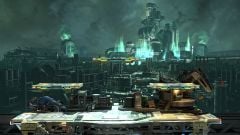
  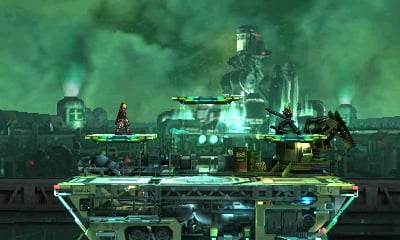 Midgar as it appears in Smash. | |
| Universe | Final Fantasy |
| Appears in | SSB4 Ultimate |
| Availability | Downloadable (SSB4) Starter (Ultimate) |
| Crate type | Normal |
| Maximum players | 4 (3DS) 8 (Wii U, Ultimate) |
| Article on Wikipedia | Midgar |
| “ | Grab the Summon Materia to call forth powerful beings. If a Summon knocks out a fighter, the point is awarded to whoever grabbed the Summon Materia, so make sure it's you! | ” |
| —Super Smash Blog, Super Smash Bros. Ultimate Official Site | ||
Midgar (ミッドガル, Midgar) is a Final Fantasy stage in Super Smash Bros. 4 which was released as downloadable content on December 15th, 2015, as part of a set with Cloud. The stage returns in Super Smash Bros. Ultimate, where Cloud is fought here for his unlock battle.
Stage overview[edit]
The basic layout of the stage consists, like Battlefield, of a main platform with three overhanging soft platforms in a triangle formation; however, the stage is slightly larger.
Summon Materia occasionally float around the stage and stops in a random location with a flash. When a character touches it, they are surrounded by magical symbols, and a summoned beast unleashes a massive attack on all opponents.
Ifrit[edit]

Ifrit uses Hellfire (called Inferno by Masahiro Sakurai during the Final Video Presentation). A huge flame erupts randomly either under the middle of the stage (raising it), under one of its sides (heavily tilting it to the side), or from one of the lateral blast lines (pushing the stage towards the other lateral blast line). Contact with the main body of the flame deals 26%, while contact with its weaker parts deals 1% with no knockback.
Ramuh[edit]

Ramuh uses Judgment Bolt. The three floating platforms are electrified, and their arrangement changes to another random one. The three platforms then, one by one, randomly glow and get electrified again. After all three have undergone this process, they return to their original position. Landing on an electrified platform paralyzes fighters and deals continuous damage (up to 21%) before launching them; simply passing through them deals damage but will not paralyze.
Odin[edit]

Odin uses Zantetsuken. Odin slices through the stage with his sword, splitting the main and top floating platforms in half. Characters hit by this attack receive 100% damage, and in most cases are KO'd. In Ultimate, this attack triggers a Special Zoom. While the stage is split, its inner ledges can be grabbed. The stage pulls itself back together after a while, crushing any character, summoner included, caught between the two halves or hanging from the inner ledges.
Leviathan[edit]

Leviathan uses Tidal Wave. The entire arena is flooded, making the main platform surf across a huge body of water. A strong current pushes swimming characters to the left; getting slammed into the right side of the stage deals 9% damage or, if the character has 100% or more damage, an instant KO. The summoner is susceptible to the current and the slam damage, but not to the instant KO. If a player happens to have invincibility and enters the water on the right side of the stage, the player may be carried away by the current when it subsides or pushed under the stage to the left side due to not slamming into it.[1] Fighters who enter the water under the effects of the Super Mushroom are trapped in the water, if on the right side, due to the low knockback, and potentially KO'd. This feature is not present in Super Smash Bros. for Nintendo 3DS, due to the removal of swimming in said game.
Bahamut ZERO[edit]

Bahamut ZERO uses Teraflare. The city in the background is destroyed, and Bahamut creates a damaging pillar of light covering about 1/3 of the stage. Getting caught in the beam deals continuous damage (up to 39%).
Any opponent KO'd by a monster's attack counts as a KO on behalf of the summoner.
In 8-Player Smash mode, no summoned monsters appear if there are five or more players. If the game is paused in Training Mode, all summon effects are paused, but the rest of the action keeps going.
In both versions of Super Smash Bros. 4, if the player summons a Smash Ball during Training Mode, the Summon Materia, Leviathan, and Ifrit will go away.
Ω forms and Battlefield form[edit]
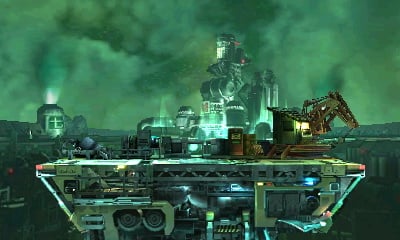
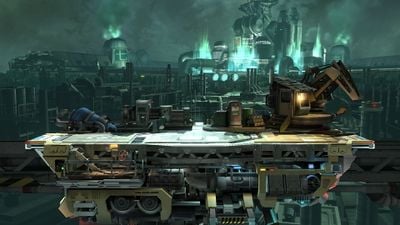
In Super Smash Bros. 4, the Ω form removes the soft platforms and Summon Materia.
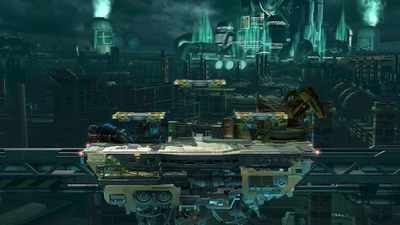
In Super Smash Bros. Ultimate, the Ω form is identical to SSB4's Ω form, while the Battlefield form is identical to the normal form. They are slightly resized and reshaped to match Final Destination and Battlefield.
Ω form in Super Smash Bros. for Nintendo 3DS.
Ω form in Super Smash Bros. for Wii U.
Ω form in Super Smash Bros. Ultimate.
Battlefield form in Super Smash Bros. Ultimate.

Hazards Off[edit]
With hazards off in Ultimate, no Summon Materia ever appears, leaving the stage in its Battlefield-shaped form.
Origin[edit]

Midgar is the first area visited in Final Fantasy VII and the site of the storyline's first act. A sprawling city ruled and created by the Shinra Electric Power Company, Midgar is heavily stratified, with most of its residents living in polluted ground-level slums, where the sky is blocked out by the upper plates. This stage appears above Midgar's top plates, with the Shinra Building and Mako Reactors 1 and 7 visible in the background.
The Shinra Building is one of the most iconic locations in Final Fantasy VII, serving naturally as Shinra's base of operations. Its first visit acts as the climax of the game's first act. Its second visit is as the game's penultimate dungeon, leading directly into the climax at the Northern Cave. Midgar is depicted in Smash as seen in the game's opening flyover, with Mako Reactor 1 visibly intact. Mako reactors are used by Shinra to farm mako energy from the lifestream, and are the target of bombing missions by the activist group AVALANCHE, whom Cloud is recruited by prior to the game's events. Reactor 1 is the site of the game's opening scenes, where it is successfully bombed by AVALANCHE.
Midgar is present throughout the Compilation of Final Fantasy VII. In the film Final Fantasy VII: Advent Children, it is depicted in ruins following the events of Meteorfall. The first installment of the Final Fantasy VII Remake trilogy takes place entirely within Midgar, depicting an expansion of the original game's first act.
Summons are a recurring element in the Final Fantasy series since their introduction in Final Fantasy III. They are powerful creatures that can be summoned into battle to attack enemies or support the party. In Final Fantasy VII, they can be summoned by equipping specific Materia. The five summons who appear on Midgar had indeed appeared in Final Fantasy VII, although Ifrit's design is instead based on its appearance in VIII.
Bahamut ZERO in Final Fantasy VII.
Ifrit in Final Fantasy VII.
Odin in Final Fantasy VII.
Ramuh in Final Fantasy VII.


Tournament legality[edit]
While the Ω form of this stage is allowed, the standard stage is banned in tournaments, as in Smash 4, it overcentralizes gameplay on collecting Materia to gain an advantage; in addition, the summons themselves are quite powerful and can result in unfair advantages to those who summoned them. In Ultimate, the stage is banned due to the layout being very similar to Battlefield, as with a few other stages. Notably, the main platform has an asymmetrical shape, making recoveries hugging the stage slightly unpredictable, the lower platforms are taller than Battlefield, preventing some attacks from hitting opponents standing on them, and the stage is slightly larger. Because of these characteristics, Midgar is considered less ideal than Battlefield and is almost never used in its place.
Gallery[edit]
Super Smash Bros. 4[edit]
Midgar in Super Smash Bros. for Wii U.
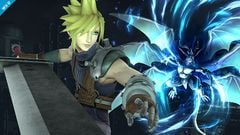
Cloud with Bahamut ZERO.
Cloud, Wii Fit Trainer, and Lucario with a Summon Materia.
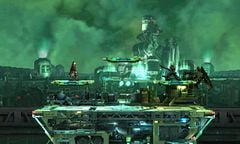
Midgar in Super Smash Bros. for Nintendo 3DS.
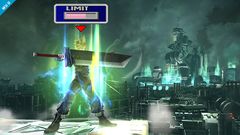
Cloud using Limit Charge on the stage.
Cloud above the stage with Bahamut ZERO.


Super Smash Bros. Ultimate[edit]
Panorama of Midgar from Ultimate.
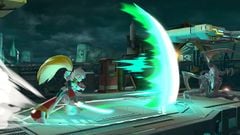
Ridley using Wing Blitz above the stage.
Cloud charging up his Limit Gauge next to Ifrit on the stage.
Greninja using its neutral aerial with Leviathan on the stage.
Piranha Plant on the stage.
Cloud, Sephiroth and Sora on the stage.




Names in other languages[edit]
| Language | Name |
|---|---|
| ミッドガル, Midgar | |
| Midgar | |
| Midgar | |
| Midgar | |
| Midgar | |
| Midgar | |
| 米德加, Midgar | |
| 미드가르, Midgar | |
| Midgar | |
| Мидгар | |
| Midgar |
Trivia[edit]

- In Super Smash Bros. for Wii U, Midgar was the stage with the fewest amount of music tracks and the only one in the game lacking any Smash-exclusive arrangements in its lineup. Further, it was the only stage in both versions of Smash 4 with the exact same music selection.
- Prior to Challenger Pack 8, it shared the record for fewest tracks in Ultimate with Flat Zone X, and its lack of arrangements with Yggdrasil's Altar.
- In for Nintendo 3DS, whenever a match starts or resets in Training Mode, the characters on the floating platforms will always perform their landing animation, as if they start in midair. This does not occur in for Wii U.
- Midgar is the only stage in SSB4 that can crush.
- Odin's attack does not appear to use a hitbox, but instead, like Psystrike, it uses a searchbox and generates a hitbox inside any fighters detected by it. Like Psystrike, it is therefore possible for two of these hitboxes to overlap, resulting in fighters being hit by the attack twice on the same frame, for a total of 200% damage, and seemingly one-hit KOing them.
- In Stamina mode, if Odin's attack does not KO, it will deal very little knockback. This is because Stamina mode treats opponents' post-hit percents to be 20%, and the move's knockback is programmed with a minimum final damage of 100% or higher in mind.
- In Training Mode, if the game is paused while a summon is in effect, it will continue its effect indefinitely, continuing to affect other fighters (excluding Odin; instead, if paused upon slashing, the game stays slowed down until unpaused or the camera briefly zooms in on the fighter that he strikes (which doesn't happen if multiple fighters are hit) after they're KOed). Summons such as Ifrit and Bahamut ZERO allow for combos of up to 999 to be registered by the game. A similar exploit can be done on stages like Mario Circuit.
- If Sonic is fighting on Midgar in for Wii U, a graphical glitch will occur wherein his eyes appear to reflect the texture of the stage, turning them gray in color. This occurs even on the Ω form of the stage.
- Upon downloading Challenger Pack 8 in Ultimate, the new Final Fantasy songs are added to Midgar's My Music settings with a default probability of 25% each, matching the default settings for Northern Cave.
- No Spirit Battles that use this stage have hazards enabled.
- In Ultimate, the following Assist Trophies cannot appear on this stage: Waluigi, Skull Kid, the Moon, Midna, Nightmare, Knuckle Joe, Andross, Samurai Goroh, Color TV-Game 15, Devil, Nintendog, Dr. Kawashima, Nikki (due to the dark background obscuring her drawings), Squid Sisters, Ghosts and Shadow the Hedgehog. Additionally, Lunala cannot be summoned from a Poké Ball on this stage.
External links[edit]
- Article on the Final Fantasy Wiki
References[edit]


|
| |
|---|---|
| Fighters | Cloud (SSB4 · SSBU) · Sephiroth (SSBU) |
| Stages | Midgar · Northern Cave |
| Other | Aerith Gainsborough · Bahamut ZERO · Barret Wallace · Chocobo · Ifrit · Leviathan · Odin · Ramuh · Tifa Lockhart |
| Trophies & Spirits | Trophies · Spirits |
| Music | SSB4 · Ultimate |
| Related universe | Kingdom Hearts |
