


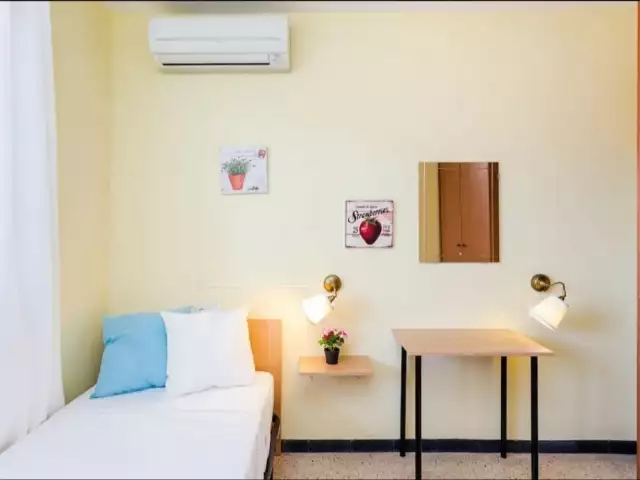

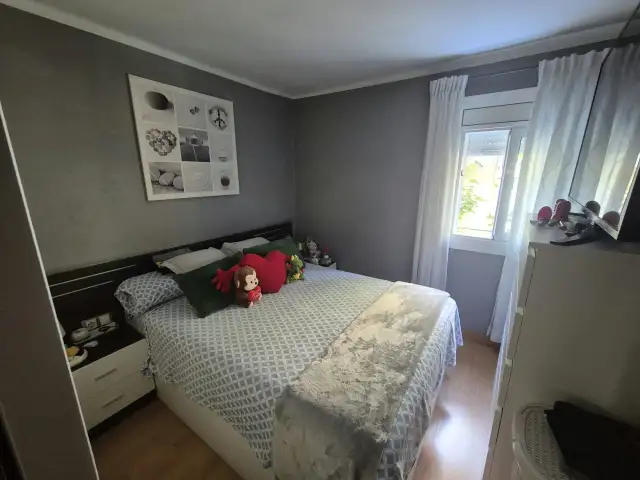
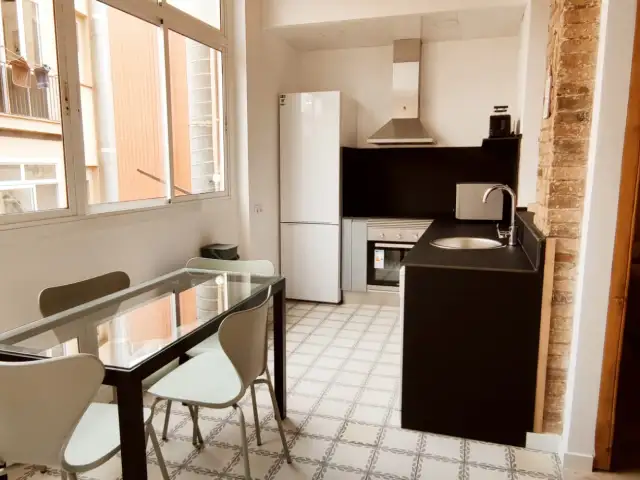


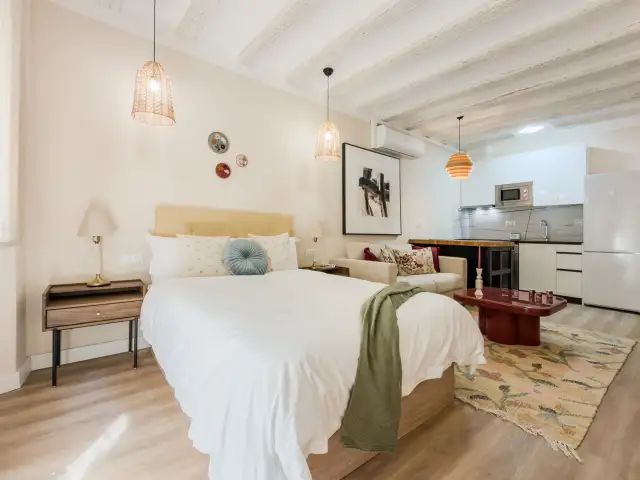





All you need to know about accommodation in Barcelona
For many people moving to Barcelona, the stay starts with a university place or a job offer. The public universities in the area welcome thousands of exchange students every academic year: in 2024/25, the UAB counted 5,152 and the UPF 3,023, according to provisional figures from Idescat, the Catalan statistics institute. At the same time, the 22@ district in Poblenou brings together more than 1,500 companies on around 200 hectares of former industrial land.
That is why accommodation in Barcelona tends to be chosen neighbourhood by neighbourhood. The faculty on the Diagonal, the office near Glòries or the market on the corner shape daily life far more than the distance to Plaça de Catalunya.
Rent in Barcelona: prices, availability and tenants
Between May 2026 and October 2026, a room to rent in Barcelona cost an average of €741 a month on Spotahome. For those who would rather have a place of their own, the average was €1,521 for a studio and €2,300 for an entire apartment.
If you are bringing your dog or cat, or looking for somewhere for two, Barcelona accommodation offers plenty of choice: 845 properties accept pets, 2,012 are suitable for couples and 218 do not ask for a deposit. The search filters help you narrow the list down to what suits you.
If your move-in date is flexible, the calendar is worth a look: over the next six months, the month with the most properties available to move into is February, and the tightest is December.
Among people renting with Spotahome in Barcelona, the most common age group is 18-24, with 45.65% of tenants. Of those who state their occupation, 70.16% are students and 29.84% are working. By nationality, the largest group comes from Spain (10.5%), followed by Italy (8.77%).
Price data updated on Nov 2, 2026.
Availability updated on Nov 2, 2026.
Tenant profile updated on Nov 2, 2026.
The best areas for living in Barcelona, depending on what you need
La Vila de Gràcia. Gràcia was an independent town until 1897, and you can still tell from its narrow streets, which open onto squares such as Plaça del Sol, Plaça de la Virreina and Plaça del Diamant that work as the neighbourhood's living room. For anyone looking at apartments in La Vila de Gràcia, the daily shop happens at the Mercat de la Llibertat, opened in 1888 and refurbished in 2009. Metro line L3 stops at Fontana and Lesseps, and from the Gràcia station of the Ferrocarrils de la Generalitat (FGC) it takes about 5 minutes to reach Plaça de Catalunya.
L'Esquerra de l'Eixample. This is the left-hand half of the grid Barcelona laid out after pulling down its city walls in the mid-19th century, now split into two neighbourhoods: l'Antiga and la Nova Esquerra. The Hospital Clínic and the UB's Medicine campus on Carrer de Casanova draw healthcare staff and students, and rooms in L'Esquerra de l'Eixample are a way to live close to work or lectures. The Mercat del Ninot on Carrer de Mallorca sets the pace of the area, with L5 stopping at Hospital Clínic and L1 at Urgell and Rocafort.
Poblenou. The former ‘Catalan Manchester’ still has more than 30 industrial chimneys and a rambla lined with shops that are over a century old. The neighbourhood runs from the Diagonal down to Bogatell beach, and right next to it lie the 22@ and the UPF campus on Carrer de Roc Boronat, already in El Parc i la Llacuna. Studios in Poblenou let you live on your own near the office, with the Mercat del Poblenou, opened in 1889, for everyday shopping. L4 takes you from Poblenou to Passeig de Gràcia in about 12 minutes.
Sants. The largest and oldest neighbourhood in its district, Sants grew up along the old royal road. Its big advantage is Estació de Sants, served by metro lines L3 and L5 and by Rodalies trains: the R2 Nord reaches Terminal 2 at the airport in 17 minutes, with a train every half hour, and the R2 gets to Passeig de Gràcia in 5. The Parc de l'Espanya Industrial, built on the site of a former textile factory, and the Mercat de Sants, a modernista market from 1913, round off neighbourhood life.
Zona Universitària. Rather than an official neighbourhood, this is the area of the Les Corts district that, on both sides of the Diagonal, is home to most of the UB and UPC faculties. That makes student apartments in the Zona Universitària a way to get to class without relying on public transport. To head into the centre, L3 takes about 18 minutes from Zona Universitària to Catalunya, and L9 Sud and the TramBaix also stop here.
FAQs about accommodation in Barcelona
How much is rent in Barcelona?
Across all types of accommodation, the average rent in Barcelona on Spotahome was €1,408 a month in October 2026, a change of -0.16% on the previous month. In May 2026, that average stood at €1,495.
By type of accommodation, the average in October was:
- €763 for a room
- €1,439 for a studio
- €2,376 for an entire apartment
The price of each listing varies with the area, the size and the bills it includes.
Average prices updated on Nov 2, 2026.
How can you rent a property in Barcelona while living in another country?
With Spotahome, you can rent in Barcelona from another country because the whole process happens online. You choose your accommodation from its listing, and those Spotahome has checked carry the ‘verified’ label. You send a request with your dates and nothing is charged until the landlord accepts it; at that point you make the first payment, equivalent to 30 days' rent, and pay the booking fee. All properties are furnished, so you can arrive with just your suitcase, and if the place does not match the listing when you move in, you have 24 hours to let Spotahome know.
How do you register as a resident in Barcelona with a monthly rental?
To complete your empadronamiento (the local residents' register) in Barcelona, the Ajuntament (Barcelona City Council) generally accepts a valid rental contract of at least three months, together with an identity document: DNI, passport, EU registration certificate or TIE (foreigner identity card). The procedure is free and can be done online with a digital certificate, through the 010 line or at a Citizen Help Office (OAC) with an appointment. On Spotahome, each listing states in its contract permissions whether it allows empadronamiento.
How long can you rent for in Barcelona?
On Spotahome, the minimum booking in Barcelona is one month, which makes it easy to arrange a monthly rental. Each landlord can set a longer minimum stay, and you will see it in the listing before sending your request. The exact length of a long-term rental in Barcelona is set out in the rental contract that you and the landlord sign.
Is Barcelona safe to live in?
Crime in Barcelona is falling: according to the Ajuntament, offences in the first half of 2026 were down 11.2% on the same period of 2025, and 23.2% of residents were the victim of some form of crime during 2025, 5.4 points fewer than the year before.
When it comes to booking, Spotahome's anti-fraud team verifies every landlord, and listings that have been checked carry the ‘verified’ label.
What type of accommodation do people search for most in Barcelona?
Rooms are the most searched-for type of accommodation in Barcelona on Spotahome, accounting for 60.3% of searches.
Apartments come second, with 28.86%.
The percentages measure activity in the search tool, not bookings. Data updated on Nov 2, 2026.