Trump teases Iran talks as Truth Social starts selling fast access to his posts

US President Donald Trump has teased new negotiations with Iran after abruptly calling off a major attack in a Truth Social post published on the same day that his media company began selling Wall Street firms millisecond-fast access to the platform’s market-moving content.
Speaking to reporters aboard Air Force One on Sunday, Trump claimed that talks would begin on Monday and said several Middle Eastern governments had urged him to give diplomacy another chance.
“We’re just going to see whether or not we can make a deal,” Trump said, claiming that the canceled operation would have been the “biggest attack since World War II.”
From ‘friendly’ talks to ‘locked and loaded’ – and back
Last Monday, Trump claimed that “very friendly negotiations” with Tehran were already underway. Within days, however, the US had resumed bombing Iran, while Trump adopted increasingly aggressive rhetoric, promising to hit the country “very hard.”

The US Department of War declared it was “locked and loaded” and prepared to unleash what Trump claimed would be levels of military power not seen since World War II.
US media reported on Friday that Washington and Israel were preparing an extensive campaign against Iranian power plants, refineries, and other energy infrastructure.
The threats, combined with continued disruption to shipping through the Strait of Hormuz, helped sustain fears of a wider energy shock and propelled crude prices toward $90 a barrel.
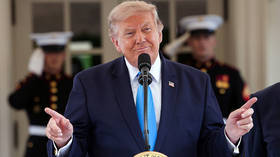
On Saturday, however, Trump abruptly called off the strikes in a Truth Social post, claiming that Iran and several regional governments had agreed to the outlines of a deal that would reopen the Strait of Hormuz and address Tehran’s nuclear program.
The sudden reversal triggered another sharp market swing when Asian trading resumed on Monday morning. Brent crude fell by more than 7% at the open, while West Texas Intermediate dropped 6.7% to $78.98 a barrel. US stock-index futures rose as traders priced in a reduced risk of further escalation and disruption to Gulf energy supplies.
Truth Social monetizes Trump’s posts
August 1 was also the launch date of Truth API, a paid service operated by Trump Media & Technology Group that provides institutional customers with a licensed, machine-readable feed of posts from influential Truth Social accounts. The service is aimed specifically at high-frequency and algorithmic trading firms and reportedly costs as much as $100,000 per month.

Trump Media says paying customers receive posts within milliseconds of publication, while market specialists have argued that the direct feed allows well-equipped firms to process announcements and execute trades much faster than retail investors relying on the public website or app.
Trump’s posts are particularly valuable because he routinely uses Truth Social to announce abrupt changes involving wars, tariffs, individual companies, and other policies capable of moving stocks, currencies, and commodities. AP noted that policy reversals can be especially lucrative for high-speed traders, who can profit from an initial threat that moves prices in one direction and then rapidly change their positions when Trump announces the opposite.
Hormuz talks are none of US business – Iran
Iran has previously accused Trump of publicizing purported diplomatic breakthroughs to lower oil prices and buy time for further military action. The latest pause also follows an established pattern: Trump has repeatedly announced that strikes against Iran were being suspended to allow negotiations, only for military operations to resume after talks faltered or new attacks occurred.

Tehran has explicitly denied that any new negotiations with the US are scheduled for Monday, saying it has no plans to host a delegation or send one abroad. It has also rejected Washington’s claim to a role in determining the future of the Strait of Hormuz.
Iranian Foreign Minister Abbas Araghchi said negotiations with Oman over the waterway’s management were “nearing completion,” while Foreign Ministry spokesman Esmaeil Baghaei described the discussions as a bilateral matter that “does not concern any other party.”
Baghaei said Iran and Oman are negotiating a new shipping route that would replace the existing northern and southern routes. He stressed that any agreement “does not mean that the Strait of Hormuz will be opened or remain closed,” contradicting Trump’s claim that the proposed deal would provide for its “immediate, complete, and total” reopening.