Overview
- Presents select talks from the first-annual Aspects of Time-Frequency Analysis conference
- Explores interesting connections among a variety of applications of harmonic analysis and pseudodifferential operators in the context of time-frequency analysis
- Chapter authors are leaders in the field of harmonic analysis and its applications
Part of the book series: Applied and Numerical Harmonic Analysis (ANHA)
Access this book
Tax calculation will be finalised at checkout
Other ways to access
About this book
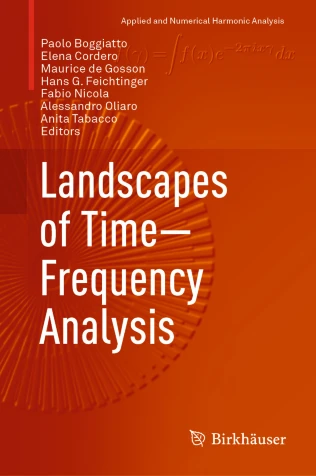
The chapters in this volume are based on talks given at the inaugural Aspects of Time-Frequency Analysis conference held in Turin, Italy from July 5-7, 2017, which brought together experts in harmonic analysis and its applications. New connections between different but related areas were presented in the context of time-frequency analysis, encouraging future research and collaborations. Some of the topics covered include:
Landscapes of Time-Frequency Analysis will be of particular interest to researchers and advanced students working in time-frequency analysis and other related areas of harmonic analysis.
- Abstract harmonic analysis,
- Numerical harmonic analysis,
- Sampling theory,
- Compressed sensing,
- Mathematical signal processing,
- Pseudodifferential operators, and
- Applications of harmonic analysis to quantum mechanics.
Landscapes of Time-Frequency Analysis will be of particular interest to researchers and advanced students working in time-frequency analysis and other related areas of harmonic analysis.
Table of contents (15 chapters)
-
Front Matter
-
Back Matter
Editors and Affiliations
Accessibility Information
Accessibility information for this book is coming soon. We're working to make it available as quickly as possible. Thank you for your patience.
Bibliographic Information
Book Title: Landscapes of Time-Frequency Analysis
Editors: Paolo Boggiatto, Elena Cordero, Maurice de Gosson, Hans G. Feichtinger, Fabio Nicola, Alessandro Oliaro, Anita Tabacco
Series Title: Applied and Numerical Harmonic Analysis
DOI: https://doi.org/10.1007/978-3-030-05210-2
Publisher: Birkhäuser Cham
eBook Packages: Mathematics and Statistics, Mathematics and Statistics (R0)
Copyright Information: Springer Nature Switzerland AG 2019
Hardcover ISBN: 978-3-030-05209-6Published: 14 February 2019
eBook ISBN: 978-3-030-05210-2Published: 30 January 2019
Series ISSN: 2296-5009
Series E-ISSN: 2296-5017
Edition Number: 1
Number of Pages: XVIII, 347
Number of Illustrations: 2 b/w illustrations, 1 illustrations in colour
Topics: Fourier Analysis, Operator Theory, Analysis, Abstract Harmonic Analysis