Permacast
Permacast is a decentralized media protocol for permanently storing and indexing digital content with AI-powered discovery and wallet-bound creator identity.
Overview
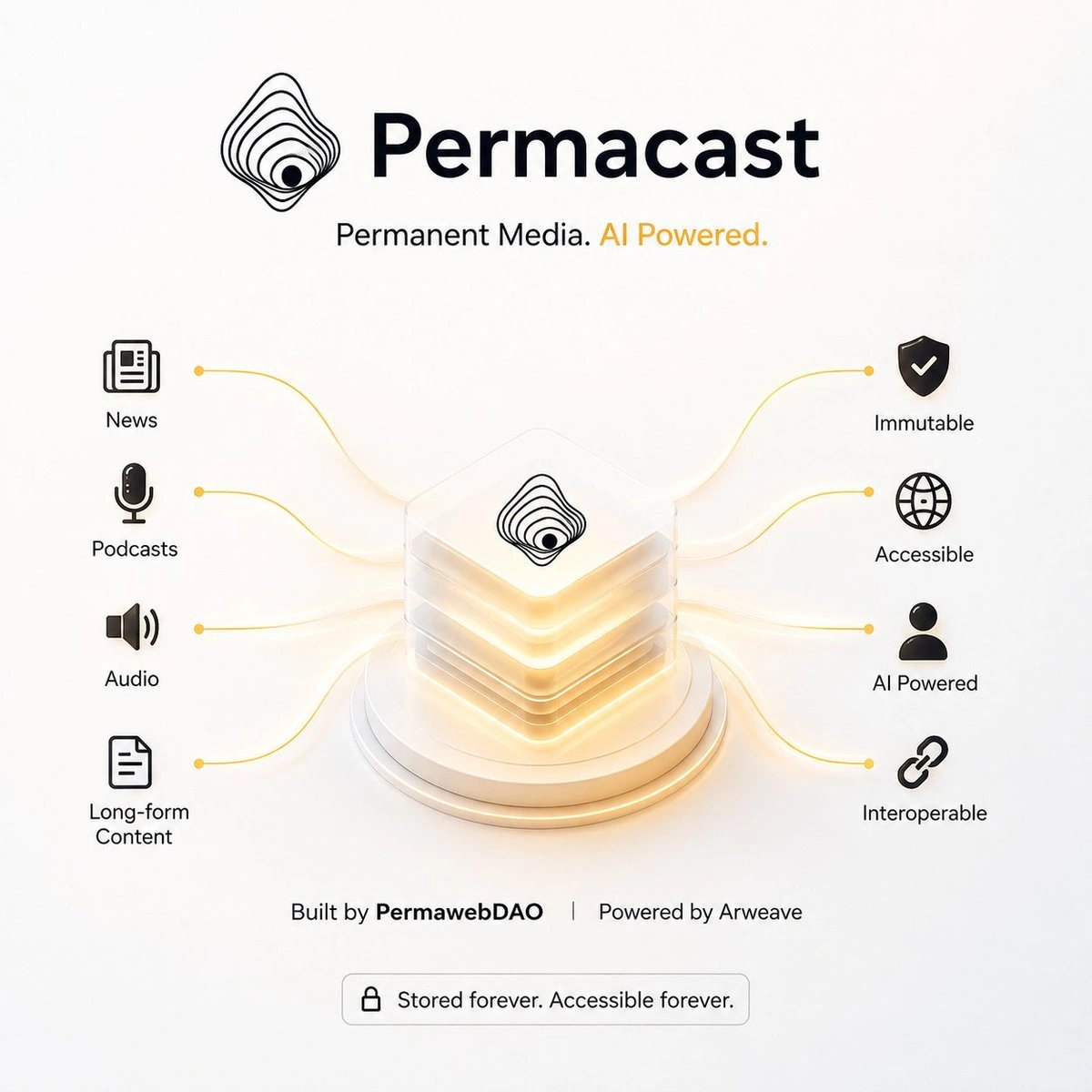
Permacast is an AI-powered permanent media network developed by PermawebDAO for publishing and distributing news, podcasts, audio, and video as interoperable assets stored on Arweave. The platform combines permanent decentralized storage with AI tools for content generation, summarization, tagging, sentiment analysis, trend discovery, and distribution, while an AI social graph maps relationships between creators, audiences, and content. User wallets are associated with published content and interactions, creating persistent on-chain identity, interests, and reputation across applications. Permacast also uses Arweave infrastructure and the EXM layer to support content serving and smart-contract functionality, with an open-source codebase intended to allow independent deployments. Its broader objective is to provide a decentralized alternative to conventional media-hosting platforms by reducing reliance on centralized intermediaries and preserving access to published content over longer periods.[2][4]
Features
Permacast’s features center on combining decentralized storage with tools for publishing and distributing audio content. Creators can upload media to decentralized storage such as Arweave, while blockchain-compatible systems handle metadata and indexing to support discoverability. Users can access and stream content without depending on centralized servers, while smart contracts can support functions related to ownership, monetization, and access rights. The platform emphasizes permanent storage, decentralized infrastructure, censorship resistance, creator control over content and distribution, and Web3-based mechanisms for potential tokenized access and monetization.[4]
Technology and Architecture
Permacast is an application built on decentralized storage and blockchain infrastructure rather than an independent blockchain with its own validator network. Its architecture combines Arweave for permanent media storage with smart-contract and indexing infrastructure for managing content, while its current implementation uses Load Network, a high-performance EVM storage chain that uses Arweave and ao/HyperBEAM for scalable data and compute, as the application layer. As a result, different parts of the system rely on different underlying technologies: transaction execution and settlement depend on the relevant blockchain infrastructure, media availability depends primarily on Arweave and associated gateways, and AI-driven features introduce additional dependencies for generating and verifying metadata, tags, rankings, and other content information.[3]
Storage and Contracts
Arweave provides the foundation for Permacast’s permanent media storage, allowing audio, video, and other content to be stored independently of conventional centralized servers. Permacast has combined this storage layer with smart contracts, indexing systems, and decentralized gateways to manage and retrieve published content. Earlier versions of the protocol used SmartWeave contracts directly on Arweave, while later development introduced EXM, an Arweave-based Layer 2 infrastructure intended to provide faster and lower-cost contract interactions. The project’s open-source architecture also allows independent deployments of the application, while services such as Meson, a decentralized content delivery and gateway service used to help deliver Arweave-hosted media to users, have been used to help deliver stored content to users.
The original protocol repository describes two stages of development: PC Amber, the testnet, and PC Bloodstone, the mainnet. Amber used SmartWeave contracts with Arweave as the underlying storage and payment infrastructure, while Bloodstone moved contract execution to EXM and introduced changes intended to reduce interaction costs and improve execution speed. The broader application stack included a React frontend, SmartWeave-based contracts, decentralized gateways, and decentralized hosting, with later versions incorporating Load Network as the primary application environment. In its current form, Permacast describes itself as a decentralized media platform on Load Network, while continuing to use Arweave for storage and related components such as ao, a decentralized compute and coordination layer, and HyperBEAM, a client implementation that powers modular EVM and storage devices, for computation and data management.[3][4]

AI Intelligence Layer
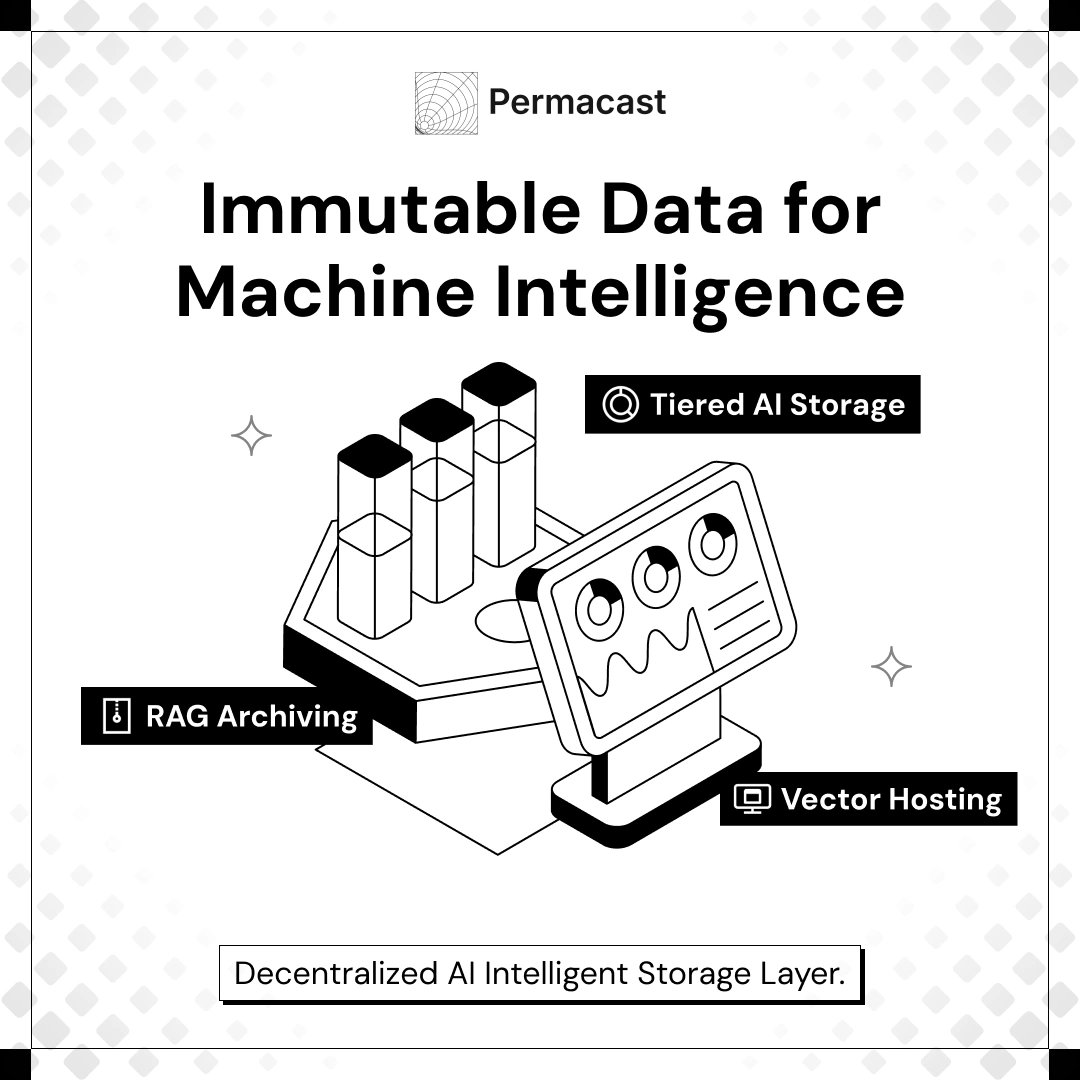
Permacast’s newer architecture adds an AI layer designed to organize and interpret the media stored on the network. Its AI Media Intelligence Engine is intended to support functions such as content generation, summarization, tagging, sentiment analysis, trend identification, and content distribution. The platform also describes an AI Social Graph that maps relationships between creators, listeners, and content to support discovery and reputation-based interactions. These systems are combined with an on-chain media identity layer that associates content and user interactions with blockchain wallets. The resulting structure is intended to turn individual media files into persistent, searchable records containing information such as metadata, semantic tags, creator identities, and interaction history. In this model, Permacast is not only storing media permanently but also using AI and blockchain-based identity systems to make that content easier to organize, discover, and reuse across applications.[1][5]
PWT Token
PWT is Permacast’s native utility token and a BEP-20 asset on BNB Smart Chain, with a fixed maximum and total supply of 1 billion PWT. It is intended to function as the platform’s primary economic unit for activities such as content publishing and storage, semantic processing, indexing, vector generation and retrieval, AI inference, identity and reputation systems, creator incentives, content distribution, governance, and third-party access to content and semantic data, with a consumption model that includes burns and token buybacks. Governance functions associated with PWT include decisions over data schemas, AI model versions, taxonomies, and API rules. Earlier plans for PWT also included a Proof of Real Traffic (PoRT) mechanism, described as an experimental rewards protocol for users who discover new creators, rather than relying on traditional advertising.[1][3][8][6]
Public token-data aggregators report that PWT’s maximum and total supply are fixed at 1 billion tokens, with roughly 210 million PWT in circulation as of August 31, 2026, indicating that a minority of the total supply is circulating and the remainder is held in non-circulating allocations.[3][6] Publicly available materials do not provide a detailed, independently verifiable vesting schedule or allocation breakdown across stakeholders, so the precise distribution of non-circulating supply and the timing of unlocks cannot be fully determined from public data.[3]
Governance
PermawebDAO is the organizational and infrastructure layer behind Permacast, providing a framework for permanent data storage, content management, application execution, and governance. Its architecture is designed around Arweave and emphasizes persistent data, unified content and asset standards, and an application environment that can operate without relying on conventional centralized servers.[7]
Public materials describe Permacast as the flagship application of PermawebDAO, with PWT positioned as a governance and coordination asset for the protocol. In this model, community and stakeholder governance over Permacast is framed as part of the wider PermawebDAO governance process, with PWT intended to be used in decisions such as how data schemas are structured, which AI model versions are adopted, how taxonomies for organizing media are defined, and how API rules for accessing content and semantic layers are configured.[3][9]
Partnerships
WOW Earn has announced a partnership with Permacast focused on preserving Web3 media content through permanent storage. The collaboration is described as enabling WOW Earn users to store posts, media, interactions, and creator profiles on Permacast so that they remain available over time with full on-chain integrity and creator-linked ownership.[9]